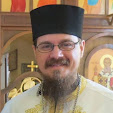
I am often asked why I became a Byzantine Catholic. Like many, if not most, cradle Roman Catholics, I made it through my formative years in the Church unaware that there was more to Catholicism than Roman Catholicism – unaware, that is, of universal, complete and entire (Catholic) Christianity. Though most Roman Catholics are hardly aware of our existence and many, upon hearing of us, ask, “are you Catholic?” or “are you under the Pope?” or a hundred such questions, it is worth pointing out that most members of our Byzantine Catholic Church in Indianapolis were themselves raised Roman Catholic. I am not alone among Westerners in my decision to practice the one, holy, Catholic, and apostolic faith according the traditions, liturgy, theology, ecclesiology, and spirituality of the East.
The question is sometimes phrased: “why did you convert?” Becoming Byzantine, having been Roman, is not a conversion of religion. Personally, it resulted from a deepening of faith, an inner conversion perhaps, but we must always remember that there is but one true Church, one God, one faith, one baptism, and one Lord who is Savior of all. Each of the more than twenty Eastern and Western Churches is equal in the one true Church.
Though it is not conversion as such, becoming Byzantine is certainly a change. The liturgical, sacramental, and theological differences attracted me and my love for them draws me into ever deeper immersion in my Byzantine Church.
My Byzantine Church is an abundant Church, a Church of plenty, a Church of overflowing cups, a Church where anything worth doing once is worth doing three times in honor of the Holy Trinity. Here there is anointing and more anointing, blessing and more blessing, incense and holy water, blessed bread and blessed wine. We don’t just dip our fingers in the holy water; we drink the holy water. When we blessed the holy water, it was the day of Theophany – our Lord’s Baptism. The priest blessed the water with fire, with breath, and with the sign of the cross. We don’t just anoint the forehead; we anoint the forehead, the eyes, the ears, the nose, the mouth, the chest, the hands, and the feet. When the priest incenses during the Divine Liturgy, he incenses the whole church, up and down the aisles, everyone singing all the while, until the place is filled with smoke.
Byzantine Liturgy is always oriented – the priest faces God, the tabernacle, the altar, and the East, from whence O.L.G.S. Jesus Christ will return. Marana tha! The congregation chants and sings throughout the entire Liturgy – the congregation is the choir. We gather together to worship and to exalt the Lord our God. We have no concept of a Low Mass in our Byzantine Church.
The Byzantine Churches make use of four distinct divine liturgies: most commonly we celebrate the Divine Liturgy of St. John Chrysostom; occasionally we use the Divine Liturgy of St. Basil; during the Great Fast (Lent) we use the Divine Liturgy of the Presanctified Gifts, traditionally attributed to Pope St. Gregory the Great – this has some similarities to the Good Friday Liturgy of the Roman Church; and, rarely, we use the Divine Liturgy of St. James the Apostle and Brother of the Lord, which is an early liturgy of the Church. Each of these liturgies is a glorious sacrifice of praise. The use of different liturgies for different seasons or occasions adds richness to the yearly cyclical life of the Church.
 |
| An infant receives communion in an Eastern Church. |
Above these liturgical differences, I love the generous and abundant Byzantine approach to the sacraments. The three mysteries of initiation (Baptism, Chrismation (Confirmation), and Eucharist) are given in their original order to infants. My own six month old son, John Elias, having been Baptized and Chrismated, receives the Most Holy Body and Blood of O.L.G.S. Jesus Christ for the remission of his sins and for life everlasting every time he attends the Divine Liturgy. He will receive the Mystery of Penance when he gets older, before which time he is seen as a holy innocent.
The Anointing of the Sick is given to all who are able and wish to receive it at least once a year – and more frequently in my parish. We do not see it as a sacrament only for the dying. All are in need of healing – whether from physical, mental, or spiritual maladies – all can therefore be anointed.
The Holy Mystery of Crowning (Matrimony) is not a bar to the reception of Holy Orders. The Roman Church acknowledges this theologically, but for pastoral and practical reasons usually forbids the ordination of married men. The Eastern Churches do not forbid such ordinations – another example of generous distribution of sacraments. Yet, we also exalt celibacy as imitative of O.L.G.S. Jesus Christ and as a calling from God – even to the extent of acknowledging the sacramentality of monastic vows.
 |
| St. Athanasius Byzantine Catholic Church |
Eastern theology has never officially limited the number of sacraments to seven, as the Roman Church did at the Council of Trent. Although, certainly, the seven sacraments are held in great reverence – the Eucharist above all others, but this does not keep us from regarding other acts and signs as sacramental. Fr. Sidney Sidor, of blessed memory, formerly of our local parish,
St. Athanasius, told us emphatically, “there are more than seven sacraments!”
These are but a few of the differences that attracted me to the Eastern Church. Probably I leave you with more questions than answers. Pope St. John Paul II had more answers than I do. His encyclical,
Orientale Lumen, is a good source of information. The Byzantine Churches are a source of truth and beauty in the Catholic Church which everyone should get to know better.