Showing posts with label Healing. Show all posts

Sunday, July 19, 2020

The Prayer

Two blind men follow Jesus, “crying aloud, ‘Have mercy on us, Son of David’” (Matt 9:27). And later they call him “Lord” (9:28). And Jesus opens their eyes. This is one of the scriptural roots of the Jesus Prayer.

Even those of us who can see with the eyes of the body are often spiritually blind. We do not know where we are going in life. We cannot see where God is in all of this. Note that the blind men were blind in body but that they could nonetheless follow Jesus from one place to another (Matt 9:27-28). Following Jesus set them on the right course. First, they followed. Then they could see. It is the same with us. If first we will follow Jesus (even for our whole earthly lives), then we will spiritually see.

Our vision of God’s presence in our lives will be 20/20 if we first live faithfully and then look back upon it. Perhaps we cannot always see where God is in our lives right now, but we know by faith that he is present and, if we follow him, he will give us eyes to see that he was with us all along. I have experienced this already in my own life. Most of the time, I know where God intends me to go only after I get there, like a blind man following him through the streets of the city.

But how can I begin or continue to follow Jesus if I am blind and do not see where he is? It would help then to call out to him, like the blind men do. I promise, it will help us just to call out his holy name – the name of Jesus. Let us pray the Jesus prayer:

Lord Jesus Christ, Son of God, have mercy on me, the sinner.

Can you hear how this is like the prayer of the blind men? “Have mercy on us, Son of David,” they pray. This is, as I say, one of the scriptural roots of the Jesus Prayer. There are also others:
  • Another blind man sits outside of Jericho and similarly calls out to Jesus: “Jesus, Son of David, have mercy on me!” (Mark 10:47; Luke 18:38; cf Matt 20:30–31).
  • The publican (unlike the Pharisee in Jesus' parable) shows us how to pray when he bows his head, beats his breast, and says, “God, be merciful to me, the sinner” (Luke 18:13).
  • In a village between Samaria and Galilee, ten lepers stand at a distance, lift up their voices and say, “Jesus, Master, have mercy on us” (Luke 17:13).
From these examples, I think we can see that the prayer of Jesus has been with us from the very beginning of Christianity. From these scriptural roots, the prayer developed further.

The Desert Fathers and Mothers of Egypt would frequently repeat short and simple prayers like these – “arrow prayers” we sometimes call them because, as St. Augustine observed, “the brethren of Egypt offer prayers that are frequent but very brief and suddenly shot forth” – rather like arrows meant to pierce heaven.

Of these short prayers, St. Diadochus recommends we constantly repeat the utterly simple prayer, “Lord Jesus.” The frequent repetition of the divine name of Jesus serves as a constant reminder of his divine presence with us and helps us fulfill St. Paul’s instruction that we pray unceasingly (1 Thessalonians 5:17).

We are beset constantly by distracting thoughts and temptations, which threaten to remove remembrance of God from our minds and hearts. A short and simple prayer like this, that can be called upon at any moment and for any need, is a powerful tool against these thoughts and temptations. The prayer must be as constant as are the thoughts. It must be unceasing.

There are many ways to approach unceasing prayer. The Jesus Prayer is not the only way, but it is a great help and it may be the best way.

A benefit of constantly repeating this prayer is that it then enters into the unconsciousness and you begin to find it there behind the noise of life. It joins with your breathing and the beating of your heart – the rhythms of life itself – and helps us in this way to approach unceasing prayer and the constant remembrance of the presence of God.

Pray it at home and in church and in your car. Pray it a few times first thing in the morning and throughout the day as often as you can think of it and again before you go to bed. Pray the prayer while you do the dishes or the laundry. It was a great aid to my wife Pani Katie while she was in labor. There is no time when it is not a good time to pray the Jesus prayer.

Sit quietly and pray it slowly again and again for 5 minutes or for thirty minutes. Use a chotki or don’t use a chotki. A chotki can be a helpful aid – a physical reminder to persist with the prayer when we become distracted by intrusive thoughts and imaginings. If you don’t have a chotki, get one. Some have 33 knots - one for each year of Jesus’ earthly life, others have 100 , or others 300. On each knot, you pray the Jesus Prayer. Simple.

There’s more than one way to say the Jesus Prayer. The formula of the Jesus prayer as we know it now –

Lord Jesus Christ, Son of God, have mercy on me, the sinner

– is good and was pretty well set already by the seventh century, but this is not to bind us and it’s not the only way. There’s no need to change it – all its elements are already there in the scriptural roots of the prayer, which I listed – but at the same time we may find other ways helpful.

We may want to pray as simply as St. Diadochus recommends: “Lord Jesus.” The holy name of Jesus itself is a saving cry.  It means “the Lord saves” or “the Lord is a cry for salvation”. Or, you can add to it, as do some of the nuns at our Christ the Bridegroom Monastery, saying “Lord Jesus Christ, Son of the living God, have mercy on me, the sinner.” Or, we can simplify it a bit and pray “Lord Jesus Christ, have mercy on me,” as do many of the monks on Mount Athos. Or, we may wish to pray for others as well as ourselves and so pray “Lord Jesus Christ, Son of God, have mercy on us” – in the plural. (In this case, I personally recommend that we omit the word “sinners” because, while we accuse ourselves of sin, I find it better not to accuse others of sin while we pray). All this is to say that there are many good ways of praying the Jesus prayer. Pray it whichever way you will pray it. The important thing is to pray it.

The Jesus Prayer is the central private prayer of our spiritual tradition. So much so that some simply call it “the prayer.” It is profound, versatile, and life-changing. This is due above all to the holy name of Jesus, which is the name above every other name (Philippians 2:9). St. Theophan the Recluse says “The Jesus Prayer is like any other prayer. It is stronger than all other prayers only in virtue of the all-powerful name of Jesus, our Lord and Savior.” In his name and by his name, we find salvation. “There is no other name under heaven given among men by which we must be saved” (Acts 4:12).


Much information was provided by Kallistos Ware, “Foreword,” in On the Prayer of Jesus (Boston, Mass.: New Seeds, 2006)

Sunday, July 28, 2019

It is the Lord who heals.


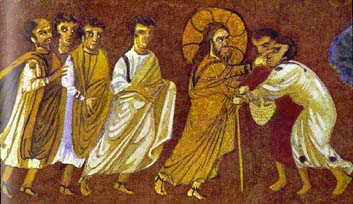
Today, Jesus heals two blind men. He gives sight to the blind. Then, he drives the demon out of a demoniac. He gives voice to the mute. Then, he goes around to all the cities and villages curing every disease and healing every infirmity and preaching the gospel of the kingdom (Matt 9:27-35).
SinopeGospelsFolio29rChristHealingBlindDetail.jpg
Christ healing the Blind
Detail of Folio 29r from the Sinope Gospels
(Bibliothèque Nationale, MS gr. 1286)
Don’t we wish he would visit our town? Come to us in our homes? Heal our sicknesses and those of our loved ones? Many of us are suffering and in need of the healing presence of our Lord Jesus Christ, who is the Healer - the Healer, I say, and not merely a healer.
God is the one who heals. We have to understand this. All healing comes from God. And he wants to heal us. This is clear if we read the gospel. Practically every page of the gospels, especially Matthew, Mark, and Luke, Jesus is healing his people.
And he carries right on with his healing here and now. Do not be deceived into thinking his healing work is merely historical. Be attentive: he is in our town, in our homes, and in our hearts. He is here right now, and he wants to heal us. And, if we are healed, it is because he has healed us.
A true and wise healer will always acknowledge this. One way to know whether a healer is authentic – and this holds true whether we're talking about a doctor or a priest or a preacher – is to look at whether they use healing to glorify themselves or to glorify God. Do they acknowledge that all healing comes from God? Or do they just crave attention or fame or money? Does your doctor acknowledge God? You might want to seek one out who does.
I'm not saying that God can't use a self-glorifying atheist to work his healing. He can and he does. He can also use heretics and charlatans. God can do anything. I'm only saying, it's often better to work with those who have some idea of what's actually going on.
And if your surgeons think they’re the ones healing you and that they aren’t instruments in God's hands every bit as much as those scalpels are instruments in theirs, then they don’t understand what's actually going on. For all their education, if they fail to acknowledge God, they understand nothing.
Every good thing comes from God. He is the giver of all talents and all knowledge.
If Jesus appears to you and heals you, it is clear that Lord is healing you. Also, if a holy man or woman prays over you and you are healed, it is the Lord who heals you. If you come before the presbyters of the Church when you are sick and they pray over you and anoint you with oil in the name of the Lord and you are healed, it is the Lord who heals you (cf. James 5:14-15). But also, if a showy faith healer in it for the money knocks you over and you are healed, it is the Lord who heals you. If a pious Christian surgeon cuts out your tumor and your cancer is cured, it is the Lord who heals you. If an atheist nutritionist gives you good advice about how to eat right and heal your gut, it is the Lord who heals you.
If we are healed, it is because the Lord has healed us.
No one understood this better than St. Panteleimon, whose feast we celebrated just yesterday (July 27th). He was a highly learned physician – so talented that he impressed the ruler Maximian, who gave instruction that Panteleimon was to be prepared as the Royal Physician. (Of course, that was when Panteleimon was still following the paganism of his father, who had paid for all his fancy education).
But Panteleimon wanted to be a great physician, and his desire to bring healing led him to the only true Healer, because healing only comes from God. He came to understand this and so embraced the Christian faith of his mother.
Panteleimon raised up a child bitten by a deadly viper, gave sight to the blind, healed the paralyzed, healed wounds, and cured all who came to him. He was a trained physician, but he insisted that it is Jesus Christ and not Panteleimon who is our true healer.
In fact, though he is counted among the unmercenary healers because he did not charge his patients any money, he did ask for another form of payment: that those who were healed acknowledge Jesus Christ as their true healer.
And so they gladly did, even though doing so at that time and place often earned them a martyr’s death. Think on that – to be healed only to be killed for it. But this, in fact, was their true healing: to come to Christ, to live in Christ, and to die in Christ is to rise in Christ and live forever in him. This is our true and lasting and total healing of both body and spirit.
Saint Panteleimon himself went on to die a martyr at the age of 30. He died even younger than Jesus, who was crucified at the age of 33.
Take note of this as well: they extended the lives of others, but died young themselves. Long life is not the point. Eternal life is the point.
Another fact to bear in mind: all the people that Saint Panteleimon healed, and all the people that Jesus healed before his own death on the cross, have died since then. Even the people that he raised from the dead have died again since then. Despite having been raised from the dead, Lazarus now awaits the resurrection with his sisters Martha and Mary (cf. John 11:23-44).
Some die young and some die old; some die sick and some die healthy, but we all die. So, what is the point of all this healing? Why heal us if we're only going to die?
Well, did you hear what else Jesus was doing while he was going from town to town and healing everybody? He was preaching the coming Kingdom (Matt 9:35)! The healings we receive now are a foretaste of the lasting healing we receive in the Kingdom. They are a sign, as the Gospel of John likes to call them.
Furthermore, they are calling and an opportunity. We who have been healed will have to answer for the fact. What do we do with the gift of life God has given us? Each day we draw breath, it is by God’s mercy and grace.
For one thing, he gives us life so we can be a witness to others of the healing and saving power of Jesus Christ! We must testify to the world that he has healed us and saved us.
For another thing, it so that we have more time to repent and be forgiven. Are we using our time for repentance? For worshiping God? Or for more self-indulgence?
Healing and the forgiveness of sins go hand in hand. We are bodies and souls at the same time. Note that the Lord will often begin his healing by forgiving sins. He says, “your sins are forgiven” even before he says, “stand up and walk” (cf. Matt 9:2-6)
Note also, that many times when our English translations of the scripture say “heal,” the Greek word (ἰάομαι) connotes salvation (eg Matt 13:15). He saves us. From what? From sin and death.
The connection between healing and the forgiveness of sins is preserved in the holy mystery of anointing as we celebrate it in our Byzantine Churches. Our prayers are for healing and also for the forgiveness of sins.
If we repent, we will be forgiven and healed. And if we are healed, it is a calling to repent.
Both as a sign of the coming kingdom and as an opportunity to repent, our healing by the Lord points to the everlasting healing from death we receive in Jesus Christ and in his kingdom.

Sunday, July 7, 2019

Knowing to Whom We Speak in Prayer


The centurion gives us such an example of faith, as Jesus says, and also of prayer, of trust, of humility, & of divine knowledge (Matt 8:5-13).

Listen to what he says to Jesus: “Lord, my servant is lying paralyzed at home, in terrible distress” (Matt 8:6).


I am struck by the fact that there is in this prayer – and I would call it a prayer – no explicit petition.

Petition is where we ask God for what our heart desires. Petition is good, and earnestly desired by the Lord. Jesus himself makes petitions to his Father many times. This is good. The Lord’s heart desires that we say to him what our heart desires.

But note that, in this case, the centurion does not here explicitly ask Jesus for anything, not even for healing. He only expresses the suffering of his situation. He suffers together with his servant, I say, because we learn from Luke that his servant is dear to him (Luke 7:2). But, in Matthew, it is the Lord and not the centurion who brings up healing. Jesus says, “I will come and heal him” (Matt 8:7).

Luke recalls this differently. According to Luke, the centurion sends a message to Jesus, asking him to come and heal his sick servant – a petition. And I think it is clear, even in Matthew, that this is what the centurion wants. The centurion wants the Lord to heal his suffering servant. Jesus understands this immediately, and offers to come and heal him.

What can it mean, then, that the centurion does not here give voice to the petition that surely lies on his heart? “Out with it!” we might say to him. “Say what you really want!” “Stop beating around the bush!”

But, no, this is a beautiful prayer in need of no improvements or additions. “Lord, my servant is… in terrible distress.” The centurion knows to whom he speaks.

How he came to know him we do not learn, but he knows him. In Luke, some elders of the Jews point out that the centurion loves their nation and that he built their synagogue for them (Luke 7:5). This gives us some insight as to how a Gentile centurion of the Roman occupiers could have come to know and respect the Messiah of the Jews. But I daresay that his knowledge even seems to go beyond this.

He knows to whom he speaks. He knows that the one to whom he speaks will understand everything. That not everything needs to be said. The one to whom he speaks is all-knowing.

Furthermore, he trusts the one to whom he speaks.  He asks for nothing, but gives the situation into the hands of the Lord, for he knows and trusts that the one to whom he speaks is all-good.

We might try imitating this prayer of the centurion when next we are in distress.

Lord, my daughter is suffering from a terrible migraine.
Lord, my sister’s husband is abusing her.
Lord, my mother is dying of cancer.

There is a radical and profound trust in this kind of prayer. I can barely do it. I can scarcely resist adding, “heal her” “deliver her” “be with her.” And, I hasten to add, again, it is good to add those petitions.

But if we could pause for a moment in faith and trust, like the centurion did, knowing that the Lord already knows, that he already cares, that he is already inside the situation, perhaps we will hear the Lord say, as the centurion did, “I will come and heal.” Perhaps this kind of prayer can teach us something of trust and humility.

If we do hear the Lord say this, what will we say? “Thank you, Lord!” will surely be the first words from our lips. That would be a good thing to say.

But this is not what the centurion says. He says, “Lord, I am not worthy to have you come under my roof; but only say the word, and my servant will be healed.” Such humility! How can we even approach this humility? When we cry out to the Lord for healing, for his presence, for favors, do we remember our unworthiness to receive him?

Or, do we think ourselves worthy to stand in the presence of God? To be given whatever we seek? Are any of us so sinless and perfect and purified?

Many times, I hear people say of some good thing, like a bowl of ice cream or a vacation or a good night’s sleep, “I deserve this.” I do not deserve any good thing, inasmuch as I am a sinner. I am blessed by many good things, and I thank God for them, but I deserve none of them. Every good thing is an unmerited gift, a blessing, a mercy. God’s grace is gratuitous, unearned, and undeserved.

We ought to remember this, as the centurion does. We ought to thank God, yes, but not as an equal thanks an equal for a mutual exchange. Not as I thank my boss for my paycheck. No. We do not earn and do not deserve the good things God gives to us. And every good thing is from the Lord. We are not worthy of him. The centurion understood this.

Note that, after Jesus offers to come and heal, the centurion does make a petition. After, not before, Jesus says he will heal, the centurion prays, “Only say the word, and my servant will be healed.”

The centurion knows to whom he speaks. How he knows, I do not know, but he knows. The great faith that Jesus praises in him is a true divine knowledge. Only God could have given him this knowledge.

What doctor or healer can heal without touching the patient? Without even seeing the patient? Without even being in the same room or even under the same roof as the patient? What doctor or healer could do this? Who can heal by the power of the word alone? By only saying the word? Who commands creation with the authority as a centurion commands his soldiers with authority?

Only the author of creation has authority over it. Only the Word who was in the beginning with God and by whom God creates and who is God can heal by the power of the word alone. The centurion knows to whom he speaks. He speaks to God and knows it.

Echoing the word of creation, “let there be…” Jesus says to him, “let it be…” (Gen 1; Matt 8:13). And the servant was healed at that very moment.


Sunday, November 4, 2018

Stop

Jairus, a ruler of the synagogue, falls at Jesus’ feet and begs him to come heal his twelve-year old daughter, who is dying (Luke 8:41-42). And so Jesus sets off to Jairus’s house to heal her and prevent her death.

As he is going, the crowds crush in on him on all sides (8:42). Nonetheless, Jesus presses on toward his vital task of healing. That is, until a woman touches the fringe of his garment (8:44). She had had a hemorrhage of blood for twelve years, but she knew Jesus to be a great and powerful healer, and so she believed that just by touching the fringe of his garment, she would be healed (8:43, 47). So with faith she touched him, and she was healed. 


The healing of a bleeding woman
Rome, Catacombs of Marcellinus and Peter
4th century

But what does Jesus do? Remember Jairus and his daughter, who is dying not far away. Surely that should lend some urgency to the situation? Surely Jesus should press on through the crowd to get to her and save her? Shouldn't Jesus hurry past and get going? Shouldn't Jesus finish the one task he has set out to do before stopping to attend to another one? But Jesus stops. He stops and starts inquiring who has touched him (8:45). Peter is dumbfounded by his question because Jesus has been crushed on all sides by the crowd (8:45).


Having two parishes now, I can relate somewhat to this situation. That is, very often I will be attending to the needs of one person or group of people of one parish, and I will receive a call from another person or group of people from my other parish who have needs equally as pressing. Unfortunately, I am not enough like Jesus. And I don't know how to put things in their proper order and respond to all things in all charity and all justice. Nonetheless, I will pray and I will try.

I'm sure many can relate to this. Many have both jobs and families for example – or school and jobs and families and friends and so on. Many of us know what it is to have many groups competing for our attention – all people whom God has created in his own image, all people we are called to love and serve and respect. Well, how do we do this?

Jesus – he stops. This makes sense to no one. Not to his disciples. Not to Jairus. And not even to the woman he has healed. The disciples were dumbfounded by his question. Jairus is eager for his own daughter to be healed by the Lord. He is standing there in great need. Also, he is a leader – a ruler in the synagogue – and is probably used to more deference. The woman with the hemorrhage who had been healed tried to hide and thought that she could just touch the fringe of Jesus’ garment as he went by, that she would be healed, and that he would keep on going (8:47).  

But no, they all have to stop and wait for Jesus to question a crowd pressing in all around him, “Who touched me?” It would take a lot of faith not to get exasperated with Jesus at this moment. Jesus stops. And he engages the people in front of him. Maybe we should learn something from him.

Stop what you're doing. Behold the one before you. Not to deny the one you're rushing toward at all, but to love the one before you. When you're being interrupted by someone, it is tempting to become exasperated at them. Anyone with children knows the pain of constant interruption. It's natural to feel a momentary annoyance. Even Jesus may have felt this when he was touched and the power went out from him. But when you do, stop. 

Remember, before you snap back some sharp remark of irritation, like I sometimes do, that the one interrupting you is a child and an image of God. God is interrupting you. Trying to break in through your will to accomplish something. An interruption is an opportunity for patience, for grace, for self-sacrifice, for immolation of our self-will – not of our true selves, but of our stubborn and willful adherence to our own desires.

Jesus stops and engages the crowd, and meets the woman who touched him and was immediately healed. And he says to her, “Daughter, your faith has made you well; go in peace” (8:48). He treats her with patience, with kindness, and in peace. All while a twelve-year-old girl, who he can save, is dying nearby. And, in fact, while he’s still speaking, a man from Jairus’s house comes and says, “Your daughter is dead” (8:49).

How crushed Jairus must have felt in this moment. The man who could have saved his daughter’s life is here dawdling with other people’s concerns and his daughter has died. “Do not trouble the teacher anymore,” says the man from Jairus’ house (8:49). What would be the point?

Well, we know that death is no reason to stop petitioning Jesus for life. Jesus has power even over death – and he tells them, “Do not fear; only believe and she shall be made well” (8:50). Just as the woman with the twelve-year-old hemorrhage had believed and was healed, so now, if they believe, the twelve-year-old girl, who has died, will live. And live she does. Jesus raises her up (8:54-55). He has power even over death, which he calls “sleeping” (8:52).

Faith in this, more than anything, can give us the gift of patience and peace. I often say, you only live once, but at least it’s forever. “I don’t have any time,” we often complain. “I am too busy to stop and attend to the needs of passersby or of my family. I’ve got work to do. I have no time to stop and pray or to go to church.” You have all the time in the world if you live in Christ. There is no reason for wasteful haste or anxiety in Christ. Sure, some things are a matter of life and death, but, in Christ, even death will not keep us from life.

Sunday, July 8, 2018

Faith of the Blind


on Matt 9:27-35. Seventh Sunday after Pentecost

Today, two blind men teach us much about faith and about prayer.

When they encounter Jesus, they don’t exactly ask what you might expect – for sight or for healing. Rather, they follow him, calling out, “Have mercy on us, Son of David!” Now, mercy is healing, but it also more than healing.

Eventually, Jesus asks them, “Do you believe that I am able do this? So, not only, “Do you believe I can heal you?” but really also, “Do you have faith that I can have mercy on you?” Jesus is not asking these blind men merely what they think of him or who he is in their opinion – he is asking them about their faith – about whom they know him to be in their hearts. And they confess their faith that he is the one who can have mercy on them in their blindness. They do believe and, according to their faith, Jesus touches their eyes and opens them.

The Two Blind Men, detail, 6th Century Mosaic, Sant' Appollinare Nuovo, Ravenna

What drove Jesus to ask the two blind men about their faith? Well, first they followed him for quite some time, it would seem, as he walked from the house of a ruler back to his own house. This was probably quite a way, because Jesus likely wasn't staying in the same neighborhood as such a socially significant person. This in and of itself is a marvel: though they were blind, they were able to follow Jesus all the way to his house. They could not see him, but yet they went wherever he went. Now, maybe they had help, or maybe they were following him by sound, or maybe they simply knew the way to his house – the Gospel doesn’t say – but regardless, I think it is a good image of faith that, though blind, they could still follow Christ. They could see him, not with the eyes of the body, but with the eyes of faith. According to their faith, they could see already. Perhaps this is why they ask for mercy and not only for their sight. “Blessed are they who have not seen, but have believed.”

And all the while as they were following him, they were crying out, “Have mercy on us, son of David!” This kind of prayerful petition, repeated again and again, ought to seem familiar to us who follow Byzantine tradition – for here is one of the roots of the Jesus Prayer. I hope you all know the Jesus Prayer and pray it daily:

Lord Jesus Christ, Son of God, have mercy on me, the sinner.

We can hear in this, I think, an echo of the blind men’s prayer: “Son of David, have mercy on us.” But it is also similar in the way that they prayed it – crying and saying their prayer while following after Jesus. It seems to me that they did not cry out their prayer only once, but continuously and repeatedly as they followed Jesus.

In our hesychast tradition, under the guidance of our spiritual fathers and mothers, we pray the Jesus prayer so frequently that the prayer becomes a part of our very breathing – and of the beating of our hearts so that we can aspire to pray unceasingly, as Paul teaches us (1 Thess 5:17). Again and again in peace we pray to the Lord for mercy – as did these two blind men before us.

Their way of prayer also evokes the uncomfortable parable of the widow and the unjust judge in Luke (18:1-8). Not once does the widow plead for justice, but repeatedly. Not once do the blind men cry out for mercy but continuously.

It seems sometimes like we have to nag the Lord; we have to bend his ear; we have to keep after him. Of course, this is only how it seems to us humans. Repetition, I think, helps evoke the eternal for us temporal creatures. And it helps us forgetful creatures to remember. Anyone memorizing lines for a play or multiplication tables for a math test knows the necessity of repetition for a human mind. If we creatures are to remember our creator and our God, we must often repeat our prayer to him and our calling upon his holy name. Lord Jesus Christ, Son of God, have mercy on me, the sinner.

It is only after the widow has often plead for justice that the judge gives her a just judgement and it is only after the blind men have followed Jesus quite a way calling out for mercy and followed him into his house that he asks them if they have faith. Only after they have demonstrated faithfulness to some extent does he ask if they have faith. We must be persistent. We must persevere in the faith even when it seems we get no answer to our prayer the first time or the second time or the seventh time we pray. Pray again! Do not lose heart. Keep following after Jesus with a pure heart – not just in the hope of some material reward, mind you, but in the hope of mercy. This is our petition: for mercy, for healing, for eternal life, and for union with God. 

The physical blindness of these two men has also for us, I believe, a spiritual meaning. We are the blind men – until we through faith receive the grace and mercy of the Lord, for which we must continually cry out. Our vision of all things is darkened until we see them in the light of Christ.

Only in the light of Christ is it possible to see things as they really are.

Only in the light of Christ can we understand the true meaning of the Torah and the prophets.

Only in the light of Christ can we see and love our enemies as images of God.

Only in the light of Christ can we find any meaning in our suffering because without Christ and his cross, all suffering is meaningless. Only in Christ and in his cross can suffering become a means of union with God – because only in Christ and in his cross does the impassible God suffer with us

Only in the light of Christ can we see that for us even death is but falling asleep in the Lord and that the great dawn of resurrection is coming, when we will awaken.

Without the light of Christ, we are blind. And so, according to our faith and due to our unceasing prayer, Christ will open our eyes.

This is a reworking of a sermon I preached three years ago: Jesus Opens our Eyes 

Sunday, May 6, 2018

The Mystery of Good and Evil

Why do we suffer? Why do bad things happen to good people? Why is it that babies sometimes die before they get a chance to live? Why is it that sometimes they are born blind, like the man in today's Gospel?


Healing of the man born blind
Codex Egberti, Fol 50

Theologians know that God does not make death – that no evil comes from God – that God is the author of every good and only good. In other words, theologians know that God is not to blame for our suffering or for death or for blindness.

Whence come these things into the world, then? Well, the wages of sin is death, they also say with St. Paul (Rom 6:23). So, it would seem that sin, which is missing the mark, is the origin of every injustice – every instance of a good person suffering evil maybe rightly blamed on sin – either on their own sin or on someone else's sin. It's clear that it's not always our own sin that causes us to suffer, though it often is. But if someone persecutes or abuses you, you suffer even though you have done nothing wrong. Everything that Jesus suffers is like this. Jesus is altogether sinless. Yet, he suffers greatly from the sins of others who persecute him and mock him and torture him and crucify him. When we suffer at the hands of others, we do well to remember that Jesus has identified with us in that – and has taught us how to respond to it – with forgiveness.

Nonetheless, people usually do not respond that way to the injustices they suffer. Most people, when they get hurt, lash out and hurt others – often the ones they hurt aren't even people that did them any harm. Sometimes, for example, a boss will humiliate someone at work and, too fearful and cowardly to respond like a Christian to the one who has wronged him – with courage and honesty – and without animosity or resentment, instead they swallow the humiliation and shame and anger and resentment and bring that home to their spouse and their kids – snapping at them and humiliating them, though they're totally innocent and only want love and kindness.

Sometimes, we're not even good at revenge. Revenge is a bad thing but taking it out on the innocent is even worse. Yet many times this is what we do.

In this way, our sin sends out ripples of harm into the world. That's clear. When one person gets hurt, it often leads to them hurting others. Hurt people hurt people. It's not a justification, by the way. There is no justification for us to hurt each other – to be nasty to one another, or unforgiving, or judgmental. It's not a justification, it's just an observation. This can all be easily observed in our own lives.

Partly extrapolating from these experiences, many theologians have concluded that all suffering results from sin. I have often counted myself as one who agrees with them. There are the obvious ways in which this is the case, such as the examples I have described, but there are also hidden ways in which our sins hurt other people and ourselves.

We are spirits as well as bodies and so our sins have spiritual ramifications in the spiritual world as well as physical ramifications in the physical world. Sin is a break with our true created nature, which is both spiritual and material. We cannot even begin to imagine how much suffering each of our sins, voluntary and involuntary, brings into the world – into the whole cosmos. With our sin, which is unnatural, we disrupt the whole created order of nature.

So if we understand that sin is the cause of all human suffering, the disciples' question to Jesus about the man blind since birth seems to be a reasonable one: "Who sinned, this man or his parents, that he was born blind?" (John 9:2). You see, they understood that blindness results from sin. That's true.  It's true of both physical blindness and spiritual blindness. 

And they understood that we suffer from one another's sins as well as from our own. In Exodus, the Lord says he will visit “the iniquity of the fathers upon the children” (Ex 20:5; 34:7). So they suggested that it might be the sins of his parents rather than his own sins that resulted in his blindness. Again, it’s not unreasonable, especially if we understand that this man's parents include not only his mother and his father but even all his ancestors back to his first parents Adam and Eve. Surely the world is broken and sometimes people are born blind into this broken world because of sin.

We might also add the sins of demons to our consideration. Their sins too – and not only the sins of us humans – yield great suffering in the cosmos. They too are at war with God and with their own created nature.

In any case, despite all of this, Jesus once again confounds conventional theology. He says, "It was not that this man sinned, or his parents, but that the works of God might be made manifest in him" (John 9:3). Jesus later says the same thing about the illness of Lazarus, saying that “it is for God’s glory so that God’s Son may be glorified through it” (John 11:4).

I am left gasping at this explanation which confounds all my reason. I can dance around it with cleverness and point out that Jesus does not altogether deny the role of sin in the origin of blindness. He only says that it wasn't the sins of this man or his parents. One could argue that perhaps the sins of others or the sins of demons are to blame. But Jesus doesn't blame any sin at all in his etiology of the blindness. My reason wants to chirp, “If sin is not to blame, then what? If no sinner is at fault, then who? God?” I cannot blame God for this man's blindness. But Jesus says that he is blind so that the works of God might be made manifest in him.

I understand very well that Jesus heals him – and that this is a work of God that reveals the divinity of Jesus. I understand very well that the Lord uses the man's blindness to teach the world to see. This is what the Lord does again and again. Out of the darkness, he brings light – as on the first day of creation. He says, “Let there be light.” And there is light. I see that, out of death, the Lord brings life. By death, he tramples death. And so, how fitting that through the blindness of one man, he gives many the eyes of faith. The man whose eyes are opened testifies to the healing and that Jesus is of God, and he believes and worships Jesus (9:11, 25, 30-33, 38).

The Lord brings good out of evil. That's what the Lord does. But he is the origin of no evil. So today, when he says that the man is blind so that God can heal him, I don't understand. That's a mystery to me. It's rather like the mystery of the cross.

I want to ask Jesus after he gives his explanation, "Yeah, but, had it not been for sin in the world, surely this man would not have been born blind?" But that's not the kind of question we're going to hear from Jesus or his disciples. That's the kind of speculative theology they don't get into. Maybe that kind of thinking is more Greek than Hebrew – or maybe it's more a curse of this age than that to be vexed by such questions. You won't hear them saying things like, "Well, if reality were other than it is, what then would this or that be?" That's not their shtick – not at all. Jesus is much more interested in healing this man than in theoretically analyzing his condition.

We ought to be like Jesus in this. Simply love, show compassion, heal, deliver, all to the glory of God, rather than trying to subject everything to our finite analytical human understanding, as if reality, or even God, were subject to us. If instead, we seek to glorify God, then God blesses us beyond all understanding.

The mystery of good and evil is beyond our comprehension. And there comes a time to accept that we cannot understand everything and that every answer we can give is a lie. Perhaps we can understand best in silent contemplation of the awesome mystery when we stop trying to figure everything out and abandon ourselves completely to God. 

Sunday, April 22, 2018

A Paralytic Church?

Our Church is dwindling – that is, our particular Church here in the United States: the Ruthenian Byzantine Catholic Metropolitan Church sui iuris of Pittsburgh. We’re about one third the size we were in 1990.* There are also signs of diminishment in the Catholic Church in the United States as a whole. And, indeed, in all of Christianity in the United States as a whole. We're shrinking. Have you seen the numbers?


So, what can we do? Well, we can lie down and wait for death. That’s one option. Or, we can rise, take up our mat, and walk (John 5:8). In some ways, our Church is like the paralytic man lying by the sheep pool, who had been ill for thirty-eight years (John 5:2-5).

Incidentally, that is a long time to be sick, don’t you think? That is my whole life – I turn thirty-eight this year. That helps gives me a sense of how long this man had waited for healing – my whole life.

In some ways, as a Church that’s been dwindling for about that long, we can identify with this paralytic man. Maybe we feel powerless as we sit here and watch our limbs wither. “What can we do about it?” we wonder. Sometimes we blame others and shift the responsibility, saying, "I have no one to put me into the pool when it is stirred up” (John 5:7).

Meanwhile, we sit by the sheep pool of healing. And we watch others get healed. After communism fell, our own Churches in Eastern Europe experienced enormous growth. Our seminaries there are bursting at the seams compared to here. And for another example, the Church in Africa is growing by leaps and bounds. We’re talking more than five thousand percent growth over the last century.

Meanwhile, we shrink. We say with the paralytic, “While I am going [to the pool to be healed], another steps down before me" (John 5:7). We sit paralyzed by the pool and wonder who will put us into the water so that we too can be healed.

Well, Jesus is asking us, “Do you want to be healed?” (John 5:6). Do we? Or, are we too comfortable as we are? Are we even aware that we stand in need of such healing? Or, are we so focused on our own problems, our own lives, our own parish, that we have no regard for the diminishment of our larger particular Church? Or even for the diminishment of Christianity as a whole across this nation?

Of course, we want to be healed, we say. Heal us, Lord Jesus! Descend upon us, O holy and life-creating Spirit, and give us new life and growth!

This is all well and good, but be advised, this healing and new life and growth may require breaking some of our own personal rules and dearly-held expectations (which are not to be confused with the commands of God).

For example, it was forbidden among the Jews to carry certain loads in certain ways on the Sabbath (John 5:10). This was a dearly-held custom or human tradition – part of the Mishnah around the Torah – but not the Torah itself. 

It is worth recalling that Torah nowhere explicitly forbids carrying an item from one place to another on the Sabbath. Torah forbids work on the Sabbath. But what is work? Later Mishnah strives to answer this question. Mishnah developed to serve as “a fence around Torah”– to make it so that if a pious Jew follows Mishnah, he cannot come even close to breaking Torah. These are human laws built around Torah and not Torah itself. They’re good inasmuch as they bring the people closer to the Lord. But, Jesus above all has the authority to supersede Mishnah because he himself is the word of God before all ages and is himself the source of Torah.

So it is meaningful when Jesus, the Word of God, says to the man on the Sabbath, “Rise, pick up your mat, and walk” (John 5:8). And he doesn't just say, “Rise and walk.” The command to go against Mishnah – to pick up his mat – is a necessary part of the healing. It demonstrates the totality of his healing. He carries that which had carried him.§

If we as a Church are going to grow in numbers and find new life – if we are going to rise and walk like the paralyzed man – it is going to come with some violation of our own expectations. We’re also going to have to pick up our mat.  God, as it so happens, is not obligated to fulfill our expectations. We are going to have to let certain things go – including things that we hold dear – maybe even things we falsely regard as central to our faith, our mission, or our identity.

Really, these things are idols. Any good thing can become an idol in our heart once we allow it to distract us from God rather than bringing us to God. Our teeth are good for chewing the bread of life. They are good things. But if one of them begins to decay irreversibly, at a certain point, it causes nothing but pain and becomes a hindrance and distraction rather than a help. At this point, the thing to do is extract it.

I know better than to start giving examples. And I know that there are idols in my own heart that need to topple, too. So, let's each of us in our own hearts consider what our own idols may be, which are distracting us from the divinely mandated purpose of evangelizing this nation and growing this Church.

None of us can do everything, of course. But each and every one of us can do something rather than nothing. Maybe some of us are already doing all we can, but let none of us be complacent. Let each of us prayerfully consider what we are doing to help the Lord bring healing and growth to this Church. Let each of us listen in our own hearts to the Spirit’s inspiration guiding us to new life for this Church. Through us, if we will let go of our own will and seek the kingdom of God instead of our own agendas, the Lord will restore the Church’s withered limbs so that she may begin to walk strongly in this nation.

Sunday, February 25, 2018

Time Alone and Time with Others

My how we need each other! How dependent upon one another the Lord has made us!  The paralyzed man in the gospel needed his friends (Mark 2: 1-12). Through their help and because of their faith, he is forgiven and healed. 

True, we are ultimately dependent on the Lord for everything and we may rely on him to provide.

We are like helpless baby birds in a nest, unable to fly, waiting with mouths open, for our mother bird to bring us back the food that sustains us. She has left us for a time. And her absence may fill us with longing for her return. But we may hope for that return expectantly. And trust in it. And know that she is coming back and that she is bringing with her the stuff of life. And that when she comes, she will not only feed us but she will also teach us to fly.

Our Lord is like this mother bird. He does not fail us. When the Israelites were hungry in the desert, the Lord rained manna down upon them – bread from heaven. Let us never forget the care he shows for us – the good he gives us directly and personally.

We must keep a direct and personal relationship with God alive. In obedience to Jesus Christ and in imitation of him, we must go often into our room and close the door – or go away to lonely places to pray and be alone with God.

Yet, meanwhile, wherever two or three are gathered in his name, there he is in the midst of them. And also, whatever we do for the least of his brethren – that we do for him.

Our real need for solitude with God does not exclude the importance of coming together – of praying together – or of attending to each other’s needs. The truth is, we need both time together and time alone. God is with us at all times. By his grace, let us come to know and experience his ever-present presence.

Saint Gregory Palamas Fresco 
in Saints Three Church in Kastoria
15th century
This tension between our need for solitude and our need for community has been lived out especially by monastics since the beginning. The earliest monastics were hermits and anchorites who dwelt alone in caves and huts in the desert and the wilderness. Yet, they were very soon organized into communities. Because, as St. Basil says, “If you live alone, whose feet will you wash?” There is a need to serve your brother and sister as well as a need for solitude to do battle in your own heart.

The holy Hesychasts strongly emphasize this need for solitude – but they do find a balance. Our holy father Gregory Palamas, who devoted much of his life to the defense of the holy Hesychasts, lived alone and practiced great askesis usually for five days out of the week, coming down to celebrate the Eucharist and to have fellowship with the brothers only on Saturday and Sunday and on great feast days.

In prayerful time alone with God, we can really experience God, who communicates himself to us in our whole being – spirit and body. As St. Gregory teaches us, God allows us really to experience himself in his energies   to see his uncreated light in our hearts. He gives us himself – reveals himself to us – not just a created thing like himself, but his own uncreated energies. Grace is not a thing God gives us but is really himself – his own life – life in the Spirit, and life in Christ – which he enables us to live.


Our real experience of God in solitary and silent prayer in no way excludes the experience of God we have through others. We need both. St. Gregory sees the Hesychasts’ experiences of God through their solitary practice of the Jesus prayer united to their breathing (which is one means, but not the only means toward experiencing God) as possible for them because of the grace of baptism, which is a holy mystery of the Church and only possible through others. God is always working through his people. 

So it is with the paralyzed man. God provides forgiveness and healing, and he does it through the intercession of the man’s friends. We are dependent on God for everything, but he has also made us dependent on each other.

Those of us who are healthy and strong in body sometimes pretend that we are independent individuals, but this paralytic does not have that option. He is able to do nothing with his body but lie upon his bed. He is dependent upon his friends, who feed him and wash him and clothe him while he waits for the Lord to come – like a helpless baby bird crying out for the return of the mother bird.

But in this case, the Lord waits for the friends of the paralyzed man to help him – and to go to great lengths – climbing onto a roof, dismantling it, and lowering their friend on his pallet before Jesus. Only then and under these circumstances, does Jesus forgive and heal the man. 

In this way, the Lord shows us that, as good and important as it is, solitary prayer alone is not enough. This isn’t a “Jesus-and-me” spirituality that he’s revealing to us. We also need the prayer, action, and intercession of others, just as the paralyzed man needed his friends. Because of their faith, Jesus forgives the man’s sins and heals his paralysis.  

The blessed Theophylact suggests that the Lord forgives and heals many not only on account of their faith but also on account of the faith of those who bring them to the Lord for healing.[i] The gospel says, “When Jesus saw their faith, he said to the paralytic, "My son, your sins are forgiven.” It does not say, “when Jesus saw his faith” but “their faith.” It’s in the plural.

Think of this the next time someone asks you “Why can’t I just confess my sins to Jesus in prayer? Why do I need to go to a priest?” Jesus does want us to come to him alone in prayer, but he also made us to need each other. We are not individuals in division from one another with private pipelines to God. We are persons in relationship with one another with a communal connection to the Lord which is what we know as the Church.

The friends of the paralytic are like priests to him. They bring him to Jesus for forgiveness and healing. When we confess or when the priest anoints us, this is what happens. The priest lays us before Jesus for healing. We confess to Christ before His icon with the priest at our side – as a necessary witness to the confession. Because it is when Jesus sees our faith – not just the faith of one but the faith of more than one – that he says “your sins are forgiven.”

The paralytic’s useless body reveals his dependence on others  a dependence we all share spiritually, even if our bodies are strong. Spiritually, we are lost without others, without community, without the Church. Even the good and necessary experience of God we have when we are alone is made possible by the faith of others and the mysteries of the Church.


[i] Theophylactus, Bl. Theophylact's Explanation of the New Testament, trans. Christopher Stade, vol. 2, The Explanation of the Holy Gospel According to Mark (House Springs, MO: Chrysostom Press, 1993), 24.

Monday, January 22, 2018

Recognizing the Image of God

Our Lord Jesus heals a blind man outside of Jericho (Luke 18:35-43). Many people of that society looked upon those with such a disability as of significantly less worth than those who could see. But Jesus looks upon him and sees the whole man he created. He sees his own image in this man who cannot see. Because, in this man's true created human nature, he can see. He is glorified by God. He is created for glory and union with God. And Jesus simply puts this to rights. And the man who was blind can see.

Before this, while he was yet blind, there was one thing this man could probably see better than most: his own worth – his own right to exist, to live, and to flourish. He knew his own worth well enough to call out to Jesus for healing. He knew it well enough that when he was rebuked by the multitude and told to be silent, he cried out all the more (Luke 18:39).

Every life has worth, whether or not that worth is recognized. Do we permit the unpopularity of our true belief in the value of every human life to silence us? Or, do we cry out all the more?

It seems that every human society devalues some, even dehumanizes some. It was common in Roman society of that time to expose infants – that is to leave them out in the elements to die or be taken up by whoever comes along. And such a choice would have been made all the more readily by a father beholding his son born blind. “Ah, this one is deficient,” he may have exclaimed, “Get rid of it.”

We don't know the backstory of the blind man begging outside of Jericho for healing or what kind of rejection he may have faced, though we do know that he was reduced to roadside begging. Though he knew his own worth, it's clear enough that his society did not.

And we do know from the gospel of another man who was born blind. His parents were afraid to confess Jesus lest they be expelled from the synagogue (John 9:22), but they were brave enough to keep and rear their son despite his blindness, and for that they deserve some credit. They did not expose him as their Roman neighbors may have. The Pharisees disregarded him as one born in sin evidenced by his blindness (John 9:34). They diminished him, did not see his worth, did not see in him the image of God that Jesus sees.

In both cases, Jesus restores sight to the blind. In both cases, he sees the image of God, his own image, in men disregarded by the societies in which they live. Many in our own society similarly disregard the value of some. I hope our regard for and respect of the blind has improved since the first century, but we still as a society fail to see the image of God in certain people.

And our prejudices are often just ableist as the prejudices of the first-century.  Ableism is a new word for an old problem. Ableism is in many ways at the heart of our disregard for unborn human life. You see, blind men cannot see and so, what good are they? Likewise, the unborn cannot see – at least at first. They cannot walk. They cannot feed themselves. They cannot speak for themselves. They are utterly dependent upon others. So, what good are they?

They are all good. For the same reason that the blind beggar cast out by his society is good, they are also good. Just as a blind baby exposed by his Roman father is, in fact, an image of God, so too is an unborn child an image of God. And the Lord sees this. He sees all things. Nothing is done in secret from the Lord. And he sees in each of them, just as he sees in the blind man outside of Jericho, a person of infinite worth, a person worthy of healing, and caring for. And he will heal them. All who have died, he will raise up. For the victims of abortion and infanticide, we hope and pray and trust in the mercy of God.

The unborn are not the only people dehumanized by our society, but in this country we remember them in a special way at this time every year. Every year, we march for life.
We hope to outlaw abortion, and this is a good end, but as Christians it is first and foremost through works of charity – through love rather than only through legislation – that we should seek to prevent abortion and the dehumanization of the unborn.

We must love everyone in the painful circumstances that tempt women to seek an abortion. Everyone in these situations is in need of mercy and healing. The unborn child, the mother, the father, the family, the doctors, and even the abortionists.

We must love and provide for unborn children. Every bit as importantly, we must love and provide for them after they are born. An unborn child is a person, and loving a person requires a lifelong commitment. More of us should be open to adopting children whose mothers have found themselves unable to provide. We should support efforts from all quarters to provide for the needs of single mothers and their children.

We must love and help provide for the mothers who find themselves in desperate circumstances that would lead them to consider abortion. There are good efforts throughout the country by members of the pro-life movement to provide ultrasounds, counseling, and other pregnancy services to women in need. They have even created mobile pregnancy care centers that can go wherever there is a need. This is good and important work that can help women to recognize the humanity and even the image of God they are carrying in their wombs. Having recognized this, many mothers have decided against having an abortion. It is so important that we do not abandon them in this moment. They must see and it must be true that we will still be there to help after the baby is born.

We must love the women who have had abortions and those who led them to it. We must offer them the mercy and healing of God. We can be certain they are suffering and in need of healing. Jesus is a healer, as he demonstrates outside of Jericho.

Suffering is a mystery. Sometimes we suffer for our sins. Or from others' sins. Sometimes it seems we suffer for no reason at all. Or we suffer that we might be united to Christ all the more in his suffering. The man born blind suffered so “that the works of God might be made manifest in him” (John 9:3).

In any case, when we suffer, the Church should be with us in our suffering, just as Jesus is on the cross. And the Church should offer healing, just as Jesus, the physician of our souls and bodies, offers healing. The holy mystery of repentance, confession, and forgiveness of sins is deeply healing for those who have had abortions. The life of the Church, the sacraments, prayer, spiritual care, and counseling is and must be open to women who have had abortions and to all affected by it. We must receive them with open arms. 

And we must also love abortionists and those who support their evil work whether directly or politically. For many of us, this is the hardest part – loving our enemies, loving those who do wrong. In them too we must see the image of God – not in what they do, but in who they truly are. Neither should we dehumanize them. Rather, we should hope and pray for their salvation, just as we do for their unbaptized victims. There have been notable abortionists who have repented, giving evidence that there is always reason to hope.

Among the sins, murder of the innocent seems most grievous – and who is more innocent and less deserving of death than a baby – an unborn child? Only one – Jesus Christ. And he was also murdered.

Remember Longinus. He was a Roman soldier, a member of the culture that exposed infants, and one of those who participated in the murder of Jesus Christ. It was Longinus who thrust the spear into Christ's side to ensure that he was dead. And, witnessing the blood and water pouring from his side, Longinus repented, confessed the Son of God, and became a saint. If we can venerate as a saint one who participated in the murder of our Lord Jesus Christ, then we can love and hope and pray for abortionists. God’s mercy knows no bounds.

Jesus Christ came that we may have life and have it abundantly. Let us love and respect all life.

Most Popular Posts this Month

Most Popular Posts of All Time