Showing posts with label Sermon. Show all posts

Thursday, June 18, 2020

Fasting for Vocations

We are now in the midst of the Apostles Fast. Several years ago, when my sister was first learning about the Byzantine tradition – we didn’t grow up in this tradition, you see – she asked me what this fast is all about and, because I didn’t really know, I said, “Well, we’re Byzantine and Byzantines love to fast. You might as well ask why we’re not fasting at any given time as why we are fasting.”
And that really is true. Fr. Sergei Sveshnikov, in his excellent article titled “Fasting for Non-Monastics,” which I recommend you all read, estimates that there are approximately 250 fasting days each year in our calendar. That’s more than half the year! Now, this varies depending on how you interpret the Typikon (I count closer to 190 days) and it varies quite a bit from year to year – mainly because of this fast – the Apostles Fast – which is a different length each year. It can be anywhere from two to six weeks in length. But my answer to my sister – that we fast because we love to fast and because it is good to fast – is really insufficient, I think, even if it is true. I mean, I want there to be something that makes this fast distinctly meaningful. And I believe there can be.
Historically, I am told, this fast developed to give those who were unable to fast during the Great Fast for various reasons – such as pregnancy or illness – an opportunity to fast. It’s sort of like summer school – a chance to catch up with those who may have gotten ahead of us last semester. But I also find this to be an insufficient reason for us all to continue observing this fast year after year – even those of us who did keep the Great Fast.
We call this the Apostles Fast simply because we fast until the great feast of the Holy and Preeminent Apostles Peter and Paul on June 29th. However, perhaps it is also meaningful that the first Sunday of this Apostles Fast, which is always the Second Sunday after Pentecost, we always read about the calling of the first apostles: Simon, who would become Peter, and Andrew, his brother, and then James and John, the sons of Zebedee. This fast, it would seem, from its movable beginning until its fixed end, is apostolic in its liturgical focus. And, indeed, we have much to learn from the apostles about ascetic practices like fasting and their role in our vocations.

Calling of Peter and Andrew
by Duccio di Buoninsegna
between 1308 and 1311
tempera on wood

Today, Andrew and Peter and James and John show us how to respond to vocation: immediately they leave behind everything they have – those fishing nets and boats were their livelihood – and they follow Jesus (Matt 4:20, 22). This is a pure ascetic act – an act of self-denial.
One thing that fasting can help teach us is detachment from the things of this world. Let us not be enslaved to a small sack of flesh[i] in our bellies. Then perhaps we will not even be enslaved to our employers, for example, or to any power in this world, even if it is our livelihood, but we will be free and ready to respond to the call of Jesus Christ in our lives when we hear it. If we train in this way (which is what the word askesis originally meant – training or exercise) during this Apostles Fast, we will be more ready, like the first apostles, to respond immediately, to immediately walk away from whatever worldly attachments we have accrued, and to follow our Lord wherever he goes, even to the cross, through which is everlasting life.
Peter immediately leaves everything to follow Jesus, but he did not always follow through. Just before Jesus was to be delivered up to death, Peter said that he would follow Jesus, even to death. “I will lay down my life for you,” he says to Jesus (John 13:37). These are good words, but when death is truly imminent, when Jesus is arrested and suffers imprisonment, lies, interrogation, spit, and beatings, Peter reveals his weakness – a weakness many of us share. His earlier words were only so much bravado and three times he denied even knowing Christ, let alone being his disciple and apostle.
This is not Peter’s finest hour. But it is an hour that many of us can relate to. Sad to say, I’ve heard lies come out of my own mouth before – merely to avoid an awkward situation regarding trivialities, let alone to avoid torture and death. Lord, have mercy on me the sinner. Perhaps the lies of my mouth have not been so weighty as Peter’s lie about not knowing Jesus, but what we practice in small things become the habits that inform our large decisions and responses. So, again, it is important to fast so that we are well-trained not to give in to our every impulse, but to watch carefully and discern in our hearts whether they are from the Lord or our passions or the demons.
After Peter’s denial will come his repentance and in this he is once again a good model for us during the Apostles Fast, which is a season of repentance. After his denial of Christ, Peter hears the rooster crow and he remembers that the Lord predicted his denial before the crowing and then he weeps bitterly (Matt 26; Luke 22). In the Greek prayer of absolution after the confession of sins, the priest recalls, “The Lord forgave Peter his denial when he wept bitterly.” Repentance and confession of our sins during this Apostles Fast and each of the four fasts is an essential part of our tradition and it is an essential part of our vocations, inasmuch as each of us are sinners and at times fail to follow the Lord wherever he goes.
We do all have a vocation, each and every one of us is called by the Lord, just as Peter and Andrew and James and John are called by the Lord today. We are not all called to be apostles, of course, but we are all called by Christ to a life in Christ. It will take its own shape as he intends for us and as is best for us. Whatever shape our vocation takes, the fasting, prayer, and repentance that we emphasize during this Apostles Fast are necessary tools for walking the narrow way he calls us to.
The word “vocations” is often bandied about, misused, and over-specialized. When people talk about vocations – we need to pray for vocations, they say, or, the Church is suffering from a vocations crisis, you will sometimes hear – they are often actually talking only about vocations to the priesthood.
Sadly, the vocations crisis extends well behind the priesthood. There should be more deacons than there are priests, if you ask me, and the opposite is the case. There’s a long-lasting crisis in the vocation to the diaconate. I’ve only been a priest for a few years, but it is still disturbing that in this time I have celebrated only one baptism and only one crowning in marriage. There is a crisis in the vocation to marriage and even to the life in Christ.
It’s an error to say that there is a shortage of vocations. That would imply that God is not calling – that God is not doing his job, not holding up his end of the deal and, frankly, I find that a blasphemous suggestion. God is calling to the priesthood, to the diaconate, to the monastic life, to marriage, but we are not responding. We are not answering God’s call. We are not immediately leaving behind our nets – our earthly toils and vain anxieties – and following him wherever he goes.
One reason so many of us are ignoring the call of the Lord is that we have failed to train to be at the ready to respond to his call by a life a prayer, fasting, almsgiving, and repentance. We’re not taking this seriously, when in fact there is nothing more important. Our priorities are out of whack. We seek immediate comfort rather than everlasting life. Let us take this Apostles Fast as an opportunity to reverse these tendencies in our lives.
Our Lord is saying to us all, “Come, follow me.” Let us train and ready ourselves like soldiers at attention to respond to that call.

[i] “If you cannot be in control of your stomach, if this simple sack of flesh is the ruler your life, how can you hope to be in control of more complex physiology, or your mind, or your soul?!” (Sveshnikov)

Sunday, February 2, 2020

Prayer in the Temple


The recent confluence of the Sunday of the Publican and the Pharisee and the Great Feast of the Meeting of our Lord Jesus Christ with Simeon and Anna is rare. (I think it’s even cooler than the fact that it fell on the date of 02/02/2020, which is a palindrome to boot!) In any case, it struck me as an unusual and difficult challenge to try to say something about both of these very different themes. That is, until I read the gospels (Luke 18:10-14 & Luke 2:22-40). The gospels have a way of bringing everything together.
File:050 Presentation of Jesus at the Temple Icon from Saint Paraskevi Church in Langadas.jpg
Jesus begins his parable saying, “Two men went up to the temple to pray” (Luke 18:10).
And Simeon, “inspired by the Spirit…, came into the temple” and there, when he met Jesus, he “blessed God” and prayed to the Lord (Luke 2:27-29).
And the prophetess Anna, “did not depart from the temple, worshiping with fasting and prayer night and day” (2:37).
You see the theme here? Here are four examples of prayer in the temple – three with something to teach us of how to pray in the temple and one with something to teach us of how not to.
But first of all, a question: What does praying in the temple have to do with us? Do we pray in the temple? Remember, Jesus says to the Samaritan woman, “Woman, believe me, the hour is coming when neither on this mountain nor in Jerusalem will you worship the Father…. But the hour is coming, and now is, when the true worshipers will worship the Father in Spirit and truth” (John 4:21, 23). Now, the temple is in Jerusalem, so to say that we’re no longer to worship the Father in Jerusalem but in the Spirit is to move our prayer away from the Jerusalem temple, isn’t it? So what does praying in the temple have to do with us?
It’s true that we no longer limit our spiritual sacrifice either to the place of the mountain, as the Samaritans do, or to the temple in Jerusalem, as the Jews did. But still we do go up to the temple to pray in the Spirit. Because the Word became flesh from the Holy Spirit and the Virgin Mary, our bodies have become the temples of the Holy Spirit and the place that we worship God (John 1; 1 Cor 6:19). So, yes, we still go up to the temple to pray and, yes, we have much to learn about it from the gospels.
Now, the embodied temple is always with us, making possible the unceasing prayer to which we are called and which is modeled also for us especially by the prophetess Anna (1 Thess 5:17).  She “did not depart from the temple” (Luke 2:37). Now, all who are in Christ and filled with the Holy Spirit never depart from the temple of our bodies. We are like Anna in this. Let us also be like her “with fasting and prayer night and day” (2:37). Let us also imitate her devotion in coming to the place of prayer. She was always in the temple, let us come constantly to church.
The church, understand, is the gathering of God’s people together in worship of him. Gone is the place of the Jerusalem temple as the exclusive or preeminent place for that worship and prayer, but not gone is the gathering of the people of God. Where two or three of us gather in Jesus’ name, there he is in our midst! Contrariwise, if we do not gather in his name, he will not be in our midst. If we do not come often to the church, like Simeon and Anna went often to the temple, we will not be here to meet Jesus.
It was probably not a Sabbath when Simeon and Anna came to the temple that day. Simeon came to the temple that day not because it was his habitual time to come, but because he was inspired to do so by the Spirit (Luke 2:27). Let us like Simeon listen to the Spirit’s inspiration to come and gather and pray to the Lord here with our fellow believers, even if it’s not a Sunday or a holy day of so-called “obligation.” Come because the Spirit moves you to - which is not the same thing as coming when you feel like, but it’s also not the same things as coming because you think you have to. Come in the freedom of the Spirit. When you come in the Spirit, like Simeon, you will meet the Lord Jesus here and bless God his Father.
Come constantly like Anna. Because she was constantly in the temple, she was there to meet the Lord when he came. Let’s take advantage of any free time we have and offer that time to the Lord in prayer – more time to Lord and less to the endless distractions our culture has on offer. I’m preaching here also to myself. When you retire, or if you have already retired from a full-time schedule of work, consider whether some greater offering of your time belongs to the Lord. The truth is, it all belongs to the Lord. Anna understands this and so went constantly to the temple, not only on the Sabbath and Holy Days.
The Spirit descends upon us in our parish churches even on weekdays, you know. And that Spirit makes present to us the very Lord God Jesus Christ there even when it’s an ordinary day. Even when there really are only two or three of us. Even when all we do is gather in his name to pray. We don’t need to limit our participation to those days highlighted on our calendars. Are we more motivated to go to church by the colorful shading of the calendar date on our wall calendars from the Byzantine Seminary Press than we are by the presence there of Jesus Christ our God? Jesus is there waiting for us every day. Don’t you yearn to be there with him? Doesn’t your heart ache to return when you must stay away? Let’s stir up the fervor in our hearts by prayer and fasting night and day, like Anna.
Whenever we do go up to the temple to pray, spiritually speaking, whether it is in the church or alone in our prayer corners, let us do so with humility like the publican, and without judging others in any way. The publican can teach us how to pray: “God, be merciful to me a sinner.”
Notice something else about the publican’s prayer: he does not mention the Pharisee at all. The Pharisee mentions the publican – saying, “God I thank you that I am not like other men, extortioners, unjust, adulterers, or even like this publican.” But the publican makes no comparison at all – not even in an inverse way. He does not say, “O Lord, this Pharisee is so much holier that I am,” or any such thing. Even that is a judgment we are not fit to make. The publican does not compare himself at all. Comparison to others may not be the best way, when it is time to pray. The publican says only and simply, “God, be merciful to me a sinner.”
Humbling yourself is not the same thing as tearing yourself down or beating yourself up or demeaning yourself. Those things are an insult to the God who made you and made you his good image. Humility, rather, is truth. A recognition in the presence of the Lord of what we really are – his children made in his image – and what we have done. We are sinners, it is true – all of us – and if we acknowledge this in our prayer, crying out to God for mercy, he will justify us, as a father who longs to reunite with his child.
When we go up to pray in the temple, therefore, let our prayer be humble like the publican’s, constant like Anna’s, and filled with the Spirit like Simeon’s. In this way, we will encounter the Lord Jesus in our prayer and give thanks and praise to God his Father.

Sunday, January 26, 2020

Appearances

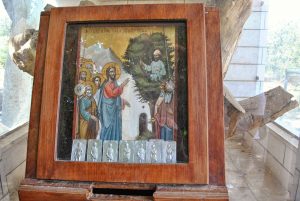
It appears to Zacchaeus and to us that he is searching strenuously to see Jesus. The crowd gets in his way so he runs on ahead and climbs up a tree so that he will be able to see him. He’s doing some real work to accomplish this goal. But, in the end, Jesus tells us that it is he who is searching for Zacchaeus. “For the Son of Man came to seek and to save the lost,” he says. Zacchaeus seeks to see Jesus, but at the time and more importantly Jesus seeks to save Zacchaeus.
Orthodox icon showing Zacchaeus in the sycamore,
behind, the tree is believed to be the ancient sycamore of Zacchaeus.
Greek Orthodox Monastery of the Prophet Elisha,
Jericho, Palestine.
While we are looking for the Lord in our lives, it is good to remember that he is the one looking for us. He has been looking for us ever since we hid from him in the garden because of our shame over our sin. Then he went looking for Adam and called out to him, “Where are you?” (Gen 3:9). He is calling out to us still today – searching for us among the trees.
Some of us, like Zacchaeus, are looking for the Lord, but some of us, like Adam, are hiding from him. Some of us are climbing our trees to get a better look while some of us are hiding among the trees (Gen 3:8).
The Venerable Bede connects the tree Zacchaeus climbs to that of the Cross. Some of us embrace that cross while some of us shun it.
But notice that whether we make ourselves conspicuous like Zacchaeus or hide like Adam, one thing remains the same: The Lord finds us. He finds Adam who is hiding as easily as he finds Zacchaeus in the tree. The Lord is seeking for us and the Lord is the one who finds what he’s looking for. He comes to seek and save the lost and we can count on him to accomplish his purposes. Still, it will be better for us if, when he finds us, he finds us also searching for him. Things went better for Zacchaeus that day than they did for Adam, as you might recall.
While we’re working to find the Lord in our lives, it can seem to us that we’re all alone – that he isn’t with us, or searching for us, but that we’ve been abandoned. Even Jesus, who is God, knows what it is to feel forsaken by God as he hangs upon a tree seeking the will of his Father. So, if we, like Zacchaeus, are looking for the Lord, have embraced our cross, and climbed our tree and now we feel forsaken and that it was all for naught (there is no darker or more painful feeling) we may rely on the hope that the Lord has gone even into that desolation and is there with us in it. He is with us even when it doesn’t feel like it – and not only passively, but is actively seeking us with an infinitely greater fervor than that with which we seek him. The truth of it is not how it appears to us, but is how the Lord knows it to be.
It appears to the crowd and us that Zacchaeus is a great sinner. And maybe he is. The tax collectors of that time and place grew rich by taking more than was owed. By dishonesty. Zacchaeus was both a chief tax collector and rich. So you do the math I guess.
Still, who is the judge of other men’s sins? The crowd murmurs about the sins of Zacchaeus when the Lord goes to stay with him. Did they forget their own sins while the Lord was walking among them? Were they not in awe that he would stoop to associate with them in their sins? Do we forget our own sins when other’s sins come to light? “Lord, help me to remember my own sins, and not judge my brother and sister.”
In any case, our judgments are worthless. We do not see things as they really are. We see only appearances. It appears to us that we and Zacchaeus are searching for the Lord, when really it is the Lord who is searching for us. It appears to us that Zacchaeus and others are great sinners, while our own sins are paltry. But the truth is that Zacchaeus is penitent while the crowd (and maybe some of us) are oblivious to our own need to repent. Meanwhile impenitence, as long as it lasts, it is the unforgivable sin. If our impenitence were to last forever, so would our estrangement from the God we claim to seek.
Listen to Zacchaeus: “Behold, Lord, half my goods I give to the poor; and if I have defrauded any one of anything, I restore it fourfold.” He repents and makes restitution. One of the fathers calculates that after Zacchaeus gives away half his goods and then restores any dishonestly acquired wealth fourfold, he’ll be left with nothing. He’ll have given everything to the poor.
Contrast him to another rich man – the rich ruler who kept all the commandments, but was unwilling to give his wealth to the poor and follow Jesus (Luke 18:18-25). That man seemed to all to be a godly man, but he was unwilling to grow any further toward the perfect and eternal life Jesus is calling us to.
We do not see things as they really are. Jesus does. Jesus proclaims salvation to Zacchaeus, whom the crowd thought a sinner. And Jesus laments how difficult it will be for the other rich man to enter the kingdom, though the crowd thought him a saint. Remember, when Jesus observes how hard it would be for him to be saved, those who hear it ask, “Then who can be saved?” (18:26). In their judgement, if the rich man who kept the commandments cannot be saved, then no one can.
Our judgments are worthless. It is the Lord who sees things as they really are. So let us not trust in appearances, but trust rather in the Lord. Let us repent of our own sins rather than judging others. Let us trust the Lord to find us, even when we are lost.

Sunday, January 19, 2020

The True Desire of our Hearts

A blind man sat by the road near Jericho begging (Luke 18:35). What do you think he was begging for? Money, right? Or food. Or clothing. Or perhaps a place to stay. He was not begging for his sight, surely. That would be a strange sight, no? A blind beggar by the road begging for sight? Whereas most of us have encountered beggars begging for money and food, I expect. People tend to ask for something they think they can get. And who could expect to get sight or healing of any real and lasting kind from random passersby. The gospel doesn’t tell us what the blind beggar is begging for before he hears that Jesus is passing by, but I think we can infer.
Begging is rather like prayer. In fact, the Latin word meaning “to pray” – orare – also means “to beg.” In archaic English also, you might hear someone say, for example, “Please, I pray you, give me something to eat.” We don’t really talk that way anymore, but it shows the relationship between these ideas.
So, this gospel passage is about prayer, from the very beginning. And the prayer of the beggar at the beginning – his begging – has a lot in common with the prayers that we sometimes pray. We ask God for what we want, and for what we think we need, and for what we think we can get.
The prayers of our liturgy are not so timid. For example, at every Divine Liturgy, and also at Vespers and Matins, we pray for peace in the whole world. When has there ever been peace in the whole world? And yet we go on boldly praying for it every day. And we’re right to do so. It is the earnest desire of our hearts, which we are to express to the Lord in prayer.
Sometimes, we don’t get the thing we explicitly pray for. Whether it is peace on Earth or winning the lottery or a Hail Mary for a football pass. Sometimes, we don’t even get the healing we ask for. My father asked God to heal my mother of cancer, and yet, she died anyway at the age of 52. And believe you me, he was explicit in what he God asked for in prayer. And this is good. I maintain, this is good to express the earnest desires of our hearts to the Lord in prayer. To beg him for healing.
The blind beggar raised his begging to a higher caliber when he heard that Jesus was passing by. He began to beg, not for mere money or food, but for mercy, crying out “Jesus, Son of David, have mercy on me!” Crying this out ceaselessly, even when those around him tried to make him stop. Do we go on with our prayer, even when those around us discourage it? How long is it been now since we began to tuck our tails and cease our prayers in schools and public places? Have we internalized the heresy that religion is a private affair? The gospel and the faith are to be proclaimed in every nation, even this one, believe it or not. So let us cry out all the more when we are asked to be silent, “Jesus, have mercy on us.” Let us move, from the stage of timid begging, which represents a less mature prayer, to boldly crying out for mercy with faith.
In response to his bold crying out, Jesus then asks the beggar, what do you want me to do for you? And the beggar asks for sight. “Lord, let me receive my sight.” Now this is a prayer offered in faith. We continue to beg for what we think we can get, so a prayer for something as great as sight indicates faith that Jesus is a giver of good things that not just anyone can give. Surely the beggar didn’t ask the random passersby for his sight, but he knows he’s now speaking to someone who can make him see.
That takes faith, which is the ability to see things as they really are. By faith, the beggar could see who he was talking to, even while he could not yet see with the eyes of his body. When we come to appreciate something of the majesty the power and the glory of the one to whom we pray, we can get a little bolder in the things we pray for. There’s nothing wrong with that asking God for little things, but let’s remember who we’re talking to, to the one who gives us life, who can deliver us from oppression, who can heal our diseases and drive out demons, who can give us everlasting life. Let’s ask him for the healing we seek and all the true desires of our hearts. Just as this blind beggar did outside of Jericho. And also just as my father did for my mother. And also, just as Jesus did himself in Gethsemane, when he prayed to his Father, “Let this cup pass from me.”
To our eyes, the outcome for the beggar looks different than the outcome my father got. The beggar received his sight but my mother died of cancer. But also remember that first petition of Jesus in the Garden of Gethsemane. The outcome of that prayer looks more like the one my father got.
Here’s the thing: we pray for what we want, for the healing our heart desires, and our Lord God is listening to the true desires of our true hearts, which he knows better than we do ourselves. He’s the one that made your heart. He knows what it really is – unclouded by the passions. And he made it to desire one thing.
All our pure desires are reflections of the one true desire of our hearts. They are like rays of light bursting through the clouds of our passions. And they are to be venerated as glimpses of that one true desire, which burns as bright and hot as the sun behind the clouds. And that one true desire of our hearts is God himself.
You want healing – he is healing. You want life – he is life. Even the small things, the seemingly petty things we want, he is the true fulfillment of all that represents. You want wealth – the wealth of this world is garbage next to the mansion he has prepared for you in his house. You want food – he is your food. He becomes your food and drink today.
He is the true desire of your heart. And he will answer your prayer the same as he did for the blind man in Jericho – the same as he did for his own son Jesus in Gethsemane. If we see the outcome for Jesus and for the blind beggar as different, it’s because we are blind and do not yet see with the eyes of faith.
When we look at our suffering, our poverty, or our illnesses from which we desire to be healed – when we look at the cross, we see death. And we rightly abhor death, which is our enemy. That is a glimpse of our true desire. Our true desire is life, which is Christ. So when we pray for a way around the cross, as Jesus did, that is like a shadow of our hope for life. And God is going to give you life. He is giving you life right now. And he is giving you life unto the ages of Ages. And he is giving it to you – through the cross.  Through your cross and his. Not around it but through it, the true desire of your heart will be fulfilled.
May the Lord give us sight to see it, the faith to know it, and thanking him for it as already received, let us glorify God and give him praise. 

Sunday, December 15, 2019

I want my house to be full.

“I want my house to be full,” says the host of the banquet (Luke 14:23). I hear that. I want our house to be full.
Most people these days call the buildings in which we gather to worship God “churches.” Many people of our particular Church, particularly in the old countries, actually call them “temples,” not “churches.” The Church is the people of God gathered together to worship God. The temple is the place of sacrifice to the Lord. But in the ancient church, it’s interesting to note, the building in which we gather would have been called neither a church nor a temple.
The church, as I say, is the people of God gathered together to worship God, and not the building in which we worship him. As for the temple, there was only ever one building that was a temple – the temple that the Lord commanded be built in Jerusalem. That temple has not been replaced by these buildings in which we worship God, it has been fulfilled by our bodies. Our bodies are the temples of the Holy Spirit (1 Cor 6:19). We now worship God in spirit and in truth. Our bodies are for worshipping God. The Lord dwells in our bodies through the holy mysteries of the Church. Through the Eucharist especially, he comes to dwell inside of us – in our hearts. When we receive communion, our heart becomes the tabernacle of the Lord in the temple of the Lord.
So, if these buildings would have been called neither church nor temple, what would they have been called? –  houses (οἶκοι). Christians first gathered in houses. This term is retained in our liturgy. Every time you hear the deacon praying “for this holy church and for all who enter it with faith, reverence, and the fear of God,” the original Greek word translated as “church” actually is Î¿á¼¶ÎºÎ¿Ï‚ – house. The house of the Church. The house of the people of God gathered together to worship the Lord. And, I want the house to be full. The Lord talks about a house today and he says he wants it to be full.
By way of filling it, are we doing what Jesus tells us to do? Are we bringing in the poor and needy to share in our banquet? Or, do we think it’s for us but not for them? As we go about our lives, are we cajoling all we meet to join us and fill the house?
I want the house to be full. Don’t you? And I don’t care about it being full of money or full of people with money. I want it to be full of God’s people. All people. People in need. Also, the blind, the crippled, the lame, and the poor, says Jesus Christ himself (Luke 14:21). Are we doing everything we can to invite them? And to make our houses accessible to them – to the Church, which is the people, so that they can join us in the worship of almighty God? Are we offering to give them a ride? Are there people who want to come but can’t?
What could be more important than filling the house of the Lord with many to share in in his banquet? It doesn’t matter how much that costs. Let’s do all we’re able to toward that end.
The banquet in Jesus parable to us today is, of course, the heavenly banquet. But if it’s less clear, it’s also the banquet we celebrate at every Divine Liturgy. The Eucharistic banquet in which we participate is the heavenly banquet. There is no difference. It is the same banquet. The one that goes on in our houses is the same one going on in heaven. There’s a reason we call the liturgy Divine. It is an act of God. God is present there.
If you listen to the prayers of the Divine Liturgy, you’ll see that God himself has broken into our ordinary time and our ordinary life. He abolishes our earthly anxieties, if we let him. In the house of the Church, we occupy the time when the Lord has already come. The second coming is an accomplished act. It’s not only something we’re waiting for the future. The future is now. The past is now. We are present in Bethlehem at the birth of our Lord Jesus Christ in a stable in a cave in Bethlehem. We’re present also at his baptism in the River Jordan. And we’re present at the foot of his cross. And by his tomb. We’re present as he rises up out of the tomb. We’re present as he ascends again to the right hand of his Father in heaven. We’re present as the Holy Spirit descends upon us with his apostles. Here. Now. Today. We’re present as he comes again in glory. The Divine Liturgy is the heavenly banquet. It is not a rehearsal. It is not a drill. It is the one and only heavenly banquet.
So, do you ever make excuses as to why you cannot come? Let’s listen to Jesus’ parable about such excuses (Luke 14:16-21). He’s not buying it.
The ideal for us for Sundays and Great Feasts is to come and pray Vespers, Matins, and Divine Liturgy. “Evening, morning, and at noon, I will pray,” says the Psalmist (55:17). But we understand that circumstances make this difficult for most of us and impossible for some of us. So, if you can’t come to one, come to another. If you can’t come Sunday morning, come to Vespers Saturday evening. Participate to the extent you’re able. God sees the heart. He knows how legitimate your excuses are. Unlike us, he is a host who really knows those he has invited.
He knows also whether we doing what we can to bring others to the Lord. This is his command to us, remember. According to some research,[1] 82% of the unchurched say they would consider attending church if they were invited. At the same time, only 2% of people who go to church have invited a friend in the last year. As a result, seven out of ten unchurched people have lived their entire lives without ever having been invited to church by a friend.
The host in today’s parable instructs that we not only invite people to this banquet, but that we compel them to come in (Luke 14:23).  Let’s invite and go beyond inviting. Let’s offer somebody a ride. Or, let’s offer to meet them at the church and show them around or walk in with them and sit with them. Make them comfortable. Answer their questions.
Image may contain: text
I also learned that not very many people come to church because they saw or heard an advertisement. That doesn’t mean we shouldn’t advertise. Even if only one person comes as a result, it’s worth spending quite a lot of money on advertising for the sake of that one person. We should advertise. But still it remains the case, that not a lot of people come to church because they saw an advertisement.
Also, perhaps more surprisingly to some, not a lot of people come to church because the pastor of that church invites them. That doesn’t mean I shouldn’t invite people. I should, I can, and I do. And it’s worth it. If only one person comes out of a thousand I invite, it’s worth inviting the thousand for the sake of the one. But still it’s the case that not a lot of people come to church because they’re invited by the pastor.
You know why most people actually come and join the church? It’s because they’re invited by a friend. This makes sense. Even Peter only came and saw Jesus because his brother invited him. Nathanael only came and saw Jesus because his friend Philip invited him (John 1:40-51).
What works is inviting our family and our friends again and again – people who know that we love them. That’s the key that makes all the difference in evangelization – love. If our house isn’t built out of love, then what is it built out of? If it’s built of something other than love, then we should certainly stop calling it a church.


[1] Thom S. Rainer, The Unchurched Next Door

Sunday, December 1, 2019

Eternal Life is Eternal Growth

The rich ruler becomes “sad” after Jesus shows him the way to “inherit eternal life” (Luke 18: 23, 18). Why should that make him sad? That’s what he asked for, isn’t it (18:18)? Yes, but the way Jesus shows him is uncomfortable. It’s not the answer he wanted. Perhaps he wanted a pat on the back for what he was already doing – a “well done, good and faithful servant” – and why not? He’d been keeping the commandments!

God knows that many of us fail to keep the commandments. This rich ruler did not commit adultery, did not kill, did not steal, did not lie. He honored his mother and his father. When Jesus began to list these commandments, the ruler must have been pleased. He had observed all these commandments from his youth (18:21), so hearing Jesus describe these as the way to eternal life must have felt reassuring at first, I would think.

The ruler had done so much already, in his own estimation. Surely following all these commandments should be enough? My brothers and sisters in Christ, there is no such thing as enough.

Upon hearing that the ruler has taken the step following the commandments, Jesus has for him another step: “Sell all that you have and distribute to the poor… and come follow me.” If the ruler had not yet been following the commandments, I wonder if Jesus would have revealed to him this next step. I think not. He feeds us first with milk, not solid food, and gives us solid food only when we are ready (cf. 1 Cor 3:2). And, on the other hand, if the ruler had readily distributed all his wealth to the poor and followed Jesus, as many saints have done, he would then have been given another step to climb. This is what those saints have discovered.

There are those who have followed the way of Jesus and have given away all their wealth to the poor to follow after him. We celebrate one of these great saints of this coming week, Saint Nicholas. Also Saint Anthony the Great. Also Saint Francis of Assisi. Many have followed Jesus in this way of poverty. What they have discovered, is that this, too, is not the end of their growth.


Eternal life is still not a done deal, even if we’ve grown to such a degree of radical trust in God. Rather, out there in the desert with no possessions and following Jesus, Saint Anthony was beset by countless demons and passions. He had to do battle out there still. The work was not done. There is always more growing to do.

We find growth uncomfortable. But Jesus is teaching us to embrace growth, which feels rather like embracing the cross. For as long as we do not embrace it, growth remains painful. We suffer growing pains. If we were to never embrace growth, the pain would become everlasting. The rich ruler did not embrace growth – and he went away sad.

I am convinced that growth is life and life is growth – and that eternal life is eternal growth. What must we do to inherit eternal life? Grow eternally. When we stop growing, it means we’re dead.

St. Gregory of Nyssa teaches us this in his book about the Life of Moses. Life is about becoming one with God, and God is boundless and perfect. "How can reach the boundary when there is no boundary?" asks Gregory (paraphrased). "The one limit of perfection is the fact that it has no limit." The race to virtue never ends (I, 5-6; cf. II, 242).

It’s important to remember that God commands us to be perfect. But perfection is unlimited, so how can we ever reach it? Only God is good, as Jesus reminds us today (Luke 18:19). St. Gregory observes, "The perfection of human nature consists perhaps in its very growth in goodness" (I, 10).

Growth is the perfection we’re called to. Growth is life. "No limit… interrupt[s] growth in the ascent to God, since no limit to the good can be found nor is the increasing of desire for the good brought to an end because it is satisfied" (II, 239). There is "always… a step higher than the one [we have] attained" (II, 227). If we live virtuously, our capacity for more virtue will increase. Our capacity to love increases the more we love. It’s not a limited commodity. It doesn’t work like that. Our potential for growth is limitless, because the God calling us to himself is limitless.

In imitation of Christ, our Byzantine tradition constantly calls us to grow. It is not a minimalist tradition. You may have noticed. It does not propose to us the least we must do to in order to find a place in the back pew of heaven. This is not what Jesus does either. When we have grown to a certain point, he shows us that it is now time to grow to a still higher point. Our Byzantine tradition is a maximalist tradition. It proposes to us more than we can possibly do so that, no matter how much we have done, there is always more to do. There’s always another step. There’s always more growing to do.

In this season of the Philip’s fast, our tradition challenges us to grow, to give a bit more of ourselves, more of our time to prayer in the church and at home, more of our wealth to the poor. Let’s listen with some fear of God to Jesus’ admonishment about wealth today and his invitation to remember the poor (Luke 18:24-25, 22). Let’s make an effort to come to church once or twice more than we usually do during the week. Let’s go to a service we’ve never been to before. If we don't sing the Divine Liturgy, let's start singing – even if we only sing quietly at first. Let’s accept the challenges our tradition offers us to grow.

Since this Byzantine tradition of our is so challenging, some might be asking, why should I bother? It’ll be more convenient – won’t it? – and more comfortable to find a Roman Catholic parish nearby where I can get in and out of Mass in 45 minutes and then be about my business. Maybe business, after all, is what we really care about. Probably, most of us could find a parish closer to home, too. Being Byzantine these days takes so much extra effort and, really, what’s the point? It’s all the same thing, isn’t it?

I’m telling you, our tradition has something to offer you very much like what Jesus is offering the rich ruler today: opportunity for growth, which is life itself. We must stop looking at the inconveniences of our tradition and our situation as a problem to be avoided, and begin to embrace them as opportunities to grow in union with God. We must stop regarding our liturgical services as some drudgery to get through in order to fulfill some imagined obligation. Check the box and move on, as if that would help us grow in union with God. If we really pray our services, rather than waiting for them to be over, we wouldn’t care if they went on all day. Getting to the end isn’t the point, we’d realize. The Divine Liturgy has no end. If we don’t like praying together, we’re not going to be able stand it in heaven, because that's what we do there. And not being able to stand it in heaven is a condition of being known as hell.

When we embrace our tradition, we will see how much it helps us grow and eventually we will realize is that it is possible to take joy in our growth. Because we are growing closer to the Lord, who is our true joy. If things other than the Lord are our joy, we find it drudgery to grow. Because growing in the Lord, after all, is growing apart from the things of this world, inasmuch as they are fallen, broken, and disordered by our sinfulness. As long as we resist this growth, it will cause us pain and life will be pain for us. As soon as we begin to take joy in growth, we begin to delight, even now, in the eternal garden of paradise.

Sunday, October 20, 2019

A Balance of Fasts and Feasts

I like to feast. That’s probably becoming more apparent as my girth expands. That’s because I feast too much. My Sicilian rector once observed that I am “a good fork.” God be merciful to me, the sinner.
But it’s not a bad thing to feast and to celebrate on occasion. Feasting itself is a good thing.
Recall the parable of the prodigal son. What does the father do when his son finally returns home to him? He kills the fatted calf and feasts and celebrates with his beloved child.
Jesus himself attends and contributes to a wedding feast in Cana.
The Church gets in on this too. We feast. We celebrate. On every icon screen are twelve icons of events we call ‘feasts.” We call them feasts because they celebrate events that call for a feast. Above all, this refers to the eucharistic feast of the divine liturgy – but it also carries the sense of celebrating and sharing a good meal with friends and family. There’s a time to fast and a time to relax our fasting, to cut loose and party. This is part of what’s good about being human and being children of God.
The first Franciscans were no Friar Tucks. They fasted severely and practiced strict asceticism. So much so that one day Brother Morico came to St. Francis and asked him if they should fast even on Christmas Day, because it fell on a Friday.  St. Francis was flabbergasted. Fast?! “On the day on which the Child was born to us? It is my wish,” he said, “that even the walls should eat meat on such a day, and if they cannot, we should smear the walls with meat!”[i] Francis, it would seem, recognized that here is a time for feasting – and even for rather extravagant feasting.
But today’s gospel begins with feasting of another kind. Jesus says, “There was a rich man, who was clothed in purple and fine linen and who feasted sumptuously every day” (Luke 16:19). He not only feasted, but feasted sumptuously, and he not only feasted sumptuously at times in celebration of great occasions, but feasted “every day!”
And furthermore, he acted in this way while the poor man Lazarus lay starving and full of sores just outside his gate (Luke 16:20). He did not ask this man in. He did not invite him to join his feast or send any portion to him at the gate. This is grotesque.
The prophet Amos saw grotesque imbalance like this in his day. He was a simple shepherd called by God to speak against corruption and injustice at a time of great material wealth and decadence. He says,
Woe to those who… eat lambs from the flock, and calves from the midst of the stall… who drink wine in bowls, and anoint themselves with the finest oils, but are not grieved over the ruin of Joseph! Therefore they shall now be the first of those to go into exile, and [their] revelry… shall pass away (Amos 6:4-7).
And we continue to see imbalance like this in our own day. Being as well sated as many of us are – as I am – can render us insensible to the sufferings of others. Too much comfort can blind us to the discomfort of the poor and needy. Perhaps we hate to be reminded of that because it disturbs our precious comfort.
The tradition of the Church gives us a remedy we ignore at our peril – a remedy that may well have saved the rich man from his torment in the flames had he observed it faithfully: a balanced cycle of feasting and fasting.
We celebrate occasional feasts as expressions of our joy in the Lord. Note that this feasting is occasional. We are not to feast every day, like the rich man. Cookies aren’t for every day, as Pani Katie tells the children and me, but only for special occasions. I should probably listen to her. And when we feast, let’s also remember that the less fortunate are always invited and welcome to join us.
And to balance this feasting, the Church invites us also to many days and seasons of fasting. Count them all up and about half the days of the year are fast days. Half and half. This is a balance.
Fasting is for many reasons, but sometimes we forget the reason of justice. We fast to humble ourselves before the Lord. We fast to train ourselves in virtue and to cleanse our hearts of vanity. We fast also so that we will have more to give. Fasting is to enable giving. Proper fasting consists in consuming less, which means spending less money. These savings are not meant to pad our investment accounts. They’re meant to be given to the poor.
The Shepherd of Hermas tells us,
You must taste nothing except bread and water on the day on which you fast. Then, you must estimate the cost of the food you would have eaten on that day…, and give it to a widow or an orphan or someone in need. In this way you will become humble-minded (Herm 56: 6-8).
This is good and practical advice for us if we are to avoid the tormented condition of the rich man in today’s parable. We might consider drawing up a more austere grocery budget during the fasting seasons and giving the savings to Food for the Poor or to another charitable organization. Or, better yet, giving it directly to those in need in our communities.
Our next fasting season, which will be in preparation for the feast of the birth of our Lord, begins in less than a month, so give this some thought.
Each fasting season ends with a feast. And a life lived simply in the Lord, without flaunting extravagance in the face of the poor, but rather sharing all that we have with those in need, will end at the heavenly banquet table with Abraham, Isaac, and Jacob (Matt 8:11).


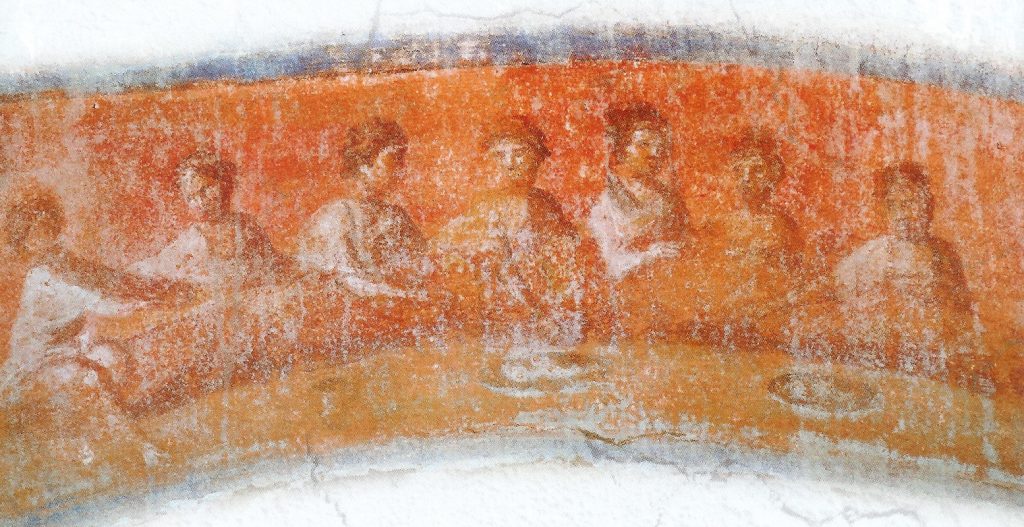
Catacombe di Priscilla, Rome. 2nd – 4th century.


[i] Saint Francis of Assisi, Celano, Second Life, Chapter CLI

Sunday, October 13, 2019

The Lord Gardens as well as Sows

on Luke 8:5-15
There is no question as to whether or not the Lord has sown the seed of the word of God in your heart. He has done so. He pours out his grace upon all of us constantly. He is present with us always. So, rather, the question is, do we receive him? If we become like good soil, we can receive the seed and with it live and grow forever.
Maybe we can recognize ourselves in the various kinds of soil that Jesus describes in his parable of the sower.
Perhaps, like the overtrodden soil, into which the seed cannot nestle, we are beset constantly by distractions and temptations – devils convincing us to turn away from the word in our hearts – from what we really know is beautiful, good, and true, and to turn instead again and again to our enslaving passions and sins, gluttony, lust, pride, or drunkenness, or whatever else.
Perhaps, like the rocky soil into which the seed cannot grow roots, our commitment to the Lord is fleeting. We embrace him with a quick fervor when we hear the good news that Jesus offers us abundant life (John 10:10b), but when it becomes all too apparent that the way to this life is the painful and difficult way of the cross (Luke 9:23), we find there are stones within us blocking further growth – a stony stubborn unwillingness to give that much, to yield, to let go of our own way (cf. 1 Cor 13:5b).
Perhaps, like the thorny, weedy soil, which chokes the seedling to death as it tries to grow, we are not so much discouraged by suffering as seduced by comforts and pleasures of this life, so that, while the word of God sounds good enough to us, we’re deluded into believing we don’t really need it. That’s nice enough for other folks, we think, but I’ve got what I need from my bed or my couch and TV and internet. Endless diversion and entertainment at my fingertips. Who needs to go to church so often?
Perhaps, like me, you’re thinking, yikes, my soil is weedy, rocky, and overtrodden all at the same time.
But whatever kind of soil we have been like so far in our lives, the Lord returns and sows the seed again and again. Like a good gardener, he’s out every year with his bag casting seeds. A sower does not plant only one season, but every planting season as it comes around. We go through seasons in our life. However we have been until now, there is no reason to despair. There is every reason to hope. Our sower has not abandoned us. He is coming again and again.
We want to become like good soil, so that the next season when he comes around, we are prepared to receive him. Much can be done with soil to prepare it to receive seed. Gardening isn’t only sowing, and our Lord is a good gardener, not only a sower.
You and I are the earth. Remember that “you are dust, and to dust you shall return” (Gen. 3:19). We are the earth in which the Lord is preparing to plant his garden.
If he sees that you’re overtrodden, he’s building a fence around you to redirect the path away from you. Your deliverer is coming to deliver you from the devils that tempt you. To cooperate with him in building this fence, change your habits. Stop treading the well-worn path from one sin to another. Stop returning again and again to your sin like a dog to his vomit. When the temptations come, as they surely will, immediately take refuge in the Jesus Prayer – “Lord, Jesus Christ, Son of God, have mercy on me, the sinner.” And the Lord will deliver you. Repeat the prayer as often and as long as the temptation persists.
If the Lord sees that you’re like rocky soil, he is raking out the rocks. Whatever stony idols you’ve clung to, preferring them to God, he’s raking them out. He’s taking out your heart of stone and giving you a heart of flesh. He’s breathing his spirit into you so that you will walk in his ways. He is delivering you from all your uncleanness. And he’s summoning the grain and the fruit of the tree and the increase of the field and making it abundant (cf. Ezekiel 36:25-30). The Lord is the good gardener. To cooperate with him in this raking, yield and do not resist him. Let go of whatever you’re clinging to that is not God. You let it go and he’ll rake it out. He’ll loosen the soil and make it receptive to his seed.
If the Lord sees that you’re like soil choked with weeds, he’ll uproot those weeds. Whatever riches or comforts or pleasures you’re overly attached to are passing away. The Lord is uprooting your attachment to them. Unlike the stones, which are negatives, the weeds are positives – they’re living things too – but anything, even any good thing, that we put in the place of God will be uprooted. To cooperate with the gardener in pulling up the weeds, embrace ascesis. Simplify your life. Give any excess to those in need. Fast. Pray. Make some prostrations in your prayer. Humble yourself before your creator.
Finally, the soil is almost ready. It is no longer trod upon, nor rocky, nor weedy. The gardener has prepared it. Only one step remains. If we are gardeners or farmers, we know how best to enrich the soil at this point – with the compost. Soil is enriched by death and decay, out of which grows forth new and abundant life. Soil thus enriched will easily receive a seed and help it grow strong and lively. The remembrance of death will enrich our hearts to hear and keep the word of God.
In a Romanian skete on Mt. Athos, they keep the bones of the departed monks in an ossuary. And on the skull of one of them is written, “What I am, you will be, too. What you are, I’ve been myself.” Brothers and sisters, we are going to die. And then, we will stand again in the glory of the Lord. This whole life is preparation for that coming experience of God.

Sunday, September 29, 2019

Taking Others at their Word

One morning, oh, about 10 or 11 years ago, I was running a bit late for work. I left in such a hurry, I forgot that I had taken my debit card out of my wallet. There was no cash in there either, but that was par for the course.
Anyway, after I got into my Jeep and had driven down the driveway, I noticed an index card someone had put under my windshield wiper: some kind of note, I guess. But, as I say, I was in a hurry, so I decided to just leave it there and drive on. I’d see what it was when I got to work.
Then, when I got to the outskirts of downtown Indianapolis, it suddenly began to rain. And I mean buckets of rain – a real deluge. So, I set my windshield wipers to full speed and they were barely keeping up. This, of course, dislodged the index card, which then became stuck to the windshield directly in my line of sight.
Some mornings everything goes wrong.
As a result of these distractions, I failed to immediately notice the traffic ahead of me slowing to a stop. When I did notice, I slammed on the brakes of course, but the road was slick from the rain and I slammed – ever so gently – into the car in front of me.
The car pulled into a parking lot just ahead and I followed. We exchanged insurance information and waited for the police, who came and made a report. That was the end of that. (Except for when they sued me two years later, but that’s another story). I never did discover what, if anything, was written on the index card.
When all was said and done, I noticed that one of my tires was mostly flat. To this day I don’t understand the physics behind that. There was no puncture. Anyway, I was right next to a gas station, with an air pump, so I got it over there. The machine took quarters.
I had no quarters – no cash, no debit card, no cell phone. And I’m late for work. I can’t risk driving the Jeep with such low tire pressure. I have no way to work. No way to get home. No way to let my boss know why I’m late and getting later. The rain and the distress of the morning have turned me into a disheveled sight.
So, there I am, transformed in an instant from an employed husband and father of two with a house and a mortgage, into a bum with a ridiculous sob story begging for change from passersby at a gas station.
File:Gavarni P. attr. - Pencil - un mendiant - 14.5x18.2cm.jpg
un mendiant – Pencil –  Gavarni P.
I felt rather a fool telling my story and begging for change only to be ignored by everyone I asked both in and out of the gas station. Most ignored me completely – not even making eye contact. One to whom I did manage to speak gave me quite a look of incredulity, actually rolling his eyes. I was not believed and I was not helped. For me, they could not spare a dime, as they purchased their coffees and gasoline.
Realizing I was making something of a nuisance of myself, I decided to go elsewhere to beg. Across the street was a bar just opening up. I walked in. And there, I was listened to. The bartender opened up the till and gave me some quarters, and all was well. Thus ended my career as a beggar.
One thing to learn from all this is that, if we’re going somewhere together, you may want to offer to drive. But another thing to learn is to “do unto others as you would have them do unto you” and to “give without expecting repayment” (Luke 6:31, 35a).
Do you want to be taken at your word? Then take others at their word, even if your suspicions are aroused. In Christ, we may become as guileless as children – as innocent as doves, even while we are at the same time as cunning as serpents (Matt 10:16).
You might need others to take you at your word quite suddenly, as I learned from experience – even if they don’t know you and have no reason to trust you – even regarding an unbelievable situation.
That’s another thing, just because you don’t believe a beggar’s story (and I’ve certainly heard some whoppers) doesn’t mean you can’t offer to help. “The Most High is kind to the ungrateful and the selfish” (Luke 6:35b). We can be kind to the unbelievable, to the liar and the thief, to the drug addict and the prostitute.
We might be surprised to find that it’s unexpected folks who are kind to us in our time of need. I was quite struck by the fact that the straitlaced types buying gas at the gas station wouldn’t help me, but the folks at the bar, thought by some to be of less moral quality, were the ones who helped me. They gave without expecting anything in return.
Let’s let go of the question of what’s in it for us. God doesn’t show us kindness, mercy, and love for his sake, but for ours. And he commands us to do the same. Far from limiting our loving-kindness to those who can give us something in return, Jesus teaches us to love even our enemies. Do good to those who hate you, bless those who curse you, pray for those who abuse you, give to everyone who asks, give even to the thief, give without expecting anything in return (Luke 6:27-30, 35).
“Be merciful,” he commands us, “even as your Father is merciful.”  And this is the point, really. He is commanding us to be like God, which we become by his grace. God is kind to the unkind and loving to the unloving. He is kind and loving to us. Let us be kind and loving to each other, also to our enemies, real and imagined. Only when there is not one excluded from our love are we in Christ.

Sunday, August 18, 2019

Have all faith (not just a little faith).


If you have faith like a mustard seed, you will move the mountain. And nothing will be impossible for you. (Matt 17:20).

Our faith should be like mustard seed.

A mustard seed is tiny, but its tininess is not the whole story. Remember, the littleness of the disciples’ faith is the reason they cannot move the mountain – that they cannot cast the demon out of the boy and heal him.  

This, by the way, is what it means to move a mountain, in my opinion.[i] Most of us have a mountain in our lives that needs moving. It’s found most often deeply rooted in our hearts. And there’s usually a demon or two who planted it there and who try to keep it there.

If we had faith like a mustard seed, we would say to that mountain of passions or addiction; ill-will, resentments, or unforgiveness; selfishness and self-centeredness; gluttony, lust, and wickedness; unkindness, impatience, and failure to love – we would say to that mountain in our hearts, “move.”[ii] And it, with all its attendant demons would “be taken up and cast into the sea” (Matt 21:21), that is, into the abyss of hell,[iii] where all such inclinations and the demons that harbor them belong.

You know as well as I do, it would be easier to move a mountain in the literal sense. But nothing will be impossible for us if we have faith like a mustard seed.

I do not say that we should have faith “the size” of a mustard seed. Some translations[iv] add a comment here about size, which does not appear in the Greek. Jesus does not say “if you have faith the size of a mustard seed.” He says, “If you have faith like or as (ὡς) a mustard seed.”  

The tininess of the mustard seed is an important part of the power of the image, that’s true, and Jesus speaks about that in another place (Matt 13:32), but to overfocus on that attribute alone causes the image to lose its potency. If we think a little faith is enough because we hear our faith should be like mustard seed, we may have missed the point.  

When we say to one another, “have a little faith,” I hope we don’t mean it in the sense that Jesus does when he tells his disciples that they fail to cast out the demon because of their “little faith” (Matt 17:20).

Size alone is not the point. It’s important that we’re speaking here of a grain of mustard and not a grain of sand. There’s a world of difference between the two – and the difference is life.  

Jesus is not, I think, making a quantitative comparison between the littleness of the disciples’ faith and the size of the mustard seed, as if their faith was even smaller and they only need a bit more of it. Rather, I think he’s making a qualitative comparison between two tiny things. If your faith is so little, let it be little in the way that mustard seed is little – not like a grain of lifeless sand, but like a grain of living seed. It's alright to have a little faith, as long as it's little in the way that a mustard seed is little and not in the way that the disciples’ faith was little that day. The difference is life, growth, & potency.

St. Paul speaks of having “all faith so as to move mountains” (1 Cor 13:2). The kind of faith that moves mountains is not “little faith” but “all faith.” Faith that is like a mustard seed is total faith.[v] A mustard seed is tiny, but it contains the whole. It has the total mustard plant within it – a great shrub rather like a tree, “so that the birds of the air come and make nests in its branches” (Matt 13:32; cf. Luke 13:19).

Jesus also teaches that a mustard seed is like kingdom of heaven. So, let our faith be like the kingdom – small, maybe, but full of life and spirit and capable of growing to greatness.
How can a mustard seed move a mountain? Only because it can do something a mountain cannot do: it can grow. It is alive and not lifeless rock. And life always wins. Patient growth has the power to reshape the whole earth.

If we have a living, growing faith, we can trust that that mountain within us that needs to move will move. We can see it begin to erode, in fact – its stones broken by the growing roots of our faith, weakening to rubble the mountain that seemed immovable and preparing it to be swept away by grace.


In the meantime, if our faith is little in the way that shouldn't be, how are we to transform our faith into the faith that is like a mustard seed? One way is by the prayer and fasting that today Jesus says is necessary to cast out this kind of demon (Matt 17:21). Such is necessary because, through these means, God transforms our faith from some dry and lifeless assent to propositions into a living seed of the word within us, that grows and grows, like life in a womb.

A mustard seed is an embryonic mustard plant. The kingdom of heaven is like an embryo. An embryo can grow to become a king. Growth is key. Life is that which grows. If we stop growing, we’re dead. Eternal life is eternal growth. Let us grow ever closer to the infinite Lord for all eternity, and let us begin to grow today.


[i]The mountains here spoken of, in my opin­ion, are the hostile powers that have their being in a flood of great wickedness, such as are set­tled down, so to speak, in some souls of various people.” Origen, com­mentary on matthew 13.7.
[ii] “If they had had this faith within them, they would have been like the grain of mustard seed. By the power of the Word they would have thrown out this burden of sins and the heavy mass of their unbelief. They would have transferred it, like a mountain into the sea.” hilary of poitiers. on matthew 17.8.
[iii] “Then such a man will say to this mountain—I mean in this case the deaf and dumb spirit in him who is said to be epileptic— "Move from here to another place." It will move. This means it will move from the suffering per­son to the abyss.” Origen, com­mentary on matthew 13.7.
[iv] e.g. NIV and NAB
[v] “When someone has total faith…, then he has all faith like a grain of mus­tard seed” Origen, com­mentary on matthew 13.7.


Most Popular Posts this Month

Most Popular Posts of All Time