Showing posts with label Judgment. Show all posts

Sunday, January 26, 2020

Appearances

It appears to Zacchaeus and to us that he is searching strenuously to see Jesus. The crowd gets in his way so he runs on ahead and climbs up a tree so that he will be able to see him. He’s doing some real work to accomplish this goal. But, in the end, Jesus tells us that it is he who is searching for Zacchaeus. “For the Son of Man came to seek and to save the lost,” he says. Zacchaeus seeks to see Jesus, but at the time and more importantly Jesus seeks to save Zacchaeus.
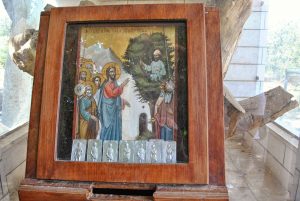
Orthodox icon showing Zacchaeus in the sycamore,
behind, the tree is believed to be the ancient sycamore of Zacchaeus.
Greek Orthodox Monastery of the Prophet Elisha,
Jericho, Palestine.
While we are looking for the Lord in our lives, it is good to remember that he is the one looking for us. He has been looking for us ever since we hid from him in the garden because of our shame over our sin. Then he went looking for Adam and called out to him, “Where are you?” (Gen 3:9). He is calling out to us still today – searching for us among the trees.
Some of us, like Zacchaeus, are looking for the Lord, but some of us, like Adam, are hiding from him. Some of us are climbing our trees to get a better look while some of us are hiding among the trees (Gen 3:8).
The Venerable Bede connects the tree Zacchaeus climbs to that of the Cross. Some of us embrace that cross while some of us shun it.
But notice that whether we make ourselves conspicuous like Zacchaeus or hide like Adam, one thing remains the same: The Lord finds us. He finds Adam who is hiding as easily as he finds Zacchaeus in the tree. The Lord is seeking for us and the Lord is the one who finds what he’s looking for. He comes to seek and save the lost and we can count on him to accomplish his purposes. Still, it will be better for us if, when he finds us, he finds us also searching for him. Things went better for Zacchaeus that day than they did for Adam, as you might recall.
While we’re working to find the Lord in our lives, it can seem to us that we’re all alone – that he isn’t with us, or searching for us, but that we’ve been abandoned. Even Jesus, who is God, knows what it is to feel forsaken by God as he hangs upon a tree seeking the will of his Father. So, if we, like Zacchaeus, are looking for the Lord, have embraced our cross, and climbed our tree and now we feel forsaken and that it was all for naught (there is no darker or more painful feeling) we may rely on the hope that the Lord has gone even into that desolation and is there with us in it. He is with us even when it doesn’t feel like it – and not only passively, but is actively seeking us with an infinitely greater fervor than that with which we seek him. The truth of it is not how it appears to us, but is how the Lord knows it to be.
It appears to the crowd and us that Zacchaeus is a great sinner. And maybe he is. The tax collectors of that time and place grew rich by taking more than was owed. By dishonesty. Zacchaeus was both a chief tax collector and rich. So you do the math I guess.
Still, who is the judge of other men’s sins? The crowd murmurs about the sins of Zacchaeus when the Lord goes to stay with him. Did they forget their own sins while the Lord was walking among them? Were they not in awe that he would stoop to associate with them in their sins? Do we forget our own sins when other’s sins come to light? “Lord, help me to remember my own sins, and not judge my brother and sister.”
In any case, our judgments are worthless. We do not see things as they really are. We see only appearances. It appears to us that we and Zacchaeus are searching for the Lord, when really it is the Lord who is searching for us. It appears to us that Zacchaeus and others are great sinners, while our own sins are paltry. But the truth is that Zacchaeus is penitent while the crowd (and maybe some of us) are oblivious to our own need to repent. Meanwhile impenitence, as long as it lasts, it is the unforgivable sin. If our impenitence were to last forever, so would our estrangement from the God we claim to seek.
Listen to Zacchaeus: “Behold, Lord, half my goods I give to the poor; and if I have defrauded any one of anything, I restore it fourfold.” He repents and makes restitution. One of the fathers calculates that after Zacchaeus gives away half his goods and then restores any dishonestly acquired wealth fourfold, he’ll be left with nothing. He’ll have given everything to the poor.
Contrast him to another rich man – the rich ruler who kept all the commandments, but was unwilling to give his wealth to the poor and follow Jesus (Luke 18:18-25). That man seemed to all to be a godly man, but he was unwilling to grow any further toward the perfect and eternal life Jesus is calling us to.
We do not see things as they really are. Jesus does. Jesus proclaims salvation to Zacchaeus, whom the crowd thought a sinner. And Jesus laments how difficult it will be for the other rich man to enter the kingdom, though the crowd thought him a saint. Remember, when Jesus observes how hard it would be for him to be saved, those who hear it ask, “Then who can be saved?” (18:26). In their judgement, if the rich man who kept the commandments cannot be saved, then no one can.
Our judgments are worthless. It is the Lord who sees things as they really are. So let us not trust in appearances, but trust rather in the Lord. Let us repent of our own sins rather than judging others. Let us trust the Lord to find us, even when we are lost.

Tuesday, April 16, 2019

The Bridegroom is coming in the middle of the night.

on Matthew 24:36-26:2


The day of the Lord is coming - and we will be judged.

It’s popular to say these days, “Only God can judge me.” And that’s true. Only in the presence of God will it be perfectly clear whether we have turned our faces toward him or set our faces against him – whether we love or have let our love grow cold (Matt 24:12).  But if we’re saying, “only God can judge me,” as an way to dismiss the criticism we receive for some unloving or self-serving behavior, we may want to rethink that. He is coming. We will come into his presence. And his presence can and will judge us. None can stand in the presence of the Lord and not be judged. That inescapable judgment is coming.   

But when? Don’t you wanna know so you can be sure to be ready? It’d be rude, wouldn’t it, if he showed up unannounced?

Jesus Christ is emphatically clear that we do not know the day or the hour of the coming of the Son of Man. This warning cuts both ways.

In the early Church, it may have been more common for people to think that the end of all things was right around the corner. That the Lord was coming next week or tomorrow or after dinner. And there are those in the contemporary world, primarily among fundamentalist Christians, who continually endeavor to determine the date by means of strange interpretations and decontextualized passages of Scripture. Catholics too, of a certain bent, are given to imminent apocalyptic expectation, often associated with various Marian apparitions.

So, to these, the warning cuts against the desire to know more than the Lord reveals to us. Let us have a little humility. He declares that not even the angels of heaven know the day and the hour of the coming of the Son of Man. St. John Chrysostom tells us “that men should not seek to learn what angels do not know.” Christ is forbidding us to even inquire about this. We think we need to know everything, but the Lord who made us disagrees. Our ignorance of certain things reveals much about our character. Do we have any humility or patience? Are we capable of saying, “I don’t know”? We don’t know. So, let’s admit that we are not wiser that the angels of heaven, for God’s sake, and give up the pursuit of knowledge that God does not want us to have. If God does not give the knowledge, no effort on our part will reveal it to us.

But Christ’s warning cuts the other way too. Nowadays, most Catholics – of my acquaintance, anyway – certainly will admit that they do not know the day or the hour of the Lord’s coming, but they seem to think that this means that the coming of the Lord must be a long way off, and it's not something that we need to think about or expect or watch for. And this is dead wrong as much as – or even more so – than the notion that we can know when it's going to happen.

A clear point of the several parables we hear on Holy Tuesday is that we are to keep watch and be ready at all times for the coming of the Lord. We know not the hour and, therefore, we must live Every. Single. Hour. as if it is the hour of the coming of the Lord. It is as likely to be this hour as to be an hour some century after my death. We are called to constant expectation and watchfulness.

The Lord provides of the images today in the Gospel to shock us out of our complacency. One central image is that of the Bridegroom. Matins on Monday, Tuesday, and Wednesday of Holy Week is called Bridegroom Matins because we especially reflect on this image on these days.


File:092 Christ Bridegroom Icon from Saint Paraskevi Church in Langadas.jpg
Christ Bridegroom Icon
from Saint Paraskevi Church in Langadas

We are like the virgins awaiting the coming of the bridegroom into the wedding banquet. And we have a fundamental choice to make: either to be prepared for his coming or to grow impatient and disregard it – thinking that, because he delays so much longer than we expect, we need not remain in readiness for him. We can be like the wise virgins or the foolish virgins.

And, by the way, if we are wise, the world will call us foolish. They’ll say to us, why don’t you indulge your passions now while you can? There’s plenty of time change your ways later. Carpe diem, and all that. YOLO. You don’t want to be thought a fool, do you? Like Noah building an ark on dry land? The wise man is willing to be thought a fool for the sake of the truth, who is the Lord.

If you are not prepared for the coming of the Lord and the judgement that comes with it, the hour to prepare is now. The day to become who you would want to be if you were standing in the presence of the Lord – to become who you really are – who God made you to be – is today. Do not delay. Behold, the Bridegroom is coming in the middle of the night.

Sunday, February 24, 2019

The Least


on Matt 25:31-46

Each of us has someone that we love the least. Maybe this is an enemy who has done us harm. Someone who abused us in various ways or humiliated us. On the other hand, maybe it's just someone God has put into our lives that we simply ignore.

We may not even know who it is that we love the least. In fact, it's likely that we don't – because it's precisely someone that we're ignoring when we ought to be loving them.

Someone we ought to care for as a friend or a brother or a sister, but we neglect them because they distract us from our personal goals. Someone lying outside our gates like Lazarus, who we step over as we go about our daily life. We think we're minding our own business maybe – but, really, we're failing to recognize in this other person the image of God.

On the other hand, it might be your wife for your husband or your mother or your father or your son or your daughter or your brother or sister that you love the least. Whoever it is, we all have someone we love the least.

This is who Jesus means, I think, when he says, whatsoever you do to the least of my brethren, that you do unto me (Matt 25:40). The least of Jesus's brethren are those of his children we love the least. And we are all God's children. Let us commit ourselves to welcoming and caring for all of God's children. This would a good plan for us, because it is on our caring for one another, above all, that we will be judged.

There will come an end of all things – the second coming of Jesus Christ – and the final judgment of each and every one of us, as we hear in today's holy gospel.

Russian c. 1660 in Yaroslavl

Let’s let fear of this judgement spur us to begin to love one another – especially those we love the least. When our love is perfected, it will cast out of us any need of fear (cf. 1 John 4:18). Until then, let us have a little fear.

Let us embrace whatever is necessary to motivate us to forgive those who have wronged us and try to do what good we can for them. Sometimes this means only that we pray for them and for all blessings upon them because we ourselves are powerless to intervene in any direct or material way. Many times, however, there is direct good that we can do – food, and clothing, and shelter that we can provide – and we neglect to do so at our peril.

Today, Jesus describes that peril as fire and punishment (Matt 25:41, 46). Elsewhere, he describes it as weeping and gnashing of teeth where the worm never dies and the fire is not quenched and as the outer darkness.

We have many ways avoiding the fulfillment of God's command to give to him by giving to the least of his brethren – to those we love the least. Sometimes, we are cleverer than the rich man who stepped right over Lazarus in brazen indifference to that brightly shining image of God lying at his own doorstep. That is, sometimes we pack up and move.

Americans are especially good at this. Rather than loving the neighbors we find ourselves surrounded by and working to provide for them whatever they may need, we can just move to another city, another town, or another neighborhood where the neighbors leave us alone because they just want to be left alone too. Where we share an unspoken mutual agreement to ignore each other in exchange for not being bothered by the inconveniences of others' needs. Pretty as neighborhoods like this may be, they are in some cases a thin disguise, the façade of an edifice of hell, a whitewashed tomb, you might say. Such may be a neighborhood built out of the desire to escape people we find uncouth or undesirable – people elsewhere known as the least.

Wherever we find ourselves, however, it is not too late. God always puts people in our lives with needs so that we will have an opportunity to give. The needs and even the begging of others is not the nuisance to us it may seem to be, but a gift and an opportunity from our Lord himself to show our Lord himself that we welcome him and care for him and love him.

“Do not neglect to show hospitality to strangers, for thereby some have entertained angels unawares” (Heb 13:2).

It takes only a fraction of a moment to repent, to begin to love, to work for and seek the good of the ones we love the least.

We know that our Lord is the Lover of mankind. We know that he is merciful and kind and that he forgives all who repent. Yet, woe to those of us who take this knowledge of his merciful loving kindness – his esed – and let it become an excuse for us to be unloving, thinking, “Oh, God will forgive me. I need not care for others.”

We must not forget that our God is awesome, mighty, and powerful beyond all measure. True paternal love, such as his, is not a spoiling and overindulgent love. God our father is not afraid to discipline us. In his love for us, he wants to make us into great men and women by his grace – by any means necessary. And greatness consists above all and becoming like God, who is love.  

Are you love? Am I love? If we are not yet love, we are not yet God. If we are not yet love, then let us have a little fear. If we do not love and also have no fear of God, we are damned. There is indeed something to fear. We damn ourselves by our failure to love and our failure to fear God.

Today's reminder of the coming Last Judgement exists to call us to repentance. Repent, forgive, and be forgiven. Today is Judgement Sunday. In one week is Forgiveness Sunday. God is both just and merciful – the end and the beginning.

We will be judged and we will be given every opportunity to repent. We are even now being given the opportunity to repent. Today. Let us not waste this one as we may have wasted many that have come before. There will be a final opportunity – we know not when – and it may be this.

Sunday, August 26, 2018

An Invitation with Teeth

On Matthew 22:1-14

You know, for a wedding story, this parable is rather violent. Now, some of the guests invited to the wedding feast simply make light of it and – excusing themselves by this or that trifle – do not come. Others, however, shamefully seize and abuse and kill the servants whom the king sent bearing the glad news and invitation. Understandably outraged at this, the king sends in his troops. But they not only kill those heartless murderers, but also burn their entire city.

Having no guests left and finding his first-invited guests unworthy, the king invites in a multitude from the streets. This is where we come in, I expect. But the violence does not end here – for both the good and the bad now sit together at the feast – and the king makes sure the bad do not go unpunished.

He sees among the guests a man who has on no wedding garment and asks him how he got in so inappropriately dressed. The man says nothing. He is speechless. He has no defense. Some sources even say that the wedding garments would have been provided by the king in a situation like this. So what’s really going on here, once again, is refusal of the king’s hospitality.

So the king has him bound hand and foot and cast into the outer darkness where there is weeping and gnashing of teeth.

What is the meaning of all this violence? What kind of party is this? What party comes with such stakes? This is rather like getting a wedding invitation – but in fine print at the bottom is written, “come and celebrate with us or die.” It becomes rather clear that we are not talking here about the usual kind of wedding party. We might not want to be invited to a wedding like this – it sounds rather dangerous – but, like it or not, we are invited.

It is a free invitation to celebrate, but it’s an invitation you’d better accept. It’s an invitation with teeth. It is an occasion of great joy, but it is deadly serious. Those unwilling to partake joyfully will have hell to pay. Because this wedding feast, as Jesus says at the outset, is like the kingdom of heaven. The wedding garments we are to put on as we enter this feast are like those we put on at baptism and at the second baptism of holy repentance. That is, they are Christ himself, for all those who have been baptized into Christ have been clothed with Christ. To be thrown out of this wedding hall is to be thrown out the gates of heaven.  

But, you know, this party isn’t just exactly like heaven either. For one thing, it’s a party to which both the good and the bad have come. I’ve been to a few parties like that.… In fact, we’re at a party like that right now, if you think about it. This church – this Eucharistic celebration, is like a party to which both the good and the bad alike are invited. The sinners and the saints sit together in the pews…. For that matter, they’re usually sitting together in the same seat. If you’re wondering whether you’re a sinner or a saint, remember: you can be both. This struggle between the good and the bad happens mostly on the inside.

This parable reminds me of a passage in C.S. Lewis’ novel The Screwtape Letters, which I highly recommend. It’s framed as a series of letters from a senior demon named Screwtape to a junior demon – his nephew Wormwood – with advice on the best way to tempt a soul to keep him out of heaven and secure his place in hell. The demons sardonically call their victims “patients.”

Well, Wormwood gets in trouble one day when his “patient” converts to Christianity. Screwtape is mightily displeased. But, he assures his nephew, their hope of damning the poor soul to hell is not yet lost. “One of our great allies at present,” says Screwtape, “is the Church itself.”

You see, Screwtape is well aware of what Jesus is saying in today’s gospel: both good and bad guests fill the wedding hall – and the devils can use the bad ones to help corrupt the good. The Church in this world is a mixed bag. Don’t we know it.

Screwtape points out that the new Christian will get to his pew, look around himself and see just those neighbors “whom he has hitherto avoided.” You’ll want to “lean pretty heavily on those neighbors,” he advises Wormwood “It matters very little, of course, what kind of people that next pew really contains,” writes Screwtape. “Provided that any of those neighbors sing out of tune, or have boots that squeak, or double chins, or odd clothes, the patient will quite easily believe that their religion must therefore be somehow ridiculous... Never let him ask what he expected them to look like….”

It may be, of course, that “the people in the next pew” are actually good and holy people. Of course, if they’re not, writes Screwtape “– if the patient knows that the woman with the absurd hat is a fanatical bridge player or the man with squeaky boots is a miser and an extortioner – then your task is so much the easier.”

You see, the demons will use our sins not only to drag us down but also to drag others down with us if they can. Our neighbors see our sins and our hypocrisy and it sometimes convinces them that the Church itself is hypocritical or ridiculous or even evil. Of course, I’m reminded of that old retort to the common complaint that there are too many hypocrites in church: “Don’t worry, there’s always room for one more.”

So, let us not judge others. Let us look instead to our own sins.

That’s the point, I think. All are invited and welcome to the feast, regardless of their sinfulness. But those who accept the invitation have a serious duty. This love feast is not a free-for-all, come-one, come-all, do-as-you-please, orgiastic bacchanalia, no matter how it has been treated by members of the Church at all levels. This is a wedding feast – a celebration of commitment, fidelity, fruitfulness, life, and love. A wedding is where two become one, and at this wedding, we the Church become one with Christ our Lord. Those unprepared to celebrate these things – those unwilling to put on the wedding garment freely offered by our king – cannot remain in the kingdom of heaven. We are now before the gates of the kingdom of heaven and our king is inviting us in. His invitation is this: Repent and know the joy only Christ can bring.


This is a reworking of a sermon I preached two years ago: Celebrate or Die

Sunday, February 4, 2018

A person in need is the coming of the Lord.

West exterior of Voroneţ Monastery chapel, 1550
Today is Meatfare Sunday – the third Sunday of the Triodion – the Sunday of the Last Judgement. This means that we are now but one week and some hours away from the beginning of the Great Fast – and today is the last day before the lesser fast of Cheesefare Week. So, we must prepare ourselves to embrace again the rigor of a penitential season. 

The three pillars of every penitential season are – as is well-known – prayer, fasting, and almsgiving. These means of bringing us to repentance are revealed to us in scripture – especially in the Sermon on the Mount – and are recommended to us by the fathers of the Church – for example by St. Maximos the Confessor.[i] Today, I would like to focus in on that last pillar, which I feel is often somewhat neglected and which, I think we will see, is particularly important when it comes to the Last Judgement.

Jesus – the son of Sirach, that is – teaches us not to neglect the giving of alms (Sirach 7: 10). And Jesus the Christ, in his Sermon on the Mount, assumes that we will give alms. He says "when you give alms," he doesn't say "if you give alms” – just as he says, “when you pray…” and “when you fast….” These things are not optional if we are Christians.

Whatever good things we have are not truly our own alone but belong also to those who do not have these good things. Giving simply helps to restore balance to the cosmos upset and distorted by our sins. We can be covetous even with what we regard as our own property, let alone the property of others, and this covetousness separates us from the God who gave us everything we have so that we can be generous with others.

And Jesus tells us how to give – in secret and not so that we may be seen by others (Matthew 6: 2). Today, he might have said, when you give to the poor, do not film it and post it on YouTube under the guise of a social experiment, but give in secret, and your Father who watches in secret will reward you (Matt 6:4).

It's interesting – I just want to point out – we often hear this list of prayer, fasting, and almsgiving – and there's a logic to this order. After all, in one sense, almsgiving results from prayer and fasting – so it comes after. Fasting leaves us with more to give and prayer inspires us to give. Nonetheless, it's worth pointing out that, in his Sermon on the Mount, Jesus puts things in a different order – he speaks first about almsgiving and then about prayer and fasting (Matt 6). So maybe this gives a little more primacy to the issue of almsgiving then we are generally wont to do.

In the Book of Tobit, the Archangel Raphael says that "prayer and fasting are good, but better than either is almsgiving accompanied by righteousness. A little with righteousness is better than abundance with wickedness. It is better to give alms than to store up gold; for almsgiving saves one from death and expiates every sin. Those who regularly give alms shall enjoy a full life" (Tobit 12: 8 - 9).

Now, first of all, what constitutes almsgiving? Well, it's giving dollars to bums, right? Or, it's donating money to charitable causes? Something like that. Well, these are good things and almsgiving encompasses them, but it's interesting if we look at the Greek word that were translating here. The Greek word is ἐλεημοσύνη. Maybe this sounds a little bit familiar because we so often repeat the phrase, Κύριε, ἐλέησον, which means Lord, have mercy. The word here has “mercy” as a root.  

So the word means a bit more than giving alms as we tend to think of it, though it carries that meaning as well. It refers also to compassion and to practicing the virtue of mercy and beneficence. In other words, it refers to doing the works of mercy – including the very works upon which we will be judged when the Son of Man comes in his glory, according to the teaching of Jesus Christ today (Matt 25:31).

When we give something to eat to someone who is hungry, when we give something to drink to someone who is thirsty, when we welcome a stranger with hospitality, when we give clothes to someone who is naked, when we take care of someone who is sick, when we visit someone who is in prison or bound by whatever circumstances – all of this is ἐλεημοσύνη – these are all ways of showing mercy and compassion – and they are all forms of almsgiving (Matt 25:35-36). Just note that – according to what Jesus is teaching us today – it is our practice of mercy in these ways that will determine whether or not we are entering the kingdom prepared for us from the foundation of the cosmos (25:34). It is on the basis of our almsgiving – and not our fasting, for example – that we are judged.

Remember that the desert fathers kept a strict rule of prayer and fasting. Well,

A brother came to see a certain hermit and, as he was leaving, he said, "Forgive me abba for preventing you from keeping your rule." The hermit replied, "My rule is to welcome you with hospitality and to send you away in peace."

Love is the highest rule and the greatest commandment and hospitality is the clearest expression of love.

It was said of an old man that he dwelt in Syria on the way to the desert. This was his work: whenever a monk came from the desert, he gave him refreshment with all his heart. Now one day a hermit came and he offered him refreshment. The other did not want to accept it, saying he was fasting. Filled with sorrow, the old man said to him, "Do not despise your servant, I beg you, do not despise me, but let us pray together. Look at the tree which is here; we will follow the way of whichever of us causes it to bend when he kneels on the ground and prays." So the hermit knelt down to pray and nothing happened. Then the hospitable one knelt down and at once the tree bent towards him. Taught by this, they gave thanks to God.

Fasting is good because it teaches us self-control, discipline, and detachment from the things of this world and, when we have learned these things, we can be more hospitable. Again, as Raphael teaches Tobit and Tobias, “Prayer and fasting are good, but better than either is almsgiving accompanied by righteousness,” and the Eastern Christian tradition is right, I believe, in emphasizing hospitality as its most cherished form of almsgiving. In giving hospitality, we sometimes give of ourselves in a more personal way than when we give money, food, or clothing. Hospitality causes us to share our homes, our time, and our very way of life. [ii]

Indeed, we must "not neglect to show hospitality to strangers, for thereby some have entertained angels unawares" (Hebrew 13:2). Remember the hospitality of Abraham to the three strangers who came to his home (Gen 18:1-5). By this, he showed hospitality to the Lord and, through his hospitality, the Holy Trinity is revealed to us. Jesus teaches us today that whatever we do to the least of these, we do to the Lord (Matt 25:40, 45). This is never more clear than in the case of Abraham showing hospitality to the three strangers who are in truth of the appearance of the Lord to him. It's really something – isn't it? – that the icon that we know as the Rublev Trinity was first known as the Hospitality of Abraham. When we show hospitality, the Lord is revealed to us. When we see the face of Christ in the face of all of our brothers and sisters and in every stranger that we meet, we will welcome him in them, show them hospitality, and give them all we have to give. Every person in need who comes to us is a coming of Christ and a theophany of the Lord  if we have eyes to see.


[i] "Almsgiving heals the soul's incensive power; fasting withers sensual desire; prayer purifies the Intellect and prepares it for the contemplation of created beings" (Maximos the Confessor, First Century on Love, 79).
[ii] Light for Life, Part Three, 48

Sunday, April 2, 2017

We do not limit grace.

Saturday was the feast day of St. Mary of Egypt and Sunday – the last Sunday of the Great fast – we remembered St. Mary of Egypt again.

Before her repentance, St. Mary of Egypt was, as Simon the Pharisee observed today about the woman of the city, "a sinner." Though she is often thought of as a prostitute, her sin was not so much prostitution as fornication. Saint Sophronios says that she would not charge her many sexual partners, but survived instead by begging and spinning flax. She was, like so many of us in this hypersexualized culture, consumed and driven "by an insatiable and an irrepressible passion" of lust.  

She went to Jerusalem among the pilgrims, but her reason for going was not pilgrimage. Rather, she went in a large group for the purpose of seducing many partners. Some might question how such a sinner could even think to enter the holy city and its holy places.
But remember the sinful woman of the city in Simon's house (Luke 7:36-38). She goes right up to Jesus himself and, weeping, wets his feet with her tears and wipes them with her hair and kisses his feet and anoints them. Though she is a sinner, she touches Jesus. And Jesus, who is more than a prophet, knows that she has sinned, yet allows her to touch him.
On the other hand, when Mary of Egypt, who is also a sinner, tries to enter the house of Jesus – that is his Holy Sepulchre in Jerusalem, the Church of the Resurrection – she is prevented by an invisible spiritual force. 

Why? What's the difference between these two sinful women? Why does Jesus allow one to touch him and kiss while the other is prevented from even entering his house? There is only one difference between them – repentance. The woman of the city in the Pharisee's house is penitent. She is weeping. And she is loving. She does not cease to kiss Jesus's feet. So all her many sins are forgiven because she loves much (Luke 7:47).

Meanwhile, Mary of Egypt tries to enter the holy place of the Lord while yet impenitent. She goes to that holy tomb not seeking to anoint the body of the Lord, but rather while seeking more partners for her lust. The invisible blockade that she experiences is in fact a strong medicine. It's not meant, I don't think, simply to keep the holy separated from the unholy or the clean from the unclean, but it is meant, I think, to reveal to her her situation and to bring her to repentance.

And, gracefully, it has this effect. Seeing outside the church an icon of another Mary – that is, of the Theotokos – she does repent. She weeps and laments, like the woman of the city in the Pharisee's house. And she learns that true love for the Lord surpasses any self-satisfaction gained by indulging in the passion of lust. Trying again, in her new state of penitence, to enter the Church of the Resurrection, she finds no force keeping her out. And she does enter and there she kisses the Holy Cross, just as the woman of the city kissed the feet of Jesus. She who is forgiven much loves much.

Now what might her fellow pilgrims have thought of her at this moment? Seeing this woman who they knew to be among their number expressly for the seduction of their members, now entering the Holy Sepulchre weeping and kissing the Holy Cross, what might they have thought? When Simon saw the sinful woman enter his house and kiss the feet of Jesus, he thought, "If this man were a prophet he would have known who and what sort of woman this is who is touching him, for she is a sinner." If Mary's fellow pilgrims were true followers of Christ, then they rejoiced at her repentance. But if they were like some of us, then they probably had thoughts rather similar to Simon’s. They may have thought "Who is this woman to kiss the Holy Cross? She has not embraced the cross by her dissolute living.” They may have judged her and thought her presence among them in this place at this time inappropriate.

I hope not. But if they did, the only true judge knew their thoughts. And if we have thoughts like this about those who come among us, he knows this as well, and we will hear about it. Let's keep our thoughts on our own sins rather than on the sins of those around us.
For things are often not what they seem. A person who seems to us to be a great sinner may, in fact, be awash in the holy grace of forgiveness through repentance.

This was the case with Mary of Egypt. She seemed to be still a great sinner, but in truth, her glorification by grace, by the life of God, had already begun. She went immediately after her eyes were opened to the holy mystery of repentance, was absolved of her sins, and received holy communion. This is the proper, ordinary, and churchly way to begin again the life in Christ after we have sinned. When we fall, we get up again. When we sin, we repent and enter again into communion with the Lord through the mysteries of the Church.

But then Mary did something less ordinary, less usual, and even less churchly by some standards. The next morning, she crossed the river Jordan and then lived the rest of her life – 47 years – in the desert as a hermit. I say this is a less churchly way of life because, for one thing, it is extremely peculiar for a person to be called directly into the anchoritic life – that is, to live alone as a hermit – without first having lived the coenobitic life for a long time in community. (Though, there are other examples of this – particularly in early monasticism – such as St. Antony the Great.) And then, even among anchorites, it is peculiar to live most of life deprived of the holy mysteries, especially the Eucharist. Yet, they say, that this is what Saint Mary of Egypt did. After that first holy repentance and communion, she went into the desert and never communed again, until the day that she died many years later.

A year before she died, St. Zosimos, a priest (whose feast day is Tuesday), came upon her in the desert. She was so rough from her many years of ascetic practice, that from a distance he did not at first know for sure whether she was human. She told him her life story and she asked him to bring her holy communion the following year on Holy Thursday, which he did, on the banks of the Jordan – the same place she had received communion the last time. When she came to receive communion from him, she walked on the water of the Jordan to meet him.

Abbas Zosimas and Mary of Egypt. 17 c. 

Here is a woman who defies all of our churchly expectations. Living apart from church services, even apart from frequent reception of holy communion, and yet living a life somehow filled with grace and faith. I do not recommend that we all imitate Mary of Egypt in her way of life. St. John Climacus (who we remembered on the Fourth Sunday of the Great Fast), warns us, after all, that the avoidance of church services is a sure sign of the deadening of the soul. But I think we can hold up Mary as demonstration that God can and does act as he will. He is not confined by us or by our expectations. We do not limit his grace.

It is good to remember John Climacus' observation when we are tempted to avoid church services. But I think Mary of Egypt is marvelous for us to consider when we are tempted to judge others for the way it seems to us they are living or not living the Christian life. We do not necessarily see their life in Christ or where God is leading them. We do not know what prayers they pray in their closets nor do we see their ascetic practice. Sometimes there is one whom the Lord loves in his own way and for his own reasons, blessed be the name of the Lord.


Sunday, February 19, 2017

Feed the Goats

At other times, Jesus says he does not come to condemn the world but to save the world (John 3:17; 12:47). The word is κρίνω, to separate, or to judge. He did not come to judge us. But here today he comes in his glory with all his angels and sitting on his glorious throne before all the nations and he separates us into two groups (Matt 25:31-33). It seems he's making a judgment – a κρίσις, a separation – and that this is his coming "day of judgment" (Mat 12:36).

In the parable, he is separating sheep from goats as would a shepherd (25:32). And much is often made of the difference in character between a sheep and a goat. I have to admit I have pretty limited experience with farm animals, but I have encountered both sheep and goats. I once held a lamb, and I found it to be the most receptive, docile, and pleasant creature I've ever touched. And then once in a petting zoo, I encountered a goat. I became particularly well acquainted with its horns as it butted me, trying – successfully – to get me to drop the feed I was carrying and run. So my own experiences prejudice me against the goat and in favor of the sheep. And I'm therefore tempted to go along with the usual narrative that we ought to be more like sheep and less like goats.


But I want to challenge this narrative just a bit. I'm not sure that the Lord really has anything against goats. God made them too, you know. And a goat can't help being a goat any more than a lamb can help being a lamb. They are as God made them, and God did not make us for damnation. He made us for himself, out of love.

So, pushing the metaphor too far, you might end up with something rather like Calvin's heretical doctrine of double predestination, wherein God creates some for salvation and others for damnation – wherein the theological virtue of hope is rendered really rather pointless.

So I think we should see this separation of animals rather as a simple image of judgment than as a commentary on the character and destiny of goats. And this is important because it affects how we regard one another. We might be tempted to regard our enemies as hopeless, irreformable goats, but this is not a Christian attitude toward anyone. Certainly, it’s not our job to judge the goats. And our attitude toward others, our regard for others, and our relationship with others is really the heart of this parable.  

The light of Christ illumines every relationship. When all the nations gather before the glorious throne of our King and our God and his light shines upon us, the reality of all our deeds toward others will be brought into his light. It isn't that Jesus is condemning anyone, but rather that some condemn themselves by living without love of others.

Fr. Thomas Hopko says that “it’s important to see that the judgment is simply the presence of Christ.” This is like a judgment with no judge. If we love Christ in the least of his brethren, to be in his presence is our salvation. To be in the presence of Christ is also judgment.

God is love. If we come into the presence of love himself unlovingly, our own hearts stand in judgment against us. In his presence, what we do in secret, which our Father sees in secret, is brought into his light and our own actions judge us (cf. Matt 6:3-6).  Christ does not condemn us. We condemn ourselves every time we fail to welcome the stranger, even if the stranger is a foreigner or of a different race or follows a false religion, even if we’re a bit afraid of him. We condemn ourselves every time we fail to visit the sick, even if they’re irascible, and the imprisoned, even if their crimes are heinous. We condemn ourselves every time we fail to clothe the naked, to feed the hungry, and give drink to the thirsty, even if they seem like goats to us (Matt 25:42-43).

This is what the judgment comes down to: How do we treat each other? Do we love each other? I've been teaching our first graders about this greatest commandment. Love God and love your neighbor as yourself - as yourself. This is remarkable. The command is not to love your neighbor as you love yourself, as it is sometimes rendered. Rather, it is to love your neighbor as yourself (Lev 19:18; Matt 22:39; Mark 12:31: Luke 10:27).

It's true that we should love ourselves, but it's all wrong and unhealthy to imagine that this means that we should have a preferential love for ourselves over and against our neighbors. In fact, this doesn’t make any sense and the very opposite is the case. It is in our neighbors – our enemies and our friends – that we find our very selves. You won't find yourself in the mirror. It's just cold glass - an illusion. We find ourselves in our spouses, in our brethren, in our friends, and even in our enemies.

Love your neighbor as being your very own self. If you are hungry, what do you do? You go get something to eat. If your neighbor is hungry, what should you do? Go and get him something to eat. This is how we can find ourselves and come to know ourselves – in other people. The other kind of self-love is a sin condemned by the fathers because we, like God, are essentially relational. That is, totally cut off from others, we have no selves. Our selves exist in relationship – even in relationship to the least of Christ’s brethren.

Who are the least of Christ's brethren? This is an important question because Jesus says that it is on how we treat these that we are judged. I think that the least of Christ's brethren are whoever we love the least. Who is your worst enemy? Who do you dislike most? It is based on how you treat that person or group of people that you are judged. The love we have for the Lord and his Christ is equal to the love that we have for the person or persons we love the least.

We’re not to worry about whether or not a person is a goat or a sheep – and therefore worthy of our love – before we decide to love them. Judgment is not our job, thank Christ. The presence of Christ is the judgment. And Christ chooses to identify himself with the least of his brethren. What we do to those we love the least we actually do to Christ.

He also gives us a new commandment to love each other as he has loved us. We are to love as Christ loves. We are to be as Christ to others. This puts Christ on both sides of the equation – both in the self and in the other. So, as Christ, we are to love the least of his brethren – as Christ. Christ is all, and in all (Col 3:11). Glory to Jesus Christ.


Most Popular Posts this Month

Most Popular Posts of All Time