Monday, June 3, 2013

2) Classical Philosophical Foundations of Patristic Epistemology

go back

The opening of Theaetetus
1578 Stephanus edition
Volume 1, Page 142
Before we can delve into the patristic understanding of the knowledge of God, it is first necessary to examine the nature of knowledge itself. The influence of classical philosophy on the thinking of the fathers of the Church can scarcely be overstated and the classical understanding of knowledge is discernable in their writings. According to the most prominent classical definition, foundationally explored by Plato in his dialogue Theaetetus, knowledge is justified true belief.

To know something or someone, it is first necessary to believe in it, or him or her. If a man does not believe something, it is nonsense to say that he knows it. It is always possible to disbelieve any truth, thus disabling knowledge of that truth. Belief is an act of the will. Perceiving it to be true, one can believe or disbelieve any true or false proposition. However, just believing something certainly does not mean knowing it.

If a proposition is false, it is not possible to know it. It is not possible to know something unless it is not only a belief but also a truth. For example, if a light is shining in a cave, it is possible to know that there is light in the cave but it is not possible to know that there is not light in the cave. All this is so even if the light is indemonstrable to those outside the cave. Those outside the cave can know of the light only by faith in the true witness of others who have been in the cave. However, they cannot “know” that there is no light in the cave, even if they honestly believe there is no light on the account of false witnesses.

Yet even a true belief may not be knowledge, if it is not also justified and accounted for. It is possible to believe a truth and still not know it. I suspect most beliefs are like this, in fact. In Theaetetus, after first rejecting the notion of knowledge as perception and then the notion of knowledge as true belief alone, Theaetetus says to Socrates, “Someone… said that true belief with the addition of an account (λόγος) was knowledge” (Theaet. 201d). One cannot know a thing without knowing that one knows it. True belief must also be justified for it to be knowledge. Socrates at first agrees with this suggestion, but later criticizes its weaknesses. Nonetheless, this understanding of knowledge as justified true belief became the most important epistemology for more than a thousand years.

At any rate, the divinely personal meaning of λόγος for Christians could give this understanding of knowledge an entirely new dimension. Not only is it possible for true belief to be justified, it can only be ultimately justified by the λόγος who is God (John 1:1), especially when it comes to knowledge of God. Only the λόγος makes the Father known.
And the λόγος became flesh and dwelt among us, full of grace and truth; we have beheld his glory, glory as of the only Son from the Father…. No one has ever seen God; the only Son, who is in the bosom of the Father, he has made him known. (John 1:14, 18). 
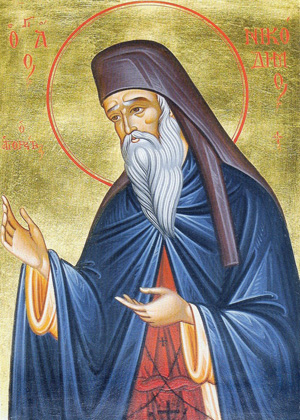
St. Nikodimos of the Holy Mountain
The only possible absolute guarantor of any true belief is God. True knowledge of God is only accessible by faith in him who is word (λόγος) and truth. God alone inspires true spiritual knowledge.

Such was certainly the understanding of many of the hesychastic fathers between the fourth and the fifteenth centuries, whose writings were compiled in the eighteenth-century into The Philokalia by St. Nikodimos of the Holy Mountain and St. Makarios of Corinth.[3] These fathers distinguish between two kinds of knowing. “According to patristic tradition, there is a rational or cataphatic knowledge of God, and an apophatic or ineffable knowledge.”[4]


___________________________________________
[3] The editors (G.E.H. Palmer, Philip Sherrard, and Kallistos Ware) of the English language Faber and Faber edition of The Philokalia ably synthesized the hesychastic understanding of knowledge in their Glossary, drawing from the writings of many fathers including St. Maximus the Confessor (in volume two) and St. Gregory Palamas (in volume four). The fourth post in this series will consider Maximus and the fifth post will consider Palamas. 

[4] Dumitru Staniloae. The Experience of God. Brookline: Holy Cross Orthodox Press, 1994. 95.

Sunday, June 2, 2013

1) "Faith is a True Knowledge"[1] - Introduction

Not only is it possible to know God, it is not possible to know without God. At least, without experience of God knowledge is not possible in the deepest and surest sense. There is more than one kind of knowing in patristic epistemology, and the next few posts will examine both kinds of knowledge. Ultimately, however, it is the experiential knowledge of God that matters most to our salvation. Our savior saves us by bringing us into union with himself. Our union with Christ is not contingent on knowing many things about him, but on following him in faith. Not only faith as an intellectual assent to authentic dogmatic propositions, but also faithfulness as a way of life, both of which are possible only by God’s grace, bring us into relationship with God, thus enabling us both to know him and to become one with him. As Fr. George Gallaro once said, “We might think that to know Jesus is to follow him… [but] it is the other way around, the more we follow Jesus, the more deeply we know him.”[2]

continue
______________________________________________________________________
[1] Maximus the Confessor. “Chapters on Knowledge.” Maximus Confessor: Selected Writings. New York: Paulist Press, 1985. 1:9; 130.

[2] Gallaro, George. “Sermon for the Feast of St. Mark.” Sermon. Byzantine Catholic Seminary of Ss. Cyril and Methodius, Pittsburgh. 25 April 2013.

Sunday, May 19, 2013

The Obligation to Pray

In 1890, the Synod of Lviv unsuccessfully attempted to obligate clerics - and only clerics - to pray the Divine Praises. Thus obliging some of the people of God (clergy), while not others, would violate the spirit of public liturgical prayer. As Fr. Robert Taft writes, “The burden of common prayer is incumbent on all.”[1] Liturgical prayer is communal by its very nature. The faithful – both lay and ordained – ought to live as vibrant and full a liturgical life as their lives reasonably allow. Daily celebration of the Divine Praises ought to be an act of, by, and for the whole community. The whole community is, in some sense,  "obliged." The Apostolic Constitutions instruct the bishop to “command and exhort” both clergy and laity to communal morning and evening prayer in the church every day: 
When you instruct the people, O bishop, command and exhort them to come constantly to church morning and evening every day, and by no means to forsake it on any account, but to assemble together continually.... For it is not only spoken concerning the priests, but let every one of the laity hearken to it as concerning himself. [2] 
Clericalizing the Divine Praises by obliging clerics and only clerics to pray them is imbalanced and contrary to the true spirit of liturgical prayer. Clergy are not properly thought of as those who pray in the place of or instead of the laity. This mentality weakens the communal and public celebration of the Divine Praises. Rather, the clergy are to lead the laity in prayer. 


An example of the clergy celebrating Vespers together with the laity 


Sunday, May 5, 2013

Praying for Mary

In the Divine Liturgy, just after the epiklesis, we offer to the Lord "spiritual worship for those who in faith have gone on before us to their rest: forefathers, fathers, patriarchs, prophets, apostles, preachers, evangelists, martyrs, confessors, ascetics and every just spirit made perfect in faith, especially for our most holy, most pure, most blessed and glorious Lady, the Theotokos and Ever-virgin Mary". 

Sometimes someone will object that we should not pray for the saints and especially not for the Theotokos. They are already with Christ, after all! We should pray to them, but surely we should not pray for them! They should pray for us!

Well, if we understand what actually occurs in the Liturgy, prayer for (περ) all the saints and especially for the Theotokos will not scandalize us. The Divine Liturgy, inasmuch as it participates in Christ, is the instrument of all salvation, even and especially that of his mother. Praying for the Theotokos, we still acknowledge that her salvation is already accomplished, but that is just the point – so is ours, in Christ, if we accept it as she has. This liturgical prayer, which the celebrant offers immediately after the epiklesis, is not bound by chronological time (χρόνος).


Sunday, April 28, 2013

Marriage and Holy Orders

St. Nonna, wife of the Bishop of Nazianzos,
St. Gregory the Elder,
and mother of St. Gregory the Theologian
As Church discipline developed, it increasingly prohibited the ordination of married men in both East and West. Initially, as in the case of Gregory the Theologian’s father, bishops were often married.* Eventually, both East and West forbade episcopal ordination of married men, as they do until this day.

Though East and West both esteemed virginity, the Latin Church grew more stringently to oppose the ordination of sexually active married men. Though the popes of Late Antiquity never forbade the ordination of married men, it is not surprising that their insistence on perpetual clerical continence soon evolved into required clerical celibacy for the Latin Church. The Eastern Church also recommended that married priests practice an ascesis of continence  - but temporary continence prior to the celebration of the Eucharist. Just as the Eucharistic fast from food was not expected to be perpetual, neither were married priests expected to practice sexual continence perpetually.

Neither approach strikes me as necessarily superior to the other. Rather, with Patriarch Photius (before 866), I regard each as legitimately distinct disciplines.** Discipline is subject to change and it is up to the Church in each age to respond effectively to the needs of her people and to demonstrate with her disciplinary decisions respect for both virginity and marriage, preferring neither.
_____________________________________________________
1 Tim 3:2; Peter Gilbert. “Introduction.” On God and Man: The Theological Poetry of St. Gregory Nazianzus. Trans. and Ed. Peter Gilbert. Crestwood: St. Vladimir’s Seminary Press, 2001, 23. 

** Peter L’Huillier. “The First Millenium.” Vested in Grace. Brookline: Holy Cross Orthodox Press, 2001. 34. 

Sunday, March 3, 2013

The Sacrifice of Praise

Worthy sacrifice, which is a loving “giving up”(Luke 22:19or “laying down” (John 15:13of self or a precious life or thing, is not necessarily traumatic, but brings about a unification that sometimes supersedes the pain of loss. With this said, the truly worthy sacrifice of Christ on the cross is traumatic. The traumatic event that “happens” in the Liturgy already happened there “once for all.” (Heb 10:10). The Liturgy, which is timeless, re-presents his traumatic sacrifice to us nontraumatically. In the Eucharist, our Lord gives up his broken body for us as he did at the mystical supper – without suffering again.

Thursday, February 28, 2013

The Demon Avarice


In our materialist era, it is worth considering John Cassian’s description of avarice in his treatise “On the Eight Vices.” (This treatise brought to the Latin West Evagrius' list of eight vicious thoughts and it is from this treatise that Gregory the Great would later develop the idea of the seven deadly sins). Cassian, whose feast would be tomorrow if this were a leap year, identifies the relationship between the destructive influence of demons and excessive worldly possessions. This vice, he teaches, is contrary to our true nature as creatures of God. It grows into an all-consuming passion, but we can overcome it.

Cassian does well to emphasize the role of the demonic in encouraging sinful passions. In this treatise, he begins his description of the struggle against each vice, except gluttony, the same way, as a “struggle against the demon.” In the case I am now considering, “our… struggle is against the demon of avarice.” By attributing evil thoughts instead to nature, the present age too quickly discounts the activity of evil spirits. Remembering that it is not from our selves that avaricious thoughts and desires come properly externalizes the enemy many all too readily internalize and consider to be only natural. Just as an abused child constantly told that he is useless and no good may begin to believe these lies about himself, so we become when we believe the lie told to us by demons that our sin is in our true nature.

We may have been “born this way” (Gaga), we may have been brought forth in iniquity and conceived in sin (Ps. 50/51:5), but it is not our true nature. There is a struggle within us. In that struggle, it is good and helpful to remember that we are not created sinful and avaricious, but holy and generous.

This vice is a sickness contrary to our true nature and thus needs healing. “It enters from the outside,” as Cassian writes, because it is concerned with possessions and the external things of this world. Cassian is careful not to “accuse nature of being the cause of sin.” The false belief that sin is our very nature leads to despair of the possibility of freedom from sin and the battle is lost before the fight begins.

Concerning avarice particularly, it is important to reference, as Cassian does, the scriptural description of the love of money as “the root of all evil” (1Tim 6:10). This image of the root is evocative. It is easy to pull up the roots of a very new and young plant. If the plant is allowed to grow, however, it roots grow deeper and stronger and soon it becomes difficult – eventually nearly impossible – to pull it up. It is the same way with the vice of avarice. One begins by setting aside perhaps more than they need to. Another begins by reducing, just a small amount, but for no good reason, the offering they put in the collection each Sunday. Habits contrary to a generous attitude begin to wear on the individuals that practice them. Soon, they are giving nothing and hoarding all. Instead of supporting the poor and hungry, perhaps they purchase a luxurious automobile. They convince themselves that they deserve to have fine things, even while their neighbors go without necessities. At this point, the roots of avarice are deep and strong.

The vice of avarice presents a particular problem for those of us who are living in the world rather than the monastery. Cassian writes of overcoming avarice, “This uprooting is difficult to achieve unless we are living in a monastery.” Monks, to whom Cassian primarily addresses his treatise, live in such a way that the daily necessities of life do not need to occupy so much of their attention. Those who have families to provide for or others that depend on them are unable to avoid some contact with money. Nonetheless, it is important that they do not love this money or make an idol of it. Some of what Cassian says about a monk applies also to those who are in the world. For example, “raging fury when he happens to sustain a loss,” or “gloom and dejection when he falls short of the gain he hoped for” reveals sinful and idolatrous passion in a layman as much as in a monk. Even those who have not renounced the world entirely should not have a “fear of poverty.” Such fear “comes from lack of faith.” The Lord calls all alike to trust in Him. Not only monks, but also each of us, must live in faith.

Cassian’s remedy to the vice of avarice of utterly renouncing the world and all possessions is a good one, but it is not a virtuous option for those who already have responsibilities for the welfare of others in the world. Consequently, I will conclude with some of his suggestions for healing vices generally. For example, against dejection he recommends “prayer, hope in God, [and] meditation on Holy Scripture.”  These remedies are efficacious not only against dejection, but also against the love of money. Rather than hoping in money to provide for our needs, we should hope in God and look to Scripture to teach us its proper use.

Most Popular Posts this Month

Most Popular Posts of All Time