Showing posts with label Apocalypse. Show all posts

Sunday, September 15, 2019

Experience the Apocalypse

“Amen,” Jesus says, “there are some standing here who will not taste death before they see the kingdom of God come in power” (Mark 9:1).  
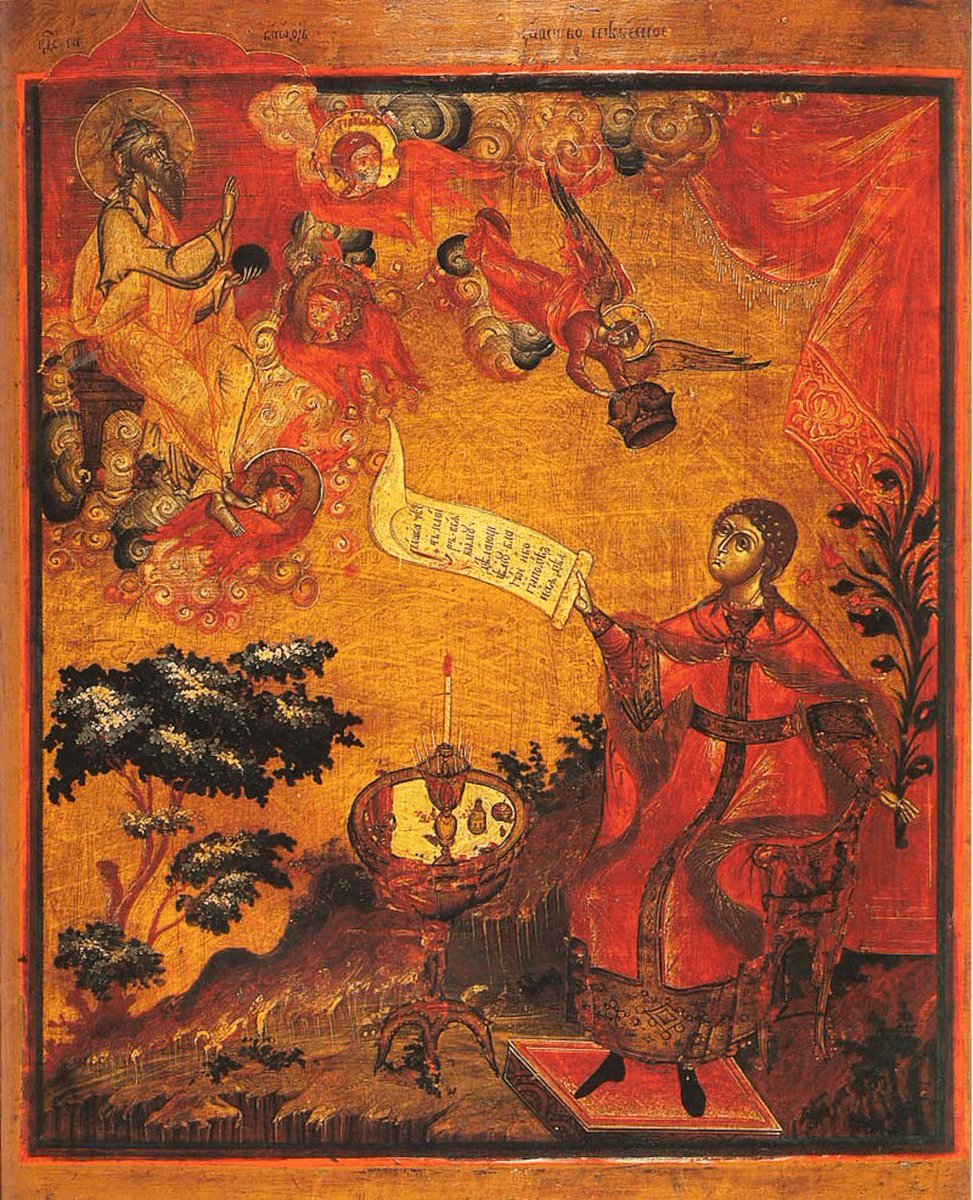
Icon of the Kingdom of Heaven
19th century Russian
State Museum of the History of Religion, St. Petersburg

What can this mean? This verse baffled me for years. How could it be, I thought, that people living at the time of Jesus have not yet tasted death? Surely all of them died by now.

If we read this without faith, it could read like an embarrassingly mistaken prediction of the time of the second coming – rather like all those doomsday dates that regularly get rolled out by various apocalyptic and fundamentalist groups - especially, I think, in this country.

The next date coming from Dr. F. Kenton Beshore is 2021. So, get ready, I guess. His previous prediction was 1988, but that embarrassment has not dissuaded him from making another prediction. I'll not go into his calculations.

The Lord is coming we know not when. Yet various Christians throughout the ages have made predictions as to what that date will be. Even some saints have gotten in on the act and made some predictions that turned out other than they expected.

But unlike all this merely human guesswork, surely the Lord Jesus Christ knows what he is talking about. And Jesus says to those standing with him almost 2,000 years ago that some of them will not taste death before they see the kingdom of God come in power. We know that everyone who was there all those years ago has by now tasted death. And we know that Jesus Christ, who is Truth himself, is not making an error here. He does not make errors. This leaves only one other possibility, that some who were standing there with Jesus did indeed see the kingdom of God come in power.

The Blessed Theophylact makes bold to name those Jesus means when he says "some standing here" and also to name the moment when they see the coming of the kingdom of God. He writes, 
Namely, Peter, James, and John, shall not die until [they see] at the Transfiguration the glory with which [Jesus] shall appear at the second coming. For the Transfiguration was nothing else than a foreshadowing of the second coming, and as he appeared shining then, so will he shine at the second coming, as will also all the righteous. 
To see the light of Jesus Christ on Mount Tabor is to see the coming kingdom of God as already come.

The Venerable Bede sees the coming kingdom of God also in another place. He writes, 
The present Church is called the kingdom of God, and some of the disciples were to live in the body until they should see the Church built up, and raised against the glory of the world.
If we can see the Church for what it really is, not obscured by the sin and corruption into which its worldly aspect has sunk, we would see it as the bride of Christ – one body with her bridegroom, who is the king of heaven and of earth.

To look upon Jesus on Mount Tabor and see in him the light of his Transfiguration; to look upon the Church and see in her the body of Christ; today, to look upon the cross and see there the king of glory enthroned  upon the cherubim; to see any of this, it is necessary to have eyes that see.

It's not a question of whether or not the Lord Jesus was right about the timing of the coming of the kingdom of God. It's a question of whether or not we have the eyes to see the truth that's all around us. It's a question of whether or not we have faith, which is the only way to know what's really going on. It's a question whether or not we have experienced the apocalypse.

We've forgotten what does the word apocalypse means. It doesn't mean the coming cataclysmic events surrounding the end of the world, at least not originally. The word apocalypse means "revelation" or, even more literally, an "unveiling." Some of you may remember a time when the Book of Revelation was commonly known as the Apocalypse of John. Apocalypse means Revelation. God revealing himself to us here and now.

Because he is here now. If we do not see him, it is not because he is not here, but because there remains a veil over our eyes, waiting to be lifted by his grace with the assent of our faith.

Today, we know from Jesus that there are some who have already seen the coming of the kingdom of God. So, why can't we see it? To that I say, who says we can't?

This is what this whole Byzantine Catholic way of life we’re trying to follow is meant to accomplish: the experience of God. This tradition is not a list of intellectual propositions to which we assent nor a series of rote behaviors we perform out of obligation or habit. It is tradition, not traditionalism, we have on offer here. “Tradition is the living faith of the dead; traditionalism is the dead faith of the living,” as Jaroslav Pelikan writes.

Our tradition passes on to us a bright and lively, warm and living experience of God. It opens our eyes to see the kingdom of God come in power. All this unceasing prayer and fasting, liturgy and sacrament, reading of scripture and the fathers is meant to unveil our eyes; to open our eyes to the light of Mount Tabor shining in all creation; to help us see the truth that God is with us and that his coming kingdom has come among us.

“The kingdom of God is not coming with signs to be observed. They will not say, “behold, here it is!” or “there it is!” for behold, the kingdom of God is within you” (Luke 17:21).

Tuesday, November 20, 2018

Where the Body is

Jesus leaves us today with a discomforting and obscure image: “where the body is, there also the vultures will gather.”[1] …

I think here of corpses in the desert, dead from dehydration and become carrion for scavengers.

And this is Jesus’ answer to his disciples’ question, “Where, Lord?”[2]  … “where the body is, there will be vultures.”

Jesus had just been telling them about something called “the Day of the Son of Man”[3] or sometimes “the apocalypse.”[4] At this time, Jesus says, “Two will be in a bed[5] – one will be taken, the other left.[6] Two will be grinding grain[7] – one will be taken, the other left.”[8] So the disciples’ question might mean, “Where will the saved[9] be taken?” or, “Where will the condemned be left?” And Jesus strikes back with this difficult expression: “where the body is, there the vultures will also gather.”

Jesus often says things difficult for us to understand. Maybe the meaning of this expression is clear to you, but it was not to me. I can certainly relate to Jesus’ foolish and tedious disciples who so often exasperate him with their incomprehension.

So, I studied the question and soon discovered many ways of understanding these words of our Lord.

Many think this is an idiom, rather similar in meaning to our expression, “Where there’s smoke, there’s fire.” -“Where there’s corpses, there’s vultures.” In other words, Jesus may be saying, “You’ll know the day has come when you see it.”… “Keep watch, for you know not the day nor the hour that that Son of Man is coming,” as he says in Matthew.[10] This stands as a caution to us not to follow after those who claim to have cracked the bible code or unlocked the date of doomsday.[11] When the Lord comes back, we’ll know – it will not be any secret knowledge.[12]

But in a most important way, Jesus is already with us. He is God with us – Emmanuel – right here and right now. He is coming, but he is already come. We particularly remember his becoming present among us during the current season of the Nativity fast. Yesterday, we read that the Kingdom of God is already among us and within us.[13]

In the Divine Liturgy – which is outside of time, which takes place at once in heaven and on earth – after the words of institution, we “remember… all that has come to pass in our behalf,” including “the second coming in glory.” The “second coming” has already “come to pass” for us from the eternal kairotic perspective of the Divine Liturgy.

In light of this reality, Ambrose offers a different understanding of this body surrounded by vultures.

First of all, “vultures” may or may not be the best translation. It works for the idiomatic understanding I mentioned before, but the Greek word here is usually translated “eagles.” This expression is the only instance in which it is rendered “vultures,” because many suppose that works better in the context.

In scripture, however, an eagle is a far nobler creature than a vulture. Eagles do not eat the dead. Because they live so long, eagles are associated with youthful and vigorous souls.[14] Isaiah prophesies, “They who wait for the Lord shall renew their strength, they shall mount up with wings like eagles.”[15] Those like eagles, then, are those who believe and hope in the Lord.

With this understanding then, the Lord’s words could have another meaning. "Where the body is, there the eagles will be gathered together."[16]

Ambrose is quick to see this body as the body of Christ. The eagles, then, are first of all those of Christ’s disciples that stayed with him to the end – Mary, Mary, Mary, and John.[17] These are the eagles gathered together around the body of the Lord on the day of the Son of Man. … Christ’s death on the cross is the consummation[18] of his loving sacrifice for us and for our salvation. The day of that sacrifice is the day of Lord in which his victory over death is accomplished[19] once and for all.[20]

“Where Lord?” we ask. “On the cross, and nowhere else” he answers. That is the place where the saved are saved and the damned are damned. In his body. On the cross.

Secondly, Ambrose writes, “Jesus says this concerning this body [surrounded by eagles]: ‘For my flesh is food indeed, and my blood is drink indeed.’”[21] The body is the one body of the Lord re-presented to you and me. If we approach him with the fear of God and with faith[22] – discerning this body[23] – it is the place of our salvation. Here, he shall forgive our iniquities, heal our diseases, redeem our lives from the Pit, crown us with love and mercy, and renew our youth like the eagles’.[24]

“Where, Lord?” we ask. “Here, in this holy place, from this holy table,” he answers us today.


[1] Luke 17:37 NAB
[2] Luke 17:37
[3] Luke 17:22, 24, 30
[4] cf. Luke 17:30
[5] the wealthy (Cyril of Alexandria)
[6] Luke 17:34
[7] the poor (Cyril of Alexandria)
[8] Luke 17:35
[9] the virtuous and good (Cyril of Alexandria) – the faithful (Ambrose)
[10] Matt 25:13
[11] cf. Luke 17:23
[12] gnosis
[13] Luke 17:21
[14] Ps. 102:5; Is 40:31
[15] Is 40:31
[16] Luke 17:37 RSV
[17] John 19:25-26
[18] consummatum est
[19] τετέλεσται
[20] Rom 6:10
[21] John 6:55
[22] Liturgikon, 91
[23] 1 Cor 11:29
[24] Ps 103:3-5

Most Popular Posts this Month

Most Popular Posts of All Time