Showing posts with label Hypocrisy. Show all posts

Sunday, September 2, 2018

Practice the Preaching

A Pharisee – a lawyer – asks Jesus to tell him the greatest commandment.

This is meant as a test or – the word also means – a temptation. Little does the Pharisee know that he is testing the Lord his God. Jesus is Lord. And, by testing him, the lawyer is breaking the law in ignorance: “You shall not test the Lord your God,” it says in the law,[i] but that is not the greatest commandment. And so Jesus does not point this out, as he did to the devil in the desert, who also tested him.[ii]

Jesus is patient with these Pharisees. This is the fourth and final time they test him in the gospel of Matthew. He answers their questions. The questions are good, even if the motive behind them is not. Jesus tells us later to “practice and observe whatever [the Pharisees] tell [us], but not what they do; for they preach, but do not practice.”[iii] (This distinction is also worth remembering in our own day about some who preach Christ.) It is for their hypocrisy and not for their teachings that Jesus denounces the Pharisees.

A rabbi once came to our seminary in Pittsburgh to give a presentation. During the Q and A, a member of the staff asked the rabbi what he thought of Jesus. And the rabbi shocked all by saying, “Jesus was a Pharisee.”

We are so used to hearing the name of Pharisee associated with all that is evil that this idea could sound blasphemous. If you look up the word ‘pharisaic” in the dictionary, it says “hypocritically pious.” And Jesus is most certainly not this, but that isn’t what the rabbi meant.

The rabbi meant that if you study first-century Judaism and compare the teachings of Jesus with the teachings of the various Jewish factions, you will find that Jesus agrees more with the Pharisees than with the other groups.

For example, Jesus accepts the prophets as well as the law as from God – so do the Pharisees, unlike the Sadducees, who hold that only the law – that is, the Torah, the Pentateuch, the first five books of the Bible – Genesis, Exodus, Leviticus, Numbers, and Deuteronomy – only these books and no others – are scripture inspired by God and binding upon the people of God. So dispute about the canon is nothing new. In our day, we have Protestants denying the inspiration of certain books of Scripture. In Jesus’ day, it was the same – though of course about different books.

And Jesus teaches the coming resurrection of the dead – so do the Pharisees, unlike the Sadducees, “who say there is no resurrection,”[iv] because it is not as clearly and directly described in the Torah as it is in the prophets and later writings – though Jesus does point out that even a proper understanding of Torah reveals the resurrection.[v]

And finally, Jesus knows which is the greatest commandment of the law – so do the Pharisees. They agree about this. The lawyer is asking Jesus a question to which he already knows the answer – an old lawyerly trick.

The greatest commandment is “you shall love the Lord your God with all your heart, and with all your soul, and with all your mind.”[vi] The Pharisees know this - because this, my dear brothers and sisters in Christ, is the Shema, the principal words of the law, found in Deuteronomy:

"Hear, O Israel: The LORD our God is one LORD; and you shall love the LORD your God with all your heart, and with all your soul, and with all your might. And these words which I command you this day shall be upon your heart, and you shall teach them diligently to your children, and shall talk of them when you sit in your house, and when you walk by the way, and when you lie down, and when you rise. And you shall bind them as a sign upon your hand, and they shall be as frontlets between your eyes. And you shall write them on the doorposts of your house and on your gates.”[vii]

These words from Deuteronomy are among those contained in the Pharisees’ phylacteries. A phylactery is a little leather box containing a scroll with these words – the Shema. They literally bind these to their foreheads and to their arms when they pray. You may remember how Jesus later criticizes how the Pharisees make their phylacteries broad, so as to be seen by men,[viii] rather than so as to always remember this greatest commandment, which is their true purpose. 

So this commandment is certainly not new to the Pharisees. They have heard it and prayed it daily since they were children. Jesus did not fail the Pharisees’ test. He knows the answer as well as them.

But he doesn’t stop there with the rote answer. Rather, he reveals something more about how it must be lived. He draws a correspondence between this great commandment and a second commandment, from Leviticus. “A second is like it,” he says. And that is, “You shall love your neighbor as yourself.” Some had noticed before that there is a verbal correspondence between these two commandments that joins them: each begins “you shall love.…”  Of course, they have more in common than that. Jesus is making a very striking point about these two commandments. Loving our neighbors is like loving God because God has made humans like God. In his image and likeness he has made us.

Sometimes, during the Divine Liturgy, the reality of God’s presence in us becomes strikingly apparent. For one example, there are prayers prescribed for the priest and deacon to say quietly before the holy doors before the beginning of the Divine Liturgy. At a certain point, the rubrics say that the priest and the deacon are to bow to the faithful. While they bow, they are praying part of Psalm 5: “I will bow down before your holy temple in awe.” 

Notice this. The rubric says to bow to the people, and the text says we are bowing to the temple. I don’t think that’s a coincidence. As Paul writes to the Corinthians, “Do you not know that you are God's temple and that God's Spirit dwells in you?”[ix] Therefore, how can we love God if we do not love one another - when God dwells in our neighbors?

For another example, at the beginning of the Divine Liturgy, the deacon censes all the icons of the church. Toward the end of this great incensation, he censes the people. It has occurred to me that this is not something separate from the incensation of the icons. Rather, it continues the incensation of the icons, because you all are also icons of God. An icon is an image, and God has made you in his image.

The image of God in us is indestructible. No sin can destroy it. It is who we are in our very being. We are in his image, but we are after his likeness. Some have suggested that we lose our likeness to God through our sin. But Jesus restores our likeness. In him, we can again become like God. Because he has identified himself with us. He, who is the Lord, has become man.

Jesus reveals this when he teaches the Pharisees something more about the Messiah – about himself – by interpreting David’s Psalm messianically. The Messiah is the one who sits at the right hand of the Lord, and Christ points out that the one who sits at the right of the Lord is also the Lord: “The Lord says to my Lord, sit at my right hand.” So he who is truly our Lord and God has become the messiah of Jews and the savior of all humanity.

Though it was always true, now in Christ it is fully revealed, that we must love our neighbor if we are to love God, because, in Christ, God is become our neighbor. Many of the Pharisees were failing to love their neighbors, neglecting “justice and mercy and faith”[x] and so, Jesus reveals, they were not really loving God after all. So let us follow the teaching of the Pharisees to love God with all our hearts, all our souls, and all our minds, but let us not fail as they fail to love our neighbors as ourselves. “Let us be doers of the word and not hearers only.”[xi]


[i] Deut 6:16; cf. Matt 4:7; Luke 4:12
[ii] Matt 4:1,7
[iii] Matt 23:3
[iv] Matt 22:23
[v] Matt 22:31-32
[vi] Deut 6:5; Matt 22:37
[vii] Deut 6:4-9
[viii] Matt 23:5
[ix] 1 Cor 3:16
[x] Matt 23:23
[xi] James 1:22

Sunday, August 26, 2018

An Invitation with Teeth

On Matthew 22:1-14

You know, for a wedding story, this parable is rather violent. Now, some of the guests invited to the wedding feast simply make light of it and – excusing themselves by this or that trifle – do not come. Others, however, shamefully seize and abuse and kill the servants whom the king sent bearing the glad news and invitation. Understandably outraged at this, the king sends in his troops. But they not only kill those heartless murderers, but also burn their entire city.

Having no guests left and finding his first-invited guests unworthy, the king invites in a multitude from the streets. This is where we come in, I expect. But the violence does not end here – for both the good and the bad now sit together at the feast – and the king makes sure the bad do not go unpunished.

He sees among the guests a man who has on no wedding garment and asks him how he got in so inappropriately dressed. The man says nothing. He is speechless. He has no defense. Some sources even say that the wedding garments would have been provided by the king in a situation like this. So what’s really going on here, once again, is refusal of the king’s hospitality.

So the king has him bound hand and foot and cast into the outer darkness where there is weeping and gnashing of teeth.

What is the meaning of all this violence? What kind of party is this? What party comes with such stakes? This is rather like getting a wedding invitation – but in fine print at the bottom is written, “come and celebrate with us or die.” It becomes rather clear that we are not talking here about the usual kind of wedding party. We might not want to be invited to a wedding like this – it sounds rather dangerous – but, like it or not, we are invited.

It is a free invitation to celebrate, but it’s an invitation you’d better accept. It’s an invitation with teeth. It is an occasion of great joy, but it is deadly serious. Those unwilling to partake joyfully will have hell to pay. Because this wedding feast, as Jesus says at the outset, is like the kingdom of heaven. The wedding garments we are to put on as we enter this feast are like those we put on at baptism and at the second baptism of holy repentance. That is, they are Christ himself, for all those who have been baptized into Christ have been clothed with Christ. To be thrown out of this wedding hall is to be thrown out the gates of heaven.  

But, you know, this party isn’t just exactly like heaven either. For one thing, it’s a party to which both the good and the bad have come. I’ve been to a few parties like that.… In fact, we’re at a party like that right now, if you think about it. This church – this Eucharistic celebration, is like a party to which both the good and the bad alike are invited. The sinners and the saints sit together in the pews…. For that matter, they’re usually sitting together in the same seat. If you’re wondering whether you’re a sinner or a saint, remember: you can be both. This struggle between the good and the bad happens mostly on the inside.

This parable reminds me of a passage in C.S. Lewis’ novel The Screwtape Letters, which I highly recommend. It’s framed as a series of letters from a senior demon named Screwtape to a junior demon – his nephew Wormwood – with advice on the best way to tempt a soul to keep him out of heaven and secure his place in hell. The demons sardonically call their victims “patients.”

Well, Wormwood gets in trouble one day when his “patient” converts to Christianity. Screwtape is mightily displeased. But, he assures his nephew, their hope of damning the poor soul to hell is not yet lost. “One of our great allies at present,” says Screwtape, “is the Church itself.”

You see, Screwtape is well aware of what Jesus is saying in today’s gospel: both good and bad guests fill the wedding hall – and the devils can use the bad ones to help corrupt the good. The Church in this world is a mixed bag. Don’t we know it.

Screwtape points out that the new Christian will get to his pew, look around himself and see just those neighbors “whom he has hitherto avoided.” You’ll want to “lean pretty heavily on those neighbors,” he advises Wormwood “It matters very little, of course, what kind of people that next pew really contains,” writes Screwtape. “Provided that any of those neighbors sing out of tune, or have boots that squeak, or double chins, or odd clothes, the patient will quite easily believe that their religion must therefore be somehow ridiculous... Never let him ask what he expected them to look like….”

It may be, of course, that “the people in the next pew” are actually good and holy people. Of course, if they’re not, writes Screwtape “– if the patient knows that the woman with the absurd hat is a fanatical bridge player or the man with squeaky boots is a miser and an extortioner – then your task is so much the easier.”

You see, the demons will use our sins not only to drag us down but also to drag others down with us if they can. Our neighbors see our sins and our hypocrisy and it sometimes convinces them that the Church itself is hypocritical or ridiculous or even evil. Of course, I’m reminded of that old retort to the common complaint that there are too many hypocrites in church: “Don’t worry, there’s always room for one more.”

So, let us not judge others. Let us look instead to our own sins.

That’s the point, I think. All are invited and welcome to the feast, regardless of their sinfulness. But those who accept the invitation have a serious duty. This love feast is not a free-for-all, come-one, come-all, do-as-you-please, orgiastic bacchanalia, no matter how it has been treated by members of the Church at all levels. This is a wedding feast – a celebration of commitment, fidelity, fruitfulness, life, and love. A wedding is where two become one, and at this wedding, we the Church become one with Christ our Lord. Those unprepared to celebrate these things – those unwilling to put on the wedding garment freely offered by our king – cannot remain in the kingdom of heaven. We are now before the gates of the kingdom of heaven and our king is inviting us in. His invitation is this: Repent and know the joy only Christ can bring.


This is a reworking of a sermon I preached two years ago: Celebrate or Die

Sunday, November 15, 2015

Who is my neighbor


There’s an infamous story about Kitty Genovese who, in 1964, was knifed in her neighborhood in Queens. She screamed for help. And more than a dozen heard her cries. Yet no one did anything to help or to intervene. Reports have often exaggerated the details of this event, but the fact remains that at least one witness knew she was stabbed and yet did nothing. Not until she was attacked yet again by the same man did someone else call the police. And by then it was too late.

You see, Jesus’ parable today is not so far-fetched. People really act this way sometimes. The priest and the Levite witness the suffering of a fellow man and yet do nothing to intervene. This happens in incidents that grab headlines and it happens in our daily lives.

I hope not many of us have had to witness such atrocities. Those of us who have, I hope, have done something to intervene. But for all of us, it isn’t difficult to find human suffering. Even if our suffering is not so great, we all do suffer and we all, daily, encounter the suffering of others. If we read the news, it will mostly be about suffering. The news from Paris this week tells of great suffering. May God be with them and defend us all. At work, we may witness spiteful and petty cruelties between coworkers. In our families, we may deal with illnesses and addictions. Downtown and in our neighborhood, we may encounter homelessness and addiction.

In my experience, everywhere we go, we see suffering. And wherever we recognize the suffering of another, we may take that recognition, I believe, as a calling from God to be an instrument of God’s healing and help. To be a neighbor.

What we should do in each given situation requires discernment, but we can trust that God has put us in the situation for his purposes. Each and every time. There is nothing random or arbitrary about the situations we find ourselves in, though it may seem that way. In truth, God has put us there. And it’s not to bring harm or callousness, but to bring healing and compassion. If you are witnessing human suffering, God is calling upon you to be a neighbor to the one who suffers.

The lawyer, desiring to justify himself, asks Jesus, “Who is my neighbor?” The witness of Kitty Genovese’s attack must have had the same question. He must have thought, "oh she is someone else’s neighbor. Someone else’s problem. Not mine. It’s nothing to do with me. Leave me out of it." When in fact, each witness is given an opportunity by God – not by random chance or accident (which does not exist) but by God, who personally knows and loves every victim, every witness, and every sinner. 

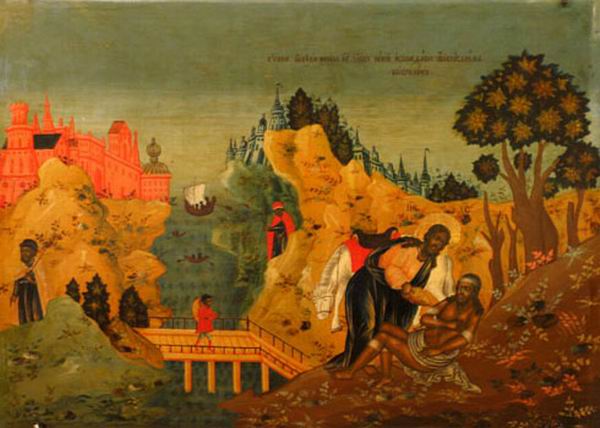
Russian Icon of the Good Samaritan
XVIII c.
When the man is stripped and beaten by robbers, God sends him a priest. God calls upon this priest to intervene for good, to help, to show mercy, to be a priest. To the priest, God gives the first opportunity to act as God’s instrument of healing. But the priest passes him by on the other side. He passes by the robbed and beaten man – and he passes by the calling of God in that moment – and he passes by the image of God lying in the dirt. So when the priest fails to do his will, God sends a Levite. And when the Levite fails, God sends a Samaritan, who acts in every way as an image of Christ to the robbed and beaten victim.

Now Samaritans and Jews would ordinarily have nothing to do with one another – they were enemies – but this Samaritan gives no consideration to that. He sees past that tribal acrimony to his common humanity with this bruised and battered Jew from Jerusalem he finds lying in the road.

Our common humanity has its grounding both in the earth we’re made out of and in the breath of life – the ruach – the spirit that God breathes into our nostrils. We are all of us earth with God breathed in – and no human divisions can surmount that common identity.

Our neighbors are not only those with whom we have certain kinds of kinship. Not only our family members and friends. Not only our coreligionists. If we were to assist only those who share our faith, we would thereby prove the enemies and critics of faith correct. They say that faithful religious people are the cause conflict and violence. This becomes true if we fail to live our faith truly.

Neighborliness is not due only to the groups in which we find ourselves. Not only to the born, the young, the healthy, and the free but also to the unborn, the elderly, the sick, the imprisoned and enslaved. Not only to Americans, but also to the French and to Syrians and Iraqis and all the people of all the nations of the world. Not only to Christians, but also to Muslims and Jews and Pagans and atheists. Not only to the moral, the innocent, and the orthodox, but also to the immoral, the guilty, and the heretical. Also to sinners. Sinners and hypocrites like us.

How often, desiring to justify ourselves, we say, “Well maybe I’m not perfect, but at least I’m not like so and so. At least I don’t want to do this or that evil. Ugh, how can a person even be tempted by that sin? I’m so far above that.”  Believe me, our own sins are no better. St. Mark the Ascetic writes that “the devil makes small sins seem smaller in our eyes, for otherwise he can’t lead us to greater evil.”[i] The very fact that our own sins look so innocent to us reveals the depth of our depravity.  How much we stand in need of the cross and of the Lord’s forgiveness and his great mercy, available to us all in the holy mystery of repentance.   

We enter today into the Philip’s Fast, which is a season of repentance. This is an especially good time of year for us to identify with all the other sinners in the world, to stop thinking ourselves better than others, to repent, to confess our own sins rather than listing the sins of others, to fast and to give to the poor, to pray for peace on earth, to be a neighbor to all.

So be a neighbor to all people, not because all people are equally right, or because there any truth the relativistic nonsense that “your truth is true for you but not for me,” but because being right is never a person’s deepest identity. Our deepest identity is that which God creates in us – his own image. Therefore, we must never allow our differences with other people – even when they’re in the wrong – to justify any hatred or indifference toward them.

In today’s epistle to the Ephesians, Paul writes, “There is… one Lord, one faith, one baptism, there is one God who is father of all, who is above all, and through all, and in all” (Eph 4:5-6). That is our relationship with all others. Always bear this in mind. It makes us neighbors of all people, even our enemies. For all people are called by the one God to the true faith and to baptism, never to death and destruction. As St. Gregory the Theologian writes and as we sing each Pascha, "Let us call brethren even those who hate us."


[i] “On the Spiritual Law: Two Hundred Texts” No. 94,

Sunday, September 6, 2015

You shall love


Today a Pharisee – a lawyer – asks Jesus to tell him the greatest commandment.

This is meant as a test or – the word also means – a temptation. Little does the Pharisee know that he is testing the Lord his God. Jesus is Lord. And, by testing him, the lawyer is breaking the law in ignorance: “You shall not test the Lord your God,” it says in the law, (Deut 6:16; cf. Matt 4:7; Luke 4:12) but that is not the greatest commandment. And so Jesus does not point this out, as he did to the devil in the desert, who also tested him (Matt 4:1,7).

Jesus is patient with these Pharisees. This is the fourth and final time they test him in the gospel of Matthew. He answers their questions. The questions are good, even if the motive behind them is not. Jesus tells us later to “practice and observe whatever [the Pharisees] tell [us], but not what they do; for they preach, but do not practice” (Matt 23:3). It is for this hypocrisy and not for their teachings that Jesus denounces the Pharisees.

A rabbi once came to our seminary in Pittsburgh to give a presentation. During the Q and A, a member of the staff asked the rabbi what he thought of Jesus. And the rabbi shocked all by saying, “Jesus was a Pharisee.”

We are so used to hearing the name of Pharisee associated with various evils that this idea could sound blasphemous. If you look up the word ‘pharisaic” in the dictionary, it says “hypocritically pious.” And Jesus is most certainly not this, but that isn’t what the rabbi meant.

The rabbi meant that if you study first century Judaism and compare the teachings of Jesus with the teachings of the various Jewish factions, you will find that Jesus agrees more with the Pharisees than with the other groups.

For example, Jesus accepts the prophets as from God – so do the Pharisees, unlike the Sadducees, who hold that only the law – that is, the Torah, the Pentateuch, the first five books of the bible – Genesis, Exodus, Leviticus, Numbers, and Deuteronomy – only these books and no others – are scripture inspired by God and binding upon the people of God. 

So dispute about the canon is nothing new. In our day, we have Protestants rejecting certain books of the Bible – the deuterocanon, which they call the apocrypha. In Jesus’ day there was also dispute – though of course about different books.

And Jesus agrees with the Pharisees about what was inspired by God. In today’s Gospel, Jesus says that David is inspired by the Spirit in composing Psalm 109. I suppose the Sadducees would have disagreed because the Psalms are not a part of Torah. Jesus, however, agrees with the Pharisees, who clearly recognize the inspired authority of the Psalm and therefore have no argument against Jesus’ revelation regarding it – that the Messiah is more than merely a Son of David, but also the Lord. Being the Lord, Jesus knows best what the Lord inspires.

And Jesus teaches the coming resurrection of the dead – so do the Pharisees, unlike the Sadducees, “who say there is no resurrection,”(Matt 22:23) because it is not as clearly and directly described in the Torah as it is in the prophets and later writings. However, Jesus points out that a proper understanding of Torah does reveal the resurrection (Matt 22:31-32).

And finally, Jesus knows which is the greatest commandment of the law – so do the Pharisees. They agree about this. The lawyer is asking Jesus a question to which he already knows the answer – an old lawyerly trick.

The greatest commandment is “you shall love the Lord your God with all your heart, and with all your soul, and with all your mind”(Matt 22:37; cf. Deut 6:5). The Pharisees know this, because this, my dear brothers and sisters in Christ, is the Shema, the principal words of the law, found in Deuteronomy:
"Hear, O Israel: The LORD our God is one LORD; and you shall love the LORD your God with all your heart, and with all your soul, and with all your might. And these words which I command you this day shall be upon your heart; and you shall teach them diligently to your children, and shall talk of them when you sit in your house, and when you walk by the way, and when you lie down, and when you rise. And you shall bind them as a sign upon your hand, and they shall be as frontlets between your eyes. And you shall write them on the doorposts of your house and on your gates”(Deut 6:4-9).
These words from Deuteronomy are among those contained in the Pharisees’ phylacteries. A phylactery is a little leather box containing a scroll with these words – the shema. They literally bind these to their foreheads and to their arms when they pray. You may remember how Jesus later criticizes how the Pharisees make their phylacteries broad, so as to be seen by men, (Matt 23:5) rather than so as to always remember this greatest commandment, which is their true purpose. 

So this commandment is certainly not new to the Pharisees. They have heard it and prayed it daily since they were children. Jesus did not fail the Pharisees’ test. He knows the answer as well as them.

But he doesn’t stop there with the rote answer. Rather, he reveals something more about how it must be lived. He draws a correspondence between this great commandment and a second commandment, from Leviticus. “A second is like it,” he says. And that is, “You shall love your neighbor as yourself.” Some had noticed before that there is a verbal correspondence between these two commandments that joins them: each begins “you shall love.…”  Of course, they have more in common than that. Jesus is making a very striking point about these two commandments. Loving our neighbors is like loving God because God has made our neighbors like God. In his image and likeness he has made us.

Sometimes, during the Divine Liturgy, the reality of God’s presence in us becomes strikingly apparent. For one example, there are prayers prescribed for the priest and deacon to say quietly before the holy doors before the beginning of the Divine Liturgy. At a certain point, the rubrics say that the priest and the deacon are to bow to the faithful. While they bow, they are praying part of psalm 5: “I will bow down before your holy temple in awe.” Notice this. The rubric says to bow to the people, and the text says we are bowing to the temple. I don’t think that’s a coincidence. As Paul writes to the Corinthians, “Do you not know that you are God's temple and that God's Spirit dwells in you?”(1 Cor 3:16). Therefore, how can we love God if we do not love one another, when God dwells in our neighbors?

For another example, at the beginning of the Divine Liturgy, I cense all the icons of the church. Toward the end of this great incensation, I cense the people. It has occurred to me that this is not something separate from the incensation of the icons. Rather, I am continuing to cense the icons, because you all are icons of God. An icon is an image, and God has made you in his image.

The image of God in us is indestructible. No sin can destroy it. It is who we are in our very being. We are in his image, but we are in pursuit of his likeness. Some have suggested that we have lost our likeness to God through our sin. But Jesus restores our likeness. In him, we can again become like God. Because he has identified himself with us. He, who is the Lord, has become man.

Jesus reveals this when he teaches the Pharisees something more about the Messiah – about himself – by interpreting David’s Psalm messianically. The messiah is the one who sits at the right hand of the Lord, and Christ points out that the one who sits at the right of the Lord is also the Lord: “The Lord says to my Lord, sit at my right hand.” So he who is truly our Lord and God has become the messiah of Jews and the savior of all humanity.

Though it was always true, now in Christ it is fully revealed, that we must love our neighbor if we are to love God, because in Christ, God is become our neighbor. Many of the Pharisees were failing to love their neighbors, neglecting “justice and mercy and faith”(Matt 23:23) and so, Jesus reveals, they were not really loving God after all. So let us follow the teaching of the Pharisees to love God with all our hearts, all our souls, and all our minds, but let us not fail as they fail to love our neighbors as ourselves. “Let us be doers of the word and not hearers only”(James 1:22).

Most Popular Posts this Month

Most Popular Posts of All Time