Showing posts with label Second Coming. Show all posts

Sunday, September 15, 2019

Experience the Apocalypse

“Amen,” Jesus says, “there are some standing here who will not taste death before they see the kingdom of God come in power” (Mark 9:1).  
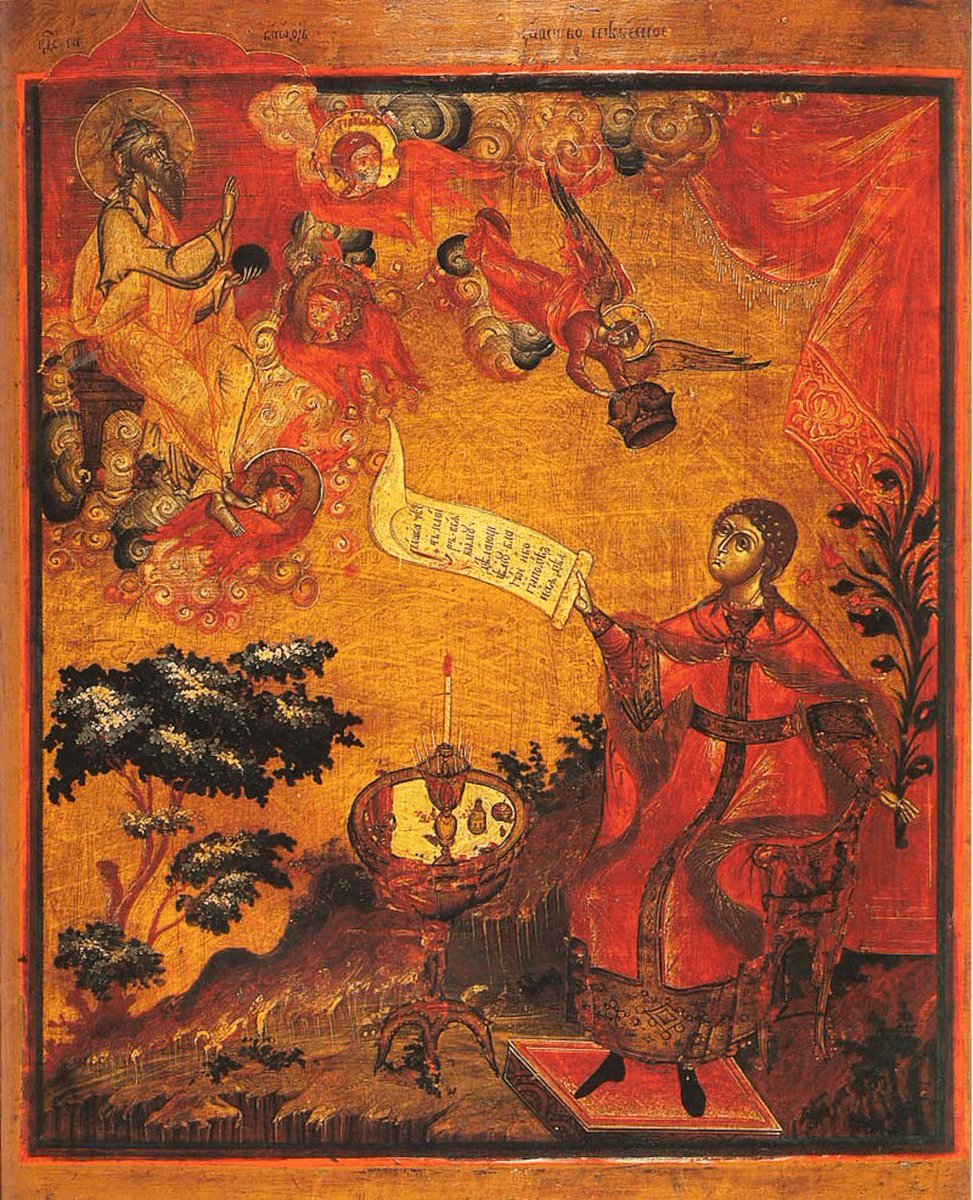
Icon of the Kingdom of Heaven
19th century Russian
State Museum of the History of Religion, St. Petersburg

What can this mean? This verse baffled me for years. How could it be, I thought, that people living at the time of Jesus have not yet tasted death? Surely all of them died by now.

If we read this without faith, it could read like an embarrassingly mistaken prediction of the time of the second coming – rather like all those doomsday dates that regularly get rolled out by various apocalyptic and fundamentalist groups - especially, I think, in this country.

The next date coming from Dr. F. Kenton Beshore is 2021. So, get ready, I guess. His previous prediction was 1988, but that embarrassment has not dissuaded him from making another prediction. I'll not go into his calculations.

The Lord is coming we know not when. Yet various Christians throughout the ages have made predictions as to what that date will be. Even some saints have gotten in on the act and made some predictions that turned out other than they expected.

But unlike all this merely human guesswork, surely the Lord Jesus Christ knows what he is talking about. And Jesus says to those standing with him almost 2,000 years ago that some of them will not taste death before they see the kingdom of God come in power. We know that everyone who was there all those years ago has by now tasted death. And we know that Jesus Christ, who is Truth himself, is not making an error here. He does not make errors. This leaves only one other possibility, that some who were standing there with Jesus did indeed see the kingdom of God come in power.

The Blessed Theophylact makes bold to name those Jesus means when he says "some standing here" and also to name the moment when they see the coming of the kingdom of God. He writes, 
Namely, Peter, James, and John, shall not die until [they see] at the Transfiguration the glory with which [Jesus] shall appear at the second coming. For the Transfiguration was nothing else than a foreshadowing of the second coming, and as he appeared shining then, so will he shine at the second coming, as will also all the righteous. 
To see the light of Jesus Christ on Mount Tabor is to see the coming kingdom of God as already come.

The Venerable Bede sees the coming kingdom of God also in another place. He writes, 
The present Church is called the kingdom of God, and some of the disciples were to live in the body until they should see the Church built up, and raised against the glory of the world.
If we can see the Church for what it really is, not obscured by the sin and corruption into which its worldly aspect has sunk, we would see it as the bride of Christ – one body with her bridegroom, who is the king of heaven and of earth.

To look upon Jesus on Mount Tabor and see in him the light of his Transfiguration; to look upon the Church and see in her the body of Christ; today, to look upon the cross and see there the king of glory enthroned  upon the cherubim; to see any of this, it is necessary to have eyes that see.

It's not a question of whether or not the Lord Jesus was right about the timing of the coming of the kingdom of God. It's a question of whether or not we have the eyes to see the truth that's all around us. It's a question of whether or not we have faith, which is the only way to know what's really going on. It's a question whether or not we have experienced the apocalypse.

We've forgotten what does the word apocalypse means. It doesn't mean the coming cataclysmic events surrounding the end of the world, at least not originally. The word apocalypse means "revelation" or, even more literally, an "unveiling." Some of you may remember a time when the Book of Revelation was commonly known as the Apocalypse of John. Apocalypse means Revelation. God revealing himself to us here and now.

Because he is here now. If we do not see him, it is not because he is not here, but because there remains a veil over our eyes, waiting to be lifted by his grace with the assent of our faith.

Today, we know from Jesus that there are some who have already seen the coming of the kingdom of God. So, why can't we see it? To that I say, who says we can't?

This is what this whole Byzantine Catholic way of life we’re trying to follow is meant to accomplish: the experience of God. This tradition is not a list of intellectual propositions to which we assent nor a series of rote behaviors we perform out of obligation or habit. It is tradition, not traditionalism, we have on offer here. “Tradition is the living faith of the dead; traditionalism is the dead faith of the living,” as Jaroslav Pelikan writes.

Our tradition passes on to us a bright and lively, warm and living experience of God. It opens our eyes to see the kingdom of God come in power. All this unceasing prayer and fasting, liturgy and sacrament, reading of scripture and the fathers is meant to unveil our eyes; to open our eyes to the light of Mount Tabor shining in all creation; to help us see the truth that God is with us and that his coming kingdom has come among us.

“The kingdom of God is not coming with signs to be observed. They will not say, “behold, here it is!” or “there it is!” for behold, the kingdom of God is within you” (Luke 17:21).

Tuesday, April 16, 2019

The Bridegroom is coming in the middle of the night.

on Matthew 24:36-26:2


The day of the Lord is coming - and we will be judged.

It’s popular to say these days, “Only God can judge me.” And that’s true. Only in the presence of God will it be perfectly clear whether we have turned our faces toward him or set our faces against him – whether we love or have let our love grow cold (Matt 24:12).  But if we’re saying, “only God can judge me,” as an way to dismiss the criticism we receive for some unloving or self-serving behavior, we may want to rethink that. He is coming. We will come into his presence. And his presence can and will judge us. None can stand in the presence of the Lord and not be judged. That inescapable judgment is coming.   

But when? Don’t you wanna know so you can be sure to be ready? It’d be rude, wouldn’t it, if he showed up unannounced?

Jesus Christ is emphatically clear that we do not know the day or the hour of the coming of the Son of Man. This warning cuts both ways.

In the early Church, it may have been more common for people to think that the end of all things was right around the corner. That the Lord was coming next week or tomorrow or after dinner. And there are those in the contemporary world, primarily among fundamentalist Christians, who continually endeavor to determine the date by means of strange interpretations and decontextualized passages of Scripture. Catholics too, of a certain bent, are given to imminent apocalyptic expectation, often associated with various Marian apparitions.

So, to these, the warning cuts against the desire to know more than the Lord reveals to us. Let us have a little humility. He declares that not even the angels of heaven know the day and the hour of the coming of the Son of Man. St. John Chrysostom tells us “that men should not seek to learn what angels do not know.” Christ is forbidding us to even inquire about this. We think we need to know everything, but the Lord who made us disagrees. Our ignorance of certain things reveals much about our character. Do we have any humility or patience? Are we capable of saying, “I don’t know”? We don’t know. So, let’s admit that we are not wiser that the angels of heaven, for God’s sake, and give up the pursuit of knowledge that God does not want us to have. If God does not give the knowledge, no effort on our part will reveal it to us.

But Christ’s warning cuts the other way too. Nowadays, most Catholics – of my acquaintance, anyway – certainly will admit that they do not know the day or the hour of the Lord’s coming, but they seem to think that this means that the coming of the Lord must be a long way off, and it's not something that we need to think about or expect or watch for. And this is dead wrong as much as – or even more so – than the notion that we can know when it's going to happen.

A clear point of the several parables we hear on Holy Tuesday is that we are to keep watch and be ready at all times for the coming of the Lord. We know not the hour and, therefore, we must live Every. Single. Hour. as if it is the hour of the coming of the Lord. It is as likely to be this hour as to be an hour some century after my death. We are called to constant expectation and watchfulness.

The Lord provides of the images today in the Gospel to shock us out of our complacency. One central image is that of the Bridegroom. Matins on Monday, Tuesday, and Wednesday of Holy Week is called Bridegroom Matins because we especially reflect on this image on these days.


File:092 Christ Bridegroom Icon from Saint Paraskevi Church in Langadas.jpg
Christ Bridegroom Icon
from Saint Paraskevi Church in Langadas

We are like the virgins awaiting the coming of the bridegroom into the wedding banquet. And we have a fundamental choice to make: either to be prepared for his coming or to grow impatient and disregard it – thinking that, because he delays so much longer than we expect, we need not remain in readiness for him. We can be like the wise virgins or the foolish virgins.

And, by the way, if we are wise, the world will call us foolish. They’ll say to us, why don’t you indulge your passions now while you can? There’s plenty of time change your ways later. Carpe diem, and all that. YOLO. You don’t want to be thought a fool, do you? Like Noah building an ark on dry land? The wise man is willing to be thought a fool for the sake of the truth, who is the Lord.

If you are not prepared for the coming of the Lord and the judgement that comes with it, the hour to prepare is now. The day to become who you would want to be if you were standing in the presence of the Lord – to become who you really are – who God made you to be – is today. Do not delay. Behold, the Bridegroom is coming in the middle of the night.

Sunday, November 29, 2015

Our deliverer is coming


For eighteen years, a woman was bent over and could not fully straighten herself. For eighteen years, she endured a spirit of infirmity. For eighteen years, she was in bondage to this suffering and torment.

Until the Lord Jesus came into her life.


Do we have something to learn from this woman? I think we do. I think we have patience to learn from her.

The Philip’s Fast in which we find ourselves is a particularly poignant liturgical moment for us to reflect upon patience and hope. We are waiting for the coming of the Lord at Christmas. As Israel prepared for the coming Messiah, so we are preparing for the second coming of our Lord. As the bent over and infirm daughter of Abraham waited for her healer with patience and hope, so we are waiting for our healer and deliverer. Just like her, we don’t know when he is coming, but we know that he is coming. So let us wait – with patience and with an expectant hope and not give ourselves over to despair when things are difficult. If we wait for the Lord, we do not wait in vain.

Through Isaiah, the Lord God comforted his people with the knowledge that “those who wait upon the LORD shall renew their strength, they shall mount up with wings like eagles” (Is 40:31). If you can't even stand upright, it is hard to believe that one day you will fly – that you “shall mount up with wings like eagles.” But against all doubt and all despair believe it, and wait upon the Lord. No matter what you or your loved ones are suffering, be assured that your healer is coming. No matter what chains bind you or what bars enclose you, your deliverer is coming. His coming is as sure as the rising of the sun.

My soul is waiting for the Lord.  I count on his word.
My soul is longing for the Lord more than watchman for daybreak.
Let the watchman count on daybreak
                        and Israel on the Lord (Psalm 129).

God’s time is not like our time. In the Chronicles of Narnia, Aslan – who is Lewis’ figure of Christ – tells the children he’ll be back “soon” and they ask him, “what do you call soon?” And he says, “I call all time soon.” With that in mind, I tell you Christ is coming soon.

But you know, what is soon to us is not necessarily soon to the Lord. Israel endured 40 years wandering in the wilderness before they could enter the Promised Land. And before that, they endured 400 years of slavery in Egypt before the Lord sent them Moses, their deliverer. But he is always coming. Our deliverer is coming. And when he comes, may he find us waiting for him.


When the Lord Jesus comes, where does he find the woman in today’s gospel? She is bent-over and infirm. Does he therefore find her hiding and waiting for death? No, he finds her in the synagogue where he is preaching. He finds her among the people who gather to hear the word of the Lord. This daughter of Abraham comes to the synagogue and there meets the Lord Jesus, who takes away her infirmity and looses her from her bondage. 

Let us all imitate this woman in this. If we are at all able, let us come often to the house of the Lord to worship him and to hear his word, even if to come we must overcome difficulties to do so. When the Lord comes, may he find us here worshipping him and listening to his word. And one day soon, he will take away our infirmities and free us from our bondage.

It is meaningful what the Lord says to the woman, I think. He says, “Woman, you are loosed” – “you are released” – “you are set free.” He doesn’t just say to her, “you are healed,” because he recognizes that the woman has been afflicted and oppressed for many years by this infirmity. Her spine has been tied up in knots and Jesus now unties those cords. But this bodily affliction has also weighed heavily upon her spirit and the Lord is offering her not only healing of body, but also freedom and deliverance from a spirit of infirmity. We are body and spirit – never one without the other.

The woman is bent over in body, but she’s not bowed down by despair. In the face of her suffering, she has not cursed God and given up hope, as Job’s wife would recommend and as many do. No, she carries on. She comes again to the synagogue. She does not give up on God even when, after eighteen years, it may have felt like God had abandoned her to that torment forever.

It may have felt that way, but we know that isn’t true. She didn’t know that morning, when she struggled for the six-thousandth time to get up and go out, that this was the day the Lord would deliver her. But she did know, I think, that her deliverer was coming. It is the same with us. We can’t know the day or the hour of our deliverance, whether it will be in this age or in the age to come, but we do know that it is coming. And so, each day, let us rise up and prepare for the Lord’s coming into our lives.

We can know that the Lord wants to be with us – that our sufferings and afflictions and difficulties – the evil and the death that we contend with daily – is not the will of the Lord. “God did not make death” (Wisdom). It wasn’t the Lord who bent this woman. The spirit of infirmity is not the Holy Spirit. It is the Lord who frees us, not ties us down. It is the Lord who heals us, not afflicts us. Jesus tells us who this spirit of infirmity is: it is Satan. St. Cyril of Alexandria affirms: “The accursed Satan is the cause of disease in human bodies.” Let us not attribute to God the things of Satan. God wants us well, as Jesus makes clear today.

Soon, to begin the anaphora, I will say to all, “Let us stand aright; let us stand in awe; let us be attentive to offer the holy Anaphora in peace.” The liturgy reveals the will of God for us. He wills that we stand aright in his presence. And here in his presence is a woman who for eighteen years has not been able to stand aright. If she were here among us, I would still say “Let us stand aright,” because that is in fact very like what the Lord did say to her: “Woman, you are loosed from your infirmity.’ And he lays his hands upon her, and immediately she is made straight.” She is able to stand aright. This is what the Lord wills for her and for us. 

Friday, May 20, 2011

The Lord is Coming Soon.

In light of the imminent beginning of the end, I thought I would share some recent thoughts about the coming (παρουσία, parousia) of the Lord as it is described in the writings of St. Paul.


A central eschatological event for Paul is the parousia, the coming of the Lord. “Parousia” becomes in the New Testament a technical term for the future coming of the Lord – every non-Pauline use of the term parousia in the New Testament refers to this specifically – but at first, for Paul, its meaning is more fluid.

Most Popular Posts this Month

Most Popular Posts of All Time