Showing posts with label Nativity. Show all posts

Sunday, November 17, 2019

Prepare to stand in the glory of the Lord.

Now we are fasting. Now we are simplifying our lives. Now we give to those in need what we save by fasting and simplifying our lives.
Now we examine our consciences in peace. Now we confess and repent of our own sins. Now we are reconciled with God and with the Church. Now we do penance.
Now we remove distractions and keep our eyes fixed on Jesus. Now we strip away what does not matter and give ourselves over to the one thing that does.
Now is the time.
Now we pray.  Now we try to learn what it means to pray unceasingly. Now we spend less time watching television and more time reading scripture. Now we come more often to the church to pray and worship God.
Because now our lives are demanded of us.
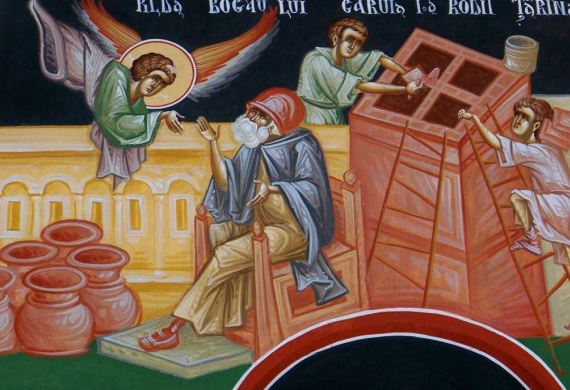
Image result for icon of the rich fool
God will say to those unprepared to stand in his glory, “Fool! This night your soul is required of you.” (Luke 12:20). It does not do to make preparations for this passing life while neglecting to prepare for the everlasting life that is to come. Pope Benedict XVI observes, “This life is not everything. There is an eternity. Today it is very unmodern to say this, even in theology.” But it remains true, and the weight of the eternal is infinitely greater than the weight of all the years of our earthly life.
How can we prepare for that limitless life and the unfathomable glory of God? He has made the way simple for us. He is the way.
The Philip’s Fast, which we have now begun in preparation for the Nativity of Jesus Christ, is a season of preparation for the coming of the Lord into the world. The Lord is coming into the world.
One morning, we will wake up and it will feel like Christmas morning when we were children, because the Lord will have come into the world. Anyway, that’s how it will feel if we have prepared for him. Either way, that day is coming.
This Philip’s Fast is another chance to prepare. I had the opportunity this week to meet up online with several of my old seminary chums. It was a group video chat, so I could see all of them as well as talk to them, even though we were all over the country. Such technological marvels we live among these days. Real life is like an episode of Star Trek. Anyway, unlike the rest of them, I didn’t have a camera, so they couldn’t see me like I could see them. All they could see of me was a photo taken a few years ago. So, I pointed out that I’d gained about 20 lbs. since that photo had been taken. Fr. Lewis chided me, “That doesn’t sound very ascetical, John.” And so I affably retorted, “Well, it’s a good thing we’re starting the Philip’s Fast now. Thank God there’s always another chance to repent.”
“Yeah,” said Fr. Dcn. Tom, “until there’s not.”
There won’t, in fact, always be more time. “The great day of the Lord is near – near and hastening fast” (Zeph 1:14). This Philip’s Fast is another opportunity to prepare and repent. Let’s not squander this chance. How many more will there be? What we do as a Church in these fasting seasons teaches us how to live our lives in preparation for the last things and the everlasting things.
Here’s the thing: the day is coming when we will stand in the glory of the Lord. This is true whether or not we prepare for that glorious day. If we do not prepare (by living the life of God and cooperating with his grace) our experience of that glory will be painful – like staring straight into the sun. But, if we first allow ourselves to be transfigured, little by little, by God’s own energies, then we will truly live this life he is giving us, and, on that day, we will be the glory of God.
“The glory of God is man truly alive,” as St. Irenaeus says. Jesus says to his Father, “I have given them the glory you gave me, so that they may be one, as we are one” (John 17:22). You see, this glory of God makes us one with one another just as God, who is three Persons, is one.
What unifies us is the same as what unifies God: love. God is love (1 John 4:8). So, the way to prepare to stand in the glory of God, the way to become the glory of God, to become one as the Persons of God are one, is to love one another. This is the simple way.
We all want to be loved, and that’s as it should be, I believe. Even God wants to be loved. And he made all of us lovable. All of us. You are lovable and God loves you. Love one another as he loves you (John 13:34). Then you will be prepared to stand in his glory and receive his love not as a searing fire but as a transfiguring light.

Saturday, September 8, 2018

Retroactive Holiness

My favorite icon is called the Virgin of the Sign. In Byzantine churches, it belongs on the eastern wall behind the holy table. It depicts Mary, the Theotokos, with her arms in a posture of prayer and with the Christ child - Emmanuel - within her womb, giving us his blessing.

I am a painter. My wife and I both have degrees in art and studied iconography for a couple of years under an experienced orthodox nun. Being a painter and being deeply in love with this icon - the Virgin of the Sign – I made a painting inspired by it. I suppose I am not allowed to call it an icon per se because it is an innovation and innovation is rarely permissible in iconography. So let’s call it a painting inspired by iconography.


It depicts the Virgin of the Sign - just as you see her with Christ within her - within the womb of her mother Anna. Christ within Mary within Anna. And Anna’s arms are also in a posture of prayer. Anna did indeed pray to have a child and thank God she did. Without Anna, we have no Mary and without Mary, we have no Jesus, no incarnate God, no salvation. I called this painting Theotokotokos - the bearer of the God-Bearer. She who bears within herself the one who bears God within herself.

One day, several years after I painted this image, a friend of mine saw it for the first time. He did not care for it at all. It was one thing to venerate Mary, the Theotokos, he thought, but this veneration of Anna could too easily spark a retroactive perception of holiness upon all the ancestors of Christ many of whom were not, in his view, so holy after all.

This friend of mine had been a Protestant. Though, by the time he was looking at my painting, he had been received into the Catholic Church. He had, I'm sure, as most Protestant converts to Catholicism do, struggled with the Catholic veneration of Mary and her role in our salvation. But he’d gotten to a point of accepting her. However, now witnessing my veneration of Anna put him a bit over the edge again I think.

Well, today's feast of the Nativity of the Theotokos is an opportunity for us to remember not only the role of Mary in our salvation but even the role of her mother Anna. There is among some Native Americans a custom of observing the birthday of a child by giving gifts – not to the child – but to the mother. Maybe this makes more sense than our custom. It is the mother who has done something worthy of thanks and praise when a child is born. Today, Mary is born and we give some thanks and praise also to her mother Anna.

I am not worried about introducing retroactive holiness. I think, rather, that may be a point of the Incarnation. Not the sanctification only of a select few, but the sanctification of all created things and beings in Christ. This Feast is a wonderful opportunity for us to behold the interconnection of all created things. It is easy to see the connection between Anna and Mary and Jesus and our salvation. Each leads to the other.

But God works inside everything, even when it is not so easy to see. He is with us always. By entering into human history at one particular point in one particular woman, whose nativity we celebrate today, he becomes the result of all human history before him and the cause of all human history after him, except for our sin. He becomes like us in all things but sin. In his humanity, God is with us in every moment and in every place because every moment and every place in creation is interconnected. This reminds me of what the mathematician Edward Lorenz called the Butterfly Effect, in which he observed that a metaphorical tornado is influenced in all its details by minor perturbations – even the flapping wings of a distant butterfly several weeks earlier. Everything is interconnected.

God does not will our sin, ever. But, even when we sin, God brings good out of the evil we have done. Even his own conception he makes dependent on a whole genealogy of conceptions all the way back to Adam. And many of these conceptions were sinful or adulterous. That of Solomon, for example.

The Troparion of the Prefeast yesterday speaks of this and says that "Today is born to us, from the root of Jesse and the loins of David, Mary, the godly child. Therefore, all creation rejoices and is renewed." It is through Solomon that Jesus descends from David and Solomon is the fruit of David’s adultery with Bathsheba. Thank God, David repents and is forgiven by the Lord. And God takes the evil that he had done and through it, ultimately, becomes man so that we together with David can become one with God.

I do not fear or oppose retroactive holiness. In fact, I hope and pray for it. Today, we sing in the Kontakion that, by the holy birth of the immaculate one, even Adam and Eve are freed from the corruption of death. And the people are delivered from the guilt of their sins. So holiness has indeed spread all the way to the beginning. May it also progress all the way until the end. In Christ, it has, it is, and it will. The whole universe rejoices today.

God makes us – just as much as he makes Adam and Eve. And he makes us – who are not holy because of our sins – to become holy by his grace if we will but cooperate with him and repent like David. He make us holy by becoming one of us – through Mary, through Anna and even through Bathsheba and through Eve. 

Sunday, January 7, 2018

A Prophetic Crescendo

In the West, and even among some Byzantines living in the West, we have a tendency to treat the time from Christmas until Theophany rather like a diminuendo – which, in music, is a gradual softening and decrease in intensity, which is a wonderful way to end a lullaby intended to put us to sleep, but maybe not the best way to regard the great feast of Theophany. What I mean is, we treat Christmas as the climax of the season and Theophany or Epiphany as an addendum, when, in fact, this is backward. In history and in liturgy this time is actually more of a crescendo – a gradual increase in excitement and intensity until it reaches Theophany – which is its climax – in which worship of the Trinity is revealed.


Look how softly we begin – with the birth of a baby in humble circumstance. His mother lays him not in a bed, but in a manger, not in some royal palace but in a cave. He is attended not by courtiers but by shepherds and later by wise men from the East. These were some of the few who knew who he was at all – and they were able to see it only with the eyes of faith overlooking the humility of his circumstance.

So, yes, the Lord is revealed at his nativity, but his revelation begins in obscurity. He is revealed quietly and to few. For many years, the mystery is contemplated in silence in the hearts of those who know before any part of it is revealed to the world. The prophets prophesied his coming long before his birth, but the true meaning of their prophecy was known to but few.

Eight days after his birth, as we remembered on January 1st, he humbly undergoes the circumcision that all Jewish boys undergo. To all appearances, he is in this like any other Jewish baby boy.

The feasts of the Nativity and the Circumcision emphasize, I think, his humanity – but the feast of Theophany reveals Christ to all to be the Son of the Father and reveals the Holy Spirit, who descends upon him like a dove.

Some knew from the beginning, of course, that Jesus is Lord – Mary knew and Joseph knew – having been told by an angel of the Lord. Christ’s divinity is present at every moment of his human existence, but sometimes it seems obscured to those without ears to hear – like a subtle musical theme underneath larger movements, which builds and builds throughout the piece until it is played loudly and clearly at times such as his baptism and his transfiguration and his resurrection.

One who reveals from the beginning that Jesus is Lord is John, whose Synaxis we celebrate today. Though John admits that he himself did not know Jesus as the Son of God until he saw the Spirit descend upon him like a dove (John 1:32), he also reveals to his mother Elizabeth that Jesus is Lord even while both he and Jesus are in the wombs of their mothers (Luke 1:41-43).  You see, prophecy is God speaking to us through his prophets, but not always with the prophets’ own understanding.

Again witness how quietly the theophany of the Lord begins when Jesus and John are babies – and yet it grows and grows – builds and builds like a musical motif in a complex composition, until it is revealed and known to more and more – to John himself, and, through John, to his disciples, and now to the whole Church and to all of us.

John, the Forerunner and Baptist of the Lord, is a prophet. Indeed, among those born of women, there is no greater prophet than John the Baptist (Luke 7:28 KJV). He is, indeed, a prophet of prophets – a prophet whose prophecy was prophesied. He is the one "who was spoken of by the prophet Isaiah when he said, 'The voice of one crying in the wilderness: "Prepare the way of the Lord. Make his paths straight"'" (Matt 3:3).

John was a prophet even before he was born. Jesus first approached John while they were both unborn in their mothers' wombs and John, being a prophet of God most high, leapt in his mother Elizabeth's womb, thus proclaiming to her that the unborn Jesus Christ is Lord (Luke 1:41-43).

And when Jesus comes to him again when they are both men, he prophecies again, “Behold the Lamb of God who takes away the sin of the world” (John 1:29). Now, this proclamation is heard by all. Whereas before, only his mother Elizabeth could feel and understand John’s hidden prophetic leap. Now, God is manifest to all. It is theophany! It is like the climax or culmination of a musical composition. What was building up quietly is now fully and loudly expressed to all.

John is the prophet through whom this revelation takes place. It is John who sees the Spirit descend upon Jesus like a dove (John 1:32). And John thereby recognizes Jesus as the Son of God (John 1:34), for he hears the voice from heaven saying “This is my beloved Son, in whom I am well pleased” (Matt 3:17). It is a prophet who can hear the word of God. A prophet recognizes the melody of the Lord in the midst of the cacophony of the world.
  
Many reduce prophecy in their understanding to the foretelling of future events, but this is not even half of what prophecy is.

There's a popular expression with a long history and many variations that one hears from time to time, which is better: "The prophet comforts the afflicted and afflicts the comfortable." This certainly holds true if we examine the effect that prophecy has on people. John's baptism was a comfort to those who repented of that which had been afflicting them. And his preaching afflicted, for example, the all-too-comfortable Herod who was unwilling to repent of his incestuous relationship (Mark 6:17-18). John was not afraid to point out that the fact of Herod's transgression, even though it ultimately cost him his life to do so. A prophet always speaks the truth, which does often afflict the comfortable and comfort the afflicted, because a prophet is one who speaks for God – who speaks God's words to each time and place as God intends them to be heard and understood.

Prophecy is speaking the word of God. For example, the Lord touches Jeremiah’s mouth and says, “I have put my words in your mouth” (Jer 1:9). And to Ezekiel he says, “You shall speak my words to them” (Ezek. 2:7). We are lost without prophecy, for our faith comes by hearing the word of God (Rom 10:17), which we can only hear through prophecy.

So, let us hear the word of God. We have now already heard the climax of the composition – we have celebrated Theophany and witnessed the revelation of the Trinity – the Father, the Son, and the Holy Spirit. The great feast of the Theophany is yesterday. Today, we honor John through whom this revelation comes to us. Now, it really is time to ask, “What now? What next? What can follow this greatest of revelations?” Well, let us continue to listen to the word of God – to the preaching of Jesus, who Theophany teaches us is himself the Son and Word of God:

Today, “Jesus began to preach and say, "Repent, for the kingdom of heaven is at hand.” These are the first words of Christ’s preaching and with them, he pays homage to John, his baptizer, the greatest of the prophets, his forerunner, who made straight his way. The words that Jesus preaches directly quote the preaching of John, who went before him to prepare his way. Jerome points out that, by quoting John in this way, Jesus shows that he is the Son of the same God whose prophet John was. There is one God and one word of God, known to us by prophecy, who now preaches to us one word: repent. This one word will comfort us if we are afflicted and afflict us if we are comfortable. 

Sunday, November 19, 2017

A Time of Silence about the Mystery

St John the Theologian in Silence
Village of Vladimir, 18th Century
source

Well, they tell me some of the radio stations have already started playing Christmas music. It seems like everyone I know loves to complain about this. I mean really across the spectrum of ideologies and denominations, people love to complain about this. My secular friends and former coworkers sigh derisively and roll their eyes at the sound of “Silver Bells” in November, saying, "It's not even Thanksgiving yet!" Meanwhile, our Roman Catholic friends complain, "It's not even Advent yet!"

Of course, to us, that sounds a little odd because, well, it is. Our Nativity Fast began on November 15th after the feast of Saint Philip. Our altar covers are already red. The secular and commercial world has nothing on us when it comes to getting ready early.

But the way and the spirit with which we prepare to welcome the Lord and to celebrate his birth in a cave in Bethlehem is very different. Or, it ought to be. How ought we to prepare?

It is interesting to compare our Byzantine approach to this season with the approaches taken by the world and even by the other Churches.

It may surprise some to learn that our lectionary has no readings particularly associated with the coming feast of the Nativity - until the Sunday of the Holy Forefathers, which, at the earliest, can fall on December 11th. This year, it falls on December 17th - its latest possible date. (By the way, it is traditional to intensify our fasting around this time - either on December 10th or December 20th). So, there's always about a full month of the Nativity Fast - and that's the majority of the fast - during which our lectionary makes no direct mention of the Nativity.

There are some liturgical changes that occur. For example, starting on November 21st, we sing the katavasiai from the Canon of the Birth of the Lord at Matins. There are also throughout this season occasional Days of Alleluia. These are particularly penitential days during which the Divine Liturgy may not be celebrated and the other services become longer and more penitential, with prostrations, the beautiful and convicting Prayer of Saint Ephrem, and other features you would expect, actually, from a liturgical service during the Great Fast.

Also, of course, in addition to these increased prayers, we are to be actually fasting - each of us to the extent that we are able - and we are to renew and intensify our practice of almsgiving - of sacrificial giving to those in need, to the poor, and to the real needs of the Church.

But, despite all of these changes to our way of prayer and life during the Nativity fast, our lectionary, as I say, makes no direct mention of the particular reason we are doing this in this season. The changes that do occur in our liturgical life often make it look more like Lent than Advent.

Now, some perceive this as a deficiency in need of correction. And maybe people do need more explicit reminders of what this season is all about. Perhaps to help with this, our own Eparchy's Archpriest David Petras has written a book of meditations for the Nativity fast, which I look forward to reading, but it draws on the lectionary of the Maronite Church for inspiration because, as I say, the Byzantine lectionary is silent at this time.

On the other hand, it's not so silent as it used to be, because now we celebrate beautiful services like the Emmanuel Moleben during the Nativity fast, which includes readings chosen for their relevance to the coming Nativity of the Lord. However, it should be known and remembered that this is no ancient Byzantine service. Its form and its original texts are the work of the Right Reverend Mitered Archpriest Conrad Dachuk, who just recently celebrated his 40th year of priesthood in the Ukrainian Catholic Eparchy of Toronto. So, we have a great Byzantine hymnographer here in the West and among the living. Our tradition is not dead nor static. There is room for new prayers.

But before we go too far in filling up all of the absences we perceive in this fasting season, let’s pause for a moment and considered whether or not the silence itself might be meaningful for us. Perhaps it's only an accident of history that the Feast of Christmas developed first in the West and so other Churches have more to say about it. Or, perhaps, as I say, our silence is meaningful. But what could it mean?

Well, our understanding of the mystery of Christ grows better in the silence than in the noise. The noise of “Jingle Bells” and “Here Comes Santa Claus” is one thing - seemingly bent precisely on distracting us - but even the sacred sound of hymnody and holy words do not teach us what silence does. The mystery of Christ - his incarnation and his birth - is so great that one wonders whether every word we speak about it draws us nearer to it or moves us further from it. So perhaps a time of silence - a fast from words about the mystery - joined with quiet contemplation of that mystery - would do us good. It could help to empty us.

This is a fast - and a fast empties our bellies.
This is a time of almsgiving, which empties our wallets.
And this is a time of prayer - without so many words about the very inspiration for our fasting and our almsgiving and our praying - the Nativity of Our Lord Jesus Christ. Perhaps this kind of prayer could help empty our hearts of earthly cares so that they may receive the king of all.

Fr. Jack Custer says that this is a "period of fasting by which we prepare an empty place for God to fill with joy, and by which we cleanse our lives of sin and selfishness so as to welcome our Savior." This kind of holy emptiness creates in us a receptivity to the Lord that we lack when we are overfull with food and possessions and self-satisfaction, like the rich man in today's parable, who pulls down his barns to build larger ones and there store all his grain and his goods (Luke 12:18).

It is especially in this season of the year with its pre-emptive holiday parties and rampant consumerism that we - especially those of us who are rich - are tempted to say to our soul, "Soul, you have ample goods laid up for many years; take your ease, eat, drink, be merry" (Luke 12:19). Let us remember that at any moment God may say to us, as he does to the rich man, "Fool! This night your soul is required of you; and the things you have prepared, whose will they be?" (Luke 12:20).

When the Lord comes to us, as he comes to the world in his Nativity, may he find us hungry, empty, and yearning for him rather than satisfied, full, and taking thought of no one but ourselves and our own families. Then, he will be the one to satisfy us eternally. 

Instead of stuffing ourselves full with rich foods and stuffing our barns full with needless possessions, let us empty ourselves and our barns by fasting and almsgiving. And with the help of prayer, let us become rich in the things of God, rather than the things of the world, whatever avarice the worldly celebration of the holidays may seem to justify.

Instead of laying up treasure for ourselves, let us be rich toward God (Luke 12:21). Let us be rich in what matters to God. The Lord requires of us only to do right, to love goodness, and to walk humbly with our God (Micah 6:8). The way is simple, really, though at times difficult. Now is the time to simplify our lives not complexify them, whatever the world may say.

Most Popular Posts this Month

Most Popular Posts of All Time