Showing posts with label Forgiveness. Show all posts

Sunday, March 3, 2019

Fasting & Forgiveness


Before we fast, we forgive. Today, we celebrate Forgiveness Sunday. Tomorrow, we begin to fast. Jesus first commands us to forgive one another (just after teaching us the Lord’s prayer) and then he teaches us how to fast (Matt 6:15-18).

This is the right order of events, because if we do not forgive one another, our fasting will be worthless. I repeat, if there is someone you will not forgive, you will not be forgiven. Now is the time for us to purge ourselves of all resentments and unforgiveness.

The Great Fast is a time of freedom from bondage. It is a time to let go of our enslaving passions – to forgive even those who don't deserve it – rather than carrying the weight of all that hatred or resentment toward them. Let’s just take that weight – that burden – and drop it – and let it go – and we’ll feel a thousand pounds lighter. Maybe fasting for 40 days will make me feel a thousand pounds lighter in body as well as soul.

The Great Fast should free us from our extra useless weight: the weight of our addiction to various sins, to overeating, to drinking too much, to being lazy about prayer, to all manner of sins of the flesh, but, above all, to being unloving and unforgiving to others – to our enemies, our family, and our friends.

Living in freedom from all of this, paradoxically gives the Fast an almost festive feeling. Jesus says today that, when we fast (not if we fast, but when we fast), we should anoint our head and wash our face. In the Byzantine tradition, we are anointed on our heads on feast days. It is a festive thing for us to do. Yet, last night we celebrated Litija at Vespers, which means we were all anointed.

And there's Litija again next Saturday evening. All this anointing during the Fast! Because there is a paradoxically festive element to this season. We call this in the Triodion bright fasting.

We will sing tonight at Vespers, “Let us begin the time of this bright Fast, giving ourselves over to spiritual struggle. …. Let us not only fast from food; let us also abstain from every passion and cultivate spiritual virtues. And let us faithfully persevere in this, so that we may be worthy to see the holy Passion of Christ our God and the joy of his holy Resurrection.”

We rejoice that we are being freed. And the path to that freedom in Christ is confessing our sins to one another and forgiving one another in his name. Forgive me, the sinner. 

Sunday, February 24, 2019

The Least


on Matt 25:31-46

Each of us has someone that we love the least. Maybe this is an enemy who has done us harm. Someone who abused us in various ways or humiliated us. On the other hand, maybe it's just someone God has put into our lives that we simply ignore.

We may not even know who it is that we love the least. In fact, it's likely that we don't – because it's precisely someone that we're ignoring when we ought to be loving them.

Someone we ought to care for as a friend or a brother or a sister, but we neglect them because they distract us from our personal goals. Someone lying outside our gates like Lazarus, who we step over as we go about our daily life. We think we're minding our own business maybe – but, really, we're failing to recognize in this other person the image of God.

On the other hand, it might be your wife for your husband or your mother or your father or your son or your daughter or your brother or sister that you love the least. Whoever it is, we all have someone we love the least.

This is who Jesus means, I think, when he says, whatsoever you do to the least of my brethren, that you do unto me (Matt 25:40). The least of Jesus's brethren are those of his children we love the least. And we are all God's children. Let us commit ourselves to welcoming and caring for all of God's children. This would a good plan for us, because it is on our caring for one another, above all, that we will be judged.

There will come an end of all things – the second coming of Jesus Christ – and the final judgment of each and every one of us, as we hear in today's holy gospel.

Russian c. 1660 in Yaroslavl

Let’s let fear of this judgement spur us to begin to love one another – especially those we love the least. When our love is perfected, it will cast out of us any need of fear (cf. 1 John 4:18). Until then, let us have a little fear.

Let us embrace whatever is necessary to motivate us to forgive those who have wronged us and try to do what good we can for them. Sometimes this means only that we pray for them and for all blessings upon them because we ourselves are powerless to intervene in any direct or material way. Many times, however, there is direct good that we can do – food, and clothing, and shelter that we can provide – and we neglect to do so at our peril.

Today, Jesus describes that peril as fire and punishment (Matt 25:41, 46). Elsewhere, he describes it as weeping and gnashing of teeth where the worm never dies and the fire is not quenched and as the outer darkness.

We have many ways avoiding the fulfillment of God's command to give to him by giving to the least of his brethren – to those we love the least. Sometimes, we are cleverer than the rich man who stepped right over Lazarus in brazen indifference to that brightly shining image of God lying at his own doorstep. That is, sometimes we pack up and move.

Americans are especially good at this. Rather than loving the neighbors we find ourselves surrounded by and working to provide for them whatever they may need, we can just move to another city, another town, or another neighborhood where the neighbors leave us alone because they just want to be left alone too. Where we share an unspoken mutual agreement to ignore each other in exchange for not being bothered by the inconveniences of others' needs. Pretty as neighborhoods like this may be, they are in some cases a thin disguise, the façade of an edifice of hell, a whitewashed tomb, you might say. Such may be a neighborhood built out of the desire to escape people we find uncouth or undesirable – people elsewhere known as the least.

Wherever we find ourselves, however, it is not too late. God always puts people in our lives with needs so that we will have an opportunity to give. The needs and even the begging of others is not the nuisance to us it may seem to be, but a gift and an opportunity from our Lord himself to show our Lord himself that we welcome him and care for him and love him.

“Do not neglect to show hospitality to strangers, for thereby some have entertained angels unawares” (Heb 13:2).

It takes only a fraction of a moment to repent, to begin to love, to work for and seek the good of the ones we love the least.

We know that our Lord is the Lover of mankind. We know that he is merciful and kind and that he forgives all who repent. Yet, woe to those of us who take this knowledge of his merciful loving kindness – his ḥesed – and let it become an excuse for us to be unloving, thinking, “Oh, God will forgive me. I need not care for others.”

We must not forget that our God is awesome, mighty, and powerful beyond all measure. True paternal love, such as his, is not a spoiling and overindulgent love. God our father is not afraid to discipline us. In his love for us, he wants to make us into great men and women by his grace – by any means necessary. And greatness consists above all and becoming like God, who is love.  

Are you love? Am I love? If we are not yet love, we are not yet God. If we are not yet love, then let us have a little fear. If we do not love and also have no fear of God, we are damned. There is indeed something to fear. We damn ourselves by our failure to love and our failure to fear God.

Today's reminder of the coming Last Judgement exists to call us to repentance. Repent, forgive, and be forgiven. Today is Judgement Sunday. In one week is Forgiveness Sunday. God is both just and merciful – the end and the beginning.

We will be judged and we will be given every opportunity to repent. We are even now being given the opportunity to repent. Today. Let us not waste this one as we may have wasted many that have come before. There will be a final opportunity – we know not when – and it may be this.

Sunday, August 5, 2018

Forgive Everything

In a parable, our Lord Jesus Christ gives us a God’s eye view of sin and forgiveness (Matt 18:23-35).

An official owes his king ten thousand talents. The king is the Lord. You and I are the official. His debt represents our sinfulness. So, when Jesus describes this debt, he is actually describing our sinfulness, which concerns us personally and is worth considering carefully.
 
There are different estimates as to the actual value of ten thousand talents. We know that a talent was the largest unit of money at the time. It was worth about six thousand denarii, which was a day’s pay. 

So, a talent was more than 15 years of pay. So, even if a day’s pay was equivalent to less than half of the current minimum wage in Michigan, ten thousand talents would still be worth more than 2 billion dollars. Imagine the burden of a debt like that! It is an impossibly large sum – more than a laborer could make in two thousand lifetimes. 

It will help us to understand Jesus’ rhetoric a bit further if we also consider the word here for ten thousand – it’s μυρίος, which is the largest Greek numeral – and as such, it is sometimes used rhetorically and less technically to mean “countless” or “innumerable” – it’s where we get the word myriad. So the servant’s debt to his master is the largest numeral of the largest unit of money. In other words, it’s as big as it can be – that’s the point, I think.

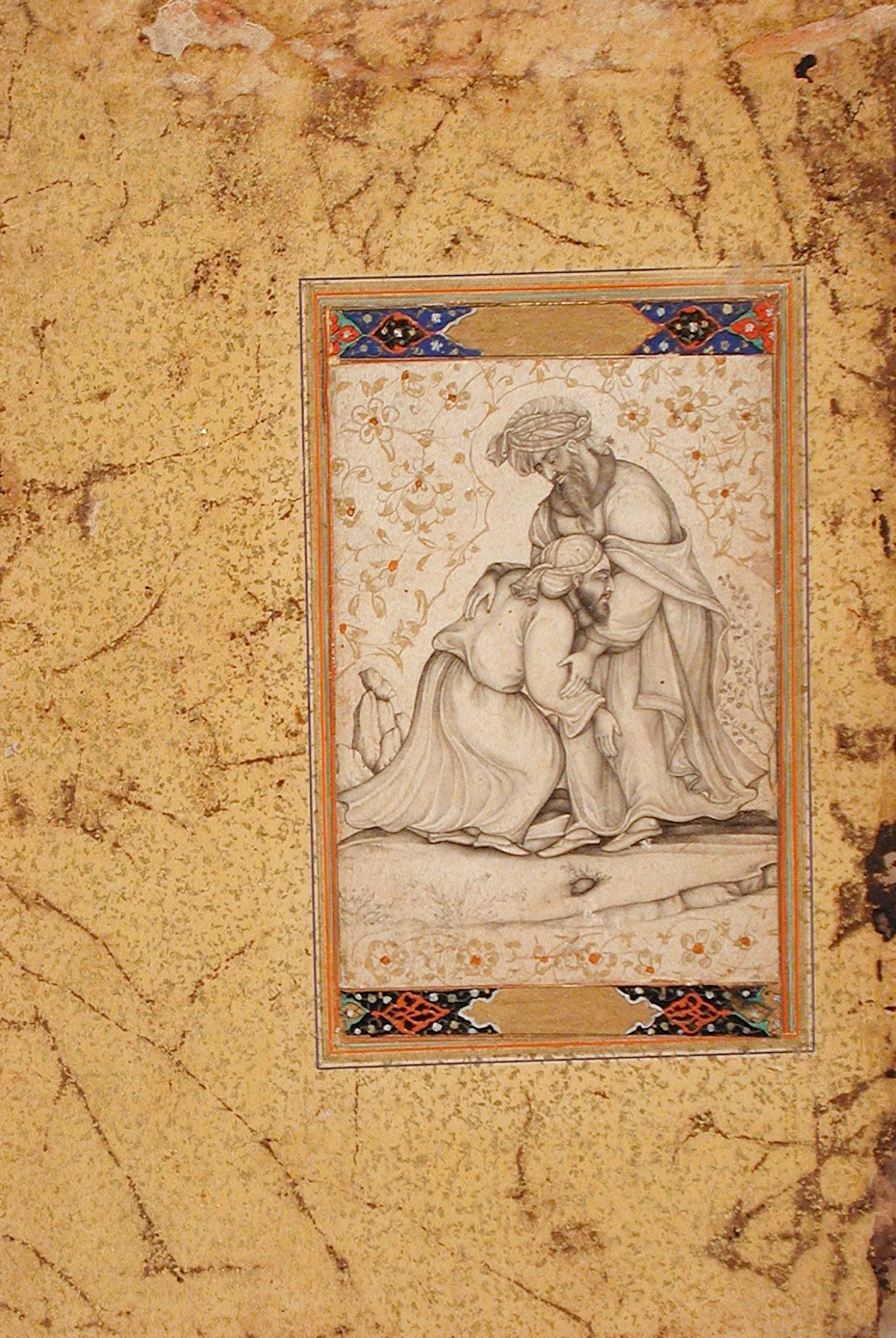
Mordecai and King Ahasuerus
India, Mughal, circa 1610
Ink with touches of color and gold
Paul Rodman Mabury Collection (39.12.76)
And it’s also possible that Jesus is making an allusion – because this isn’t the first time that the sum of ten thousand talents is mentioned in scripture. In the book of Esther, Haman, the enemy of the Jews, feeling himself insulted by the Jew Mordecai, offers to the Persian King Ahasuerus – also known as Xerxes – ten thousand talents of silver if he will agree to destroy all Jews (Esther 3:9).

Haman was indebted to his king ten thousand talents, just like the official in today’s parable. And for what? – for seeking “to destroy, to slay, and to annihilate all Jews”(Esther 3:13) – the people of God. So this sum of ten thousand talents here is blood money. The debt of the servant in today’s parable represents our sin  – and the wages of sin is death – and that death is born by the true Messiah of the Jews – Jesus Christ.

By our sins, we participate in the failed attempt to destroy Jesus, just as Haman, by his debt of ten thousand talents, participates in a failed attempt to destroy the Jews. In both cases, the Lord triumphs over sin and death. Through Esther, he delivers the Jews from oppression in Persia. And Jesus he raises from the dead. So there are meaningful parallels here, which show more clearly that this enormous debt is an image of sin and death.   

It is fitting that Jesus describes all our sinfulness with a parable about money – because the love of money is the root of all evil (1 Tim 6:10). But even if we think our sins don’t involve money, we mustn’t think that if that this isn’t about us – we must not leave this comfortably in the abstract.

We should feel invited to place ourselves in this parable as the servant, to examine our own consciences, and to discover our own sins against God and against our fellow servants. Sins perish in the light and thrive in the darkness – so we must name them and confess them to one another (James 5:16).

I cannot judge you. You and God alone know which sins trouble your hearts – and I can only know my own sins. We must all bring our sins to God in holy repentance, as the servant did at first – falling on his knees and begging for the patience and kindness of the Lord. When we do, we will receive the Lord’s forgiveness – which is more than the servant begged for.

Actually, when the extent of his debt is revealed, the servant stupidly asks for more time to pay back his king – it should be clear to us that this is a sum no servant could ever repay. It’s an absurdly large sum! This, I think, is how it must sound to the Lord if we ever say that we’ll make it up to him by being good people for the rest of our lives. That won’t make it up to him! That is good and necessary, but that doesn’t mean that it’s enough. Nothing we do can ever earn our union with God.

We are utterly and absolutely dependent upon his grace. Apart from the energies of God, there is no theosis. We do not partake of the divine nature by our own power, but by the power of God, with which we cooperate. We must make every effort to supplement our faith with virtue, but we must never think that our efforts can succeed unaided (2 Pet 1:3-5). They spring from, are supported by, and succeed in and only in the life of God, freely and gratuitously given by God.

So the king does not give his servant more time to pay him back, which would be impossible – no, he forgives the debt completely! He gives more than the servant asks for. The Lord is gracious and we depend upon his grace.

We must realize that our sin is like a debt too large for us to ever repay, and, having received the forgiveness of that debt, let us turn from our sin, repent, and sin no more. We should allow this seemingly inexcusable, impossible forgiveness and lovingkindness to prick our hearts so that we do not remain inert and insensible to our wickedness.[i] With all our hearts, let us turn away from the evils to which we cling and to which we are habituated and enslaved.

This turning, this repentance, this conversion, this μετάνοια begins, as our Lord demonstrates in this parable, with forgiveness. Not only with being forgiven, but also with forgiving others.

Our Lord taught us to pray, “forgive us our trespasses as we forgive those who trespass against us” (Matt 6:12). Or, a more literal translation is “Forgive us our debts as we forgive our debtors,” which closely ties the prayer to today’s parable of debts. So as we forgive, we will be forgiven. And if we are to have any hope for ourselves we must have the hope for others that forgiveness expresses.

After receiving the forgiveness of such an enormous amount, the servant should quickly and easily have followed his king’s example when a fellow servant begged for patience regarding a comparably small debt – a hundred denarii – a tiny fraction of what he had been forgiven.

The wrongs we suffer from our fellow servants – which really are wrongs – sometimes terrible wrongs – are nonetheless small when you compare them to the weight of our own sins against the Lord. So, let us remember our own sins and forgive others, as our heavenly Father forgives us.

Do not nurse hurt feelings or brood on wrongs. Do not let resentments grow in your hearts like weeds growing ever deeper roots. For, according to the measure with which you measure, it will be measured to you (Matt 7:2). If you would be forgiven, you must forgive – even those who don’t deserve it – even those who don’t ask for it – as Jesus and Stephen forgave those who were killing them even as they were driving the nails and throwing the stones (Luke 23:33-34; Acts 7:59-60). Let us imitate this indescribable love and forgive everything. 


[i] cf. Chrysostom, The Gospel of Matthew, Homily 61.1

Wednesday, March 21, 2018

See the Good

Joseph sees the good in the midst of evil. Do we? Or, do we complain constantly about every little thing we suffer without ever stopping to give thanks and praise to God for the good with which we are also blessed?

Joseph sending his brothers back to Jacob with food
illustration from Byzantine bible
Topkapi Palace Museum

This is not to diminish our sufferings. Our sufferings are real and sometimes unjust and it's worthwhile to complain about them from time to time. We see this with Abraham – and the Psalms are full of complaint. But it's not okay to neglect the other part of it. We must give thanks to the Lord at all times even in the midst of our complaints. If we complain to God about every evil, we must also remember to thank him for every good.

Sometimes, we even blame God for our suffering. Things don't go our way and we say to God, "I can't believe this is how you treat your friends," as if he was the one who visited evils upon us. Or, we look at all the evils in the world – the cruelty visited upon the innocent by war, murder, rape, abuse, and neglect; by poverty and ignorance; by natural disasters, earthquakes, fires, floods, and diseases – and we conclude that no good God could let this happen. By this reasoning, atheists and enemies of God conclude that either there is no God or that God is not good. One important thing to remember is that God is not the author of any of these evils. God did not make death (Wis 1:13). It is our sin that brings all these things into the world. It is my sin. We are to blame, and not God, for every evil.

Even so, we might object, "Doesn't God have the power to prevent these evil consequences of our sin?" Yes, he does. He brings good out of every evil he permits, but he isn't beholden to any evil. God is all-powerful and can do anything by any means. So, I don't have all the answers here. I'm not sure there are answers fully comprehensible to our merely human understanding. Yet God alone gives a peace which surpasses all understanding (Phil 4:7). And this is the only kind of peace that there is.

Yet, somehow, many of those who blame God for every evil neglect to credit him for every good. We experience a great deal of good in our lives and in creation. I dare say it is very good (Gen 1:31). If it weren't, the evil destruction of things that goes on would not be so very evil, which it is. There is great good, for which God deserves all the credit. We must strive to see this good.

If you cannot see the good, it's not because it isn't there, but simply because you lack the eyes to see – the eyes of faith. If a creature lives in a cave underground all its life and never emerges into the light – and there are these creatures – then it cannot see the sun. 

Nonetheless, the sun is there, and the sun is good, and the sun is necessary to that very creature's life. In the same way, there is good, even if we can't always see it. It is there and it sustains us in being. If you cannot see it now, it doesn't mean that you will never see it again. Have hope and pray for the gift of faith. The Lord loves you and in his own time and by his own means, he will answer that prayer and give you that gift.

Joseph sees the good. The Lord has clearly given him the gift of faith, I think, and he was not a man unfamiliar with suffering and evil. He experienced a great deal more of it than most – not all – but most of us. He says to his brothers, "I am your brother, Joseph, whom you sold into Egypt" (Gen 45:4). This betrayal by his own brothers (37:18-36) was only the beginning of his sufferings. He would later be falsely accused of trying to seduce his master's wife and thrown into prison (39:12-20). Some of us know the sting of false accusation. When you do, remember that you are in the good company of Joseph and draw inspiration from his example.

Despite suffering all of this as a result of their crime, Joseph says to his brothers, "And now do not be distressed or angry with yourselves because you sold me here; for God sent me before you to preserve life” (45:5). Do not be angry with yourselves?! That’s what Joseph is concerned about at this point: his brothers’ feelings? He isn’t angry at his brothers who betrayed him and enslaved him. He doesn’t even want them to be angry at themselves! How can this be? If he was angry, I would not fault him. Would you? Yet, he sees the good so clearly, that the evil he has suffered drowns in the good.

You see, the whole land was afflicted with famine, and would be for another five years. Through Joseph’s interpretation of dreams, God had revealed this to Pharaoh, and so Egypt had prepared for the famine. And this now enables Joseph to provide food for his family throughout the famine and preserve their lives. So, he concludes that it was not his brothers who sent him to Egypt, but God (45:8). This is a stunning faith and ability to see the good.

Though he lived long before Christ, Joseph not only fulfills what Christ commands us – that is, “love your enemies and pray for those who persecute you” – he even surpasses this command (Matt 5:44). He not only loves those who tried to do away with him, he even tries to convince them that they have not sinned against him, but that it was the work of God.*

Like Joseph, let us not focus so much on recovering our ease and comfort when we find ourselves in trouble and distress that we forget to always seek and offer thanks to the Lord for everything that is good.†


* Paraphrased from St. John Chrysostom’s Homily 64 on Genesis.
† Ibid. 

Wednesday, March 7, 2018

Weeding our own Garden - or - Don't Garden Drunk

To be honest, most of us have had the experience of having too much to drink. Many people have experienced this, of course. It's a rather common phenomenon for a person who has never had alcohol before – and who doesn't yet understand how it affects people – to drink a bit too much at first and to become drunk.

Well, Noah was apparently the first person to ever drink wine. He was the first to plant a vineyard (Gen 9:20) and when he drank the wine, he became drunk and lay uncovered in his tent (9:21). Given his inexperience and the inexperience of the whole human race at this point, this is really an unsurprising and predictable result.

Nonetheless, it is a shameful and embarrassing situation for a father to be discovered drunk and naked by his son and this is what happened to Noah when Ham walks in (9:22). Further unspeakable indecencies may be hinted at by some Hebrew euphemisms in the text but the situation is difficult enough without all that. And, regardless, if we have ears to hear, I think this story teaches us both the importance of sobriety and the proper way to regard others in their sins.

Deliberately getting drunk is a sin. As Catholics, and therefore as adversaries of teetotalers and Puritans, we may not say this often enough for fear of being lumped in with them, so I'll say it again: deliberately getting drunk is a sin. Alcoholism is a disease. Accidentally getting drunk is an involuntary sin or an infirmity.

In each case, we stand in need of healing. Our Lord, who alone can heal us, offers us this healing both directly and through one another, through our prayer and support for one another, through the Holy Mysteries of repentance, of anointing, and of communion in his holy body and blood.

Sobriety, however, does not only refer to the moderation of our use of alcohol. First of all, there are many other addictions. I think almost everyone is addicted to something: to alcohol or drugs, to pornography or sex, to food or sugar, to video games or social media, or to our countless passions. All these things offer us a momentary release or escape from our pain. Those who suffer less are less susceptible to addictions, by the way. There's always a pain at the root of an addiction. So, we addicts stand in need of a healing of the root.

Yet, the way to healing and to life shown to us by Jesus Christ is counterintuitive – it is the way of the cross. We're more inclined to run to our addictions and away from our pain, but the way out is through. This is the only real way out to where we want to go – to "a place of light, joy, and peace where there is no pain, sorrow, nor mourning" – through the cross. We must deny ourselves and embrace the very thing that hurts us – as Jesus embraces his cross (Mark 8:34). Usually, this means loving and forgiving an enemy, just as Jesus forgave those who were crucifying him, even as they were driving the nails into his hands and feet (Matt 5:44; Luke 23:34). He did not wait for them to apologize. This is the way of the cross – the way to healing and everlasting life. Unforgiveness, on the other hand, is a kind of drunkenness of the soul.

Sobriety is a spiritual condition. In the spiritual life, sobriety is also known as "watchfulness" or "νῆψις". This is the opposite of a drunken stupor. We must stay awake, be alert, vigilant, and watchful over our own hearts, lest we get drunk on our passions.

When the weed of unforgiveness or resentment, or anger (like the anger of Noah when he knew what his youngest son had done to him) begins to take root in our hearts, we must pluck it out before it has time to grow deep roots (Gen 9:24-27). If, for example, we wait for someone to apologize before we will forgive them, we may find that, even if they do eventually apologize, our resentment will have by then grown too strong for us to overcome – its roots too deep for us to dig up. If we are drunk like Noah was drunk – that is, if we are deeply imbued in our passions and addictions – we will lack the careful attention needed to weed the garden of our hearts without uprooting the herbs and vegetables and flowers of holiness and virtue and goodness which the Lord has planted in us.

We must always keep careful watch over our own gardens, but it is not our business to go rooting around in someone else's garden. "Yes, O Lord and King, let me see my own sins and not judge my brothers and sisters" (The Prayer of St. Ephrem). Ham looked upon the nakedness and drunkenness of his father and he told his two brothers about it – instead of keeping his mouth shut (Gen 9:22).

"A prudent man conceals his knowledge,
           but fools proclaim their folly...
He who guards his mouth preserves his life;
            he who opens wide his lips comes to ruin" (Prov 12:23;13:3).

"Lord and Master of my life, spare me from... idle chatter" (The Prayer of St. Ephrem).

Shem and Japheth, on the other hand, acted rightly and with respect for their father. They "took a garment, laid it upon both their shoulders, and walked backward and covered the nakedness of their father; their faces were turned away, and they did not see their father's nakedness" (Gen 9:23). We must never look greedily upon the sins or weaknesses or infirmities of others, whether it is to laugh at them or to puff ourselves up – saying like the Pharisee "Thank God I am not like this sinner" (Luke 18:11). Rather, like Shem and Japheth, let us avert our eyes from the sins of others and focus on repenting for our own sins.

This is not to say that there is never a time to lovingly admonish the sinner or correct the wayward, but these actions are always taken for the good of the other and never for exalting the self by comparison. That is how we can discern whether or not we should say something.   

Sunday, February 25, 2018

Time Alone and Time with Others

My how we need each other! How dependent upon one another the Lord has made us!  The paralyzed man in the gospel needed his friends (Mark 2: 1-12). Through their help and because of their faith, he is forgiven and healed. 

True, we are ultimately dependent on the Lord for everything and we may rely on him to provide.

We are like helpless baby birds in a nest, unable to fly, waiting with mouths open, for our mother bird to bring us back the food that sustains us. She has left us for a time. And her absence may fill us with longing for her return. But we may hope for that return expectantly. And trust in it. And know that she is coming back and that she is bringing with her the stuff of life. And that when she comes, she will not only feed us but she will also teach us to fly.

Our Lord is like this mother bird. He does not fail us. When the Israelites were hungry in the desert, the Lord rained manna down upon them – bread from heaven. Let us never forget the care he shows for us – the good he gives us directly and personally.

We must keep a direct and personal relationship with God alive. In obedience to Jesus Christ and in imitation of him, we must go often into our room and close the door – or go away to lonely places to pray and be alone with God.

Yet, meanwhile, wherever two or three are gathered in his name, there he is in the midst of them. And also, whatever we do for the least of his brethren – that we do for him.

Our real need for solitude with God does not exclude the importance of coming together – of praying together – or of attending to each other’s needs. The truth is, we need both time together and time alone. God is with us at all times. By his grace, let us come to know and experience his ever-present presence.

Saint Gregory Palamas Fresco 
in Saints Three Church in Kastoria
15th century
This tension between our need for solitude and our need for community has been lived out especially by monastics since the beginning. The earliest monastics were hermits and anchorites who dwelt alone in caves and huts in the desert and the wilderness. Yet, they were very soon organized into communities. Because, as St. Basil says, “If you live alone, whose feet will you wash?” There is a need to serve your brother and sister as well as a need for solitude to do battle in your own heart.

The holy Hesychasts strongly emphasize this need for solitude – but they do find a balance. Our holy father Gregory Palamas, who devoted much of his life to the defense of the holy Hesychasts, lived alone and practiced great askesis usually for five days out of the week, coming down to celebrate the Eucharist and to have fellowship with the brothers only on Saturday and Sunday and on great feast days.

In prayerful time alone with God, we can really experience God, who communicates himself to us in our whole being – spirit and body. As St. Gregory teaches us, God allows us really to experience himself in his energies  – to see his uncreated light in our hearts. He gives us himself – reveals himself to us – not just a created thing like himself, but his own uncreated energies. Grace is not a thing God gives us but is really himself – his own life – life in the Spirit, and life in Christ – which he enables us to live.


Our real experience of God in solitary and silent prayer in no way excludes the experience of God we have through others. We need both. St. Gregory sees the Hesychasts’ experiences of God through their solitary practice of the Jesus prayer united to their breathing (which is one means, but not the only means toward experiencing God) as possible for them because of the grace of baptism, which is a holy mystery of the Church and only possible through others. God is always working through his people. 

So it is with the paralyzed man. God provides forgiveness and healing, and he does it through the intercession of the man’s friends. We are dependent on God for everything, but he has also made us dependent on each other.

Those of us who are healthy and strong in body sometimes pretend that we are independent individuals, but this paralytic does not have that option. He is able to do nothing with his body but lie upon his bed. He is dependent upon his friends, who feed him and wash him and clothe him while he waits for the Lord to come – like a helpless baby bird crying out for the return of the mother bird.

But in this case, the Lord waits for the friends of the paralyzed man to help him – and to go to great lengths – climbing onto a roof, dismantling it, and lowering their friend on his pallet before Jesus. Only then and under these circumstances, does Jesus forgive and heal the man. 

In this way, the Lord shows us that, as good and important as it is, solitary prayer alone is not enough. This isn’t a “Jesus-and-me” spirituality that he’s revealing to us. We also need the prayer, action, and intercession of others, just as the paralyzed man needed his friends. Because of their faith, Jesus forgives the man’s sins and heals his paralysis.  

The blessed Theophylact suggests that the Lord forgives and heals many not only on account of their faith but also on account of the faith of those who bring them to the Lord for healing.[i] The gospel says, “When Jesus saw their faith, he said to the paralytic, "My son, your sins are forgiven.” It does not say, “when Jesus saw his faith” but “their faith.” It’s in the plural.

Think of this the next time someone asks you “Why can’t I just confess my sins to Jesus in prayer? Why do I need to go to a priest?” Jesus does want us to come to him alone in prayer, but he also made us to need each other. We are not individuals in division from one another with private pipelines to God. We are persons in relationship with one another with a communal connection to the Lord which is what we know as the Church.

The friends of the paralytic are like priests to him. They bring him to Jesus for forgiveness and healing. When we confess or when the priest anoints us, this is what happens. The priest lays us before Jesus for healing. We confess to Christ before His icon with the priest at our side – as a necessary witness to the confession. Because it is when Jesus sees our faith – not just the faith of one but the faith of more than one – that he says “your sins are forgiven.”

The paralytic’s useless body reveals his dependence on others – a dependence we all share spiritually, even if our bodies are strong. Spiritually, we are lost without others, without community, without the Church. Even the good and necessary experience of God we have when we are alone is made possible by the faith of others and the mysteries of the Church.


[i] Theophylactus, Bl. Theophylact's Explanation of the New Testament, trans. Christopher Stade, vol. 2, The Explanation of the Holy Gospel According to Mark (House Springs, MO: Chrysostom Press, 1993), 24.

Sunday, June 26, 2016

To be a child of Christ

As Aslan in the Chronicles of Narnia often liked to point out, we humans are all sons of Adam and daughters of Eve. As such, we are subject to all manner of affliction. Because, through our father Adam, “sin came into the world and death through sin, and so death spread to all men because all men sinned.” Affected and weakened by our mortality, inherited from Adam, we are all sinners, standing in need of forgiveness. And we are all witness to suffering and death.


Today, one of our fellow suffering children of Adam – a paralytic – is carried by his faithful friends to Jesus. And Jesus calls this suffering son of Adam, “my son.” So, the son of Adam becomes the son of Christ. Jesus says to him, “Take heart, my son” or, “Be of good cheer, my son,” or, “Have courage, my son. Your sins are forgiven.”
Through his father Adam, mortality and paralysis came to the man and in his weakness, he sinned. Through his father Christ, his sins were forgiven, his paralysis healed, and his life promised.
Jesus calls the paralytic man his son, his child, his τέκνον. This word is a term of endearment, an expression of loving fatherly regard. Sometimes there is a whole sermon in one word of the gospel. This word τέκνον is the gospel. When the Son of God calls the son of Adam, “my son,” that’s the gospel.[i] That is God tenderly reaching out to humanity as to his own children and inviting us to reach out to God as to our own father. Jesus is inviting us to a relationship more intimate than that of master and slave, or of teacher and disciple. He lovingly relates to us as a father to his children.
Jesus does not commonly call us his children. Today’s gospel offers us a rare instance of that. Other friendly and familial images prevail. Jesus says that whoever does the will of his Father in heaven is his brother and sister and mother (Matt 12:50). So, we more commonly understand ourselves as brothers and sisters of Christ, our fellow human, our fellow son of Adam. He is the Son of God who became the son of Adam, the Son of Man. He is the God who became like one of us, our brother.
We do call him teacher and Lord, and fittingly enough, for that is what he his (John 13:13). He is our brother, but we are not his equals. He is our elder brother, the first born, “born of the Father before all ages,” and the first born of those who have died (Col 1:18). He is above us, of course, and so he is also like a father to us. In fact, his work is the work of the Father (cf. John 5:17). He is about his Father’s business (Luke 2:49). And those who see him, see the Father. He is the image of the Father for us.
Abbott Joseph says that Jesus brings the paralytic “the Father's love and compassion…. [Jesus] looks upon all as his children…. [and] with the Father's love and divine authority, says: ‘Your sins are forgiven.’”
Jesus does give another parental image of himself, comparing himself to a mother hen. He laments to Jerusalem, "How often would I have gathered your children together as a hen gathers her brood under her wings, and you would not!” (Mat 23:37). With words and images like these, Jesus invites us into a familial relationship.
St. Makarios the Great says, “He who wishes to be a friend of God, and a brother and son of Christ, must do something more than other men, that is, to consecrate heart and mind themselves, and to stretch up his thoughts towards God…. When a man gives God his secret things, that is, his mind and thoughts, not occupying himself elsewhere, nor wandering away, but putting constraint upon himself, then the Lord deems him worthy of mysteries… and gives him heavenly food and spiritual drink.”
Contrary to these recommendations, we often get caught up in a minimalistic approach to life in Christ. We ask, “What must I do to be saved?” And we mean, what’s the least I can do and still make it to heaven? What kind of restrictions is Christianity going to place on me? What are the minimum requirements of the job of being a Christian? What rules do I have to follow if I am to be a follower of Christ?
Do I have to go to the liturgy every Sunday, or is it alright if I make it just once or twice a month, so long as I don’t miss three Sundays in a row? The Council of Trullo says that’s enough to keep from getting excommunicated, so is that enough? What about feast days? Do I have to go to church on feast days, too? Which ones? Do I have to go on all the great feasts? Or just on those days that Byzantine Ruthenian Catholic Metropolitan Church of Pittsburgh has designated as holy days of obligation? What about fasting? Do I have to fast? Do I have to keep the full monastic fasting tradition as described in the Typikon or is it enough to just eat fish on Fridays? What about tithing? Do I have to offer a full ten percent, or can I figure the ten percent after the taxes have been taken out? Or what if I just put in a five spot? Is that good enough?
My brothers and sisters in Christ, it’s not about being good enough. We get caught up sometimes in these rules. Rules are good and they have their place. They are there for us when we need to fall back on them. But Jesus is inviting us to more than this. Not to less, but to more. He’s calling us to be his children, his brethren, his friends. He loves us as more than slaves, followers, servants, disciples, or students. We are these things, or should be, but he freely and gratuitously loves us more than that. He loves us as his brothers and sisters and mothers, and as his friends. He says to his true disciples, “I no longer call you servants, but friends” (Jn 15.15). And he loves us as his children, saying to those who are faithful, “take heart, my children, your sins are forgiven.”
So we shouldn’t seek what is the least we can do for Christ who has done everything for us – who lives and dies for us. Rather, we should seek to make everything we do to be for Christ.
In terms of our worship, let us everywhere worship God who is everywhere. Yes, come often to the church for worship, but let us also worship God everywhere. Pray unceasingly. Make everything we do prayerful. Worship Christ, who is present in the least of his brethren, by serving them wherever they are in the world.
In terms of giving, let’s give all that we can to the parish, yes, but also recognize that all that we have is really the Lord’s – not just ten percent, but a hundred percent. Even the money we pay toward our mortgages is for the Lord’s work. Our houses are to be for the building up of the domestic Church. The Church includes and needs the parish, but it is not limited to parish buildings, programs, and operations. It is everywhere. It is where we live and work and play.
What I’m saying is that life in Christ is not to be merely a part of our life, but our whole life. Jesus does not want to walk into our lives like a boss walks into an office and makes everyone feel the need to look busy. When Jesus comes into our lives, we should invite him to make himself at home, as we would a member of the family. He gives us the unbearably profound opportunity to be on intimate, friendly, and familial terms. So let us practice constantly an awareness of God’s presence in every moment of our lives, in everything that we do, everywhere that we go. Because, Christ wants to be more to us than our master. Not less than our master, but more. He wants to be our friend, our brother, and our father.
Archimandrite Irenei says, “Christianity proclaims, into our broken and disfigured world, promises that defy our expectation – that sin can be forgiven, that the broken can be restored, that the sick can be healed, that the dead can arise. And yet in the midst of so many great and wonderful promises, there is perhaps none greater and none more profound than the promise that the human person, for all his frailty, weakness, rebellion, and apostasy, this human creature may become the friend of the Creator of all; that he may become brother and son to our Lord and Savior Jesus Christ.”


[i] P. G. Mathew says, “But when God's Son, Jesus Christ, says to this paralytic, "Cheer up, son," that's the gospel.”

Sunday, February 21, 2016

The natural unity of our bodies and our souls

On Mark 2:1-12 
Second Sunday of the Great Fast
Our Holy Father Gregory Palamas

When we look at each other – especially when we look at strangers or people on the street – we often don’t really see the person before us. We might see someone in our way, someone we have to wait behind in line at the grocery story, or we might see the apparent poverty of a beggar, or the struggles of a blind person preparing to cross at a busy intersection.

We may tend to see the condition of human bodies, while having little regard for human spirits. We may be attracted to some and repelled by others. We may automatically judge one other on the basis of appearance.

We may keep our heads down in a crowd, afraid of making eye contact, because sometimes that’s the moment when we see a bit more than the body, which can be unnerving or make demands upon us. Jesus even says that “the eye is the lamp of the body,” which, if sound, fills the whole body with light. So when we look another in the eye, sometimes we see not only a body, but also catch a glimpse of the light (or the darkness) that fills a body.

But when Jesus looks at us, he always sees us entirely as we are. When four men lay down their paralyzed friend before him on a pallet, Jesus sees the man. If it had been one of us, most would first have seen the man’s paralysis. But that is not what Jesus first sees. Rather, he sees their faith, and he says to the man immediately, “My son, your sins are forgiven.”  

When Jesus looks at the scribes sitting there, he doesn’t only see their silent lips, but sees in his spirit that they question him in their hearts. Again, he sees the whole person before him, whether they are filled with light or with or darkness. He knows us inside and outside. He knows us in spirit and in body. 

Jesus then demonstrates that he does also see the paralytic’s need for healing and he tells the man to rise, take up his pallet, and go home. So Jesus is able to see the whole man and he can see that he needs two kinds of healing. He needs healing of both body and soul. He needs to rise and walk, but he first needs forgiveness of his sins.  

These things do not exist in isolation from one another. As long as we are living this life, we need continual healing of both body and soul. We need repentance, which is therapy for our soul, as much as we need any kind of physical therapy for our bodies. Our need for forgiveness and our need for healing are really the same need, because our bodies and our souls are not two separate things but one thing, mysteriously interconnected.

Our holy father Gregory Palamas, who we always remember and celebrate on this second Sunday of the Great Fast, recognizes the gift of healing as one of those charisms of the Spirit that “operate through the body.” He writes,

“Healings and miracles never take place unless the soul of the one exercising either gift be in a state of intense mental prayer and his body in perfect tune with his soul…. The communication [of the Spirit] takes place… not only during the mental prayer of the soul, but also at moments when the body is operating.”[i]

Our bodies and souls work in conjunction to bring God’s healing into our lives.
Palamas writes about this in his work on “the Hesychast method of prayer and the transformation of our bodies.” The Hesychasts’ prayer does not disregard the body, but incorporates both breath and posture into prayer. We pray in spirit and in body. And we experience God in spirit and in body. Because we are spirit and body. And because God, who is spirit, has become man, who is body and spirit. 

We are body and spirit at the same time. Our bodies and souls are meant for each other. We are a psychosomatic unity. We are not only bodies animated by electrical impulses and controlled by our brains, as the materialists would have it. Nor are we only immaterial spirits inhabiting or trapped in bodies that confine us until our release from them at death, when they will pass away, as the Platonists and Gnostics would have it.

A soul is the life of a body and the human soul is also an immortal and everlasting spirit, which means that the body – though it dies, and thus experiences an entirely unnatural separation from its soul – will naturally rise again and live forever. There will be resurrection. It’s not the resurrection that is unnatural; it is death that is unnatural. Resurrection is a natural response to the unnatural reality of death.

Our veneration of relics – of the dead bodies of the saints – of the relics of St. Gregory Palamas – is not merely a remembrance of what they were but also an expectation of what they will be again. Our bodies will rise again. Our bodies have a place in everlasting union with our immortal souls.

I emphasize this because both materialism and disregard for the body have strong footholds in our culture and even among some people in the church. These ideas deny or ignore the resurrection and the natural unity of our bodies and our souls. And it is essential to our faith to get right this this understanding of our human nature – this Christian anthropology. 

If you gloss over the importance of our bodies as well as our souls, you miss the whole purpose of Christ’s resurrection. You miss what he has accomplished for us by rising from the dead in his body – which is our salvation - our salvation - the salvation of us who are bodies and are souls and are spirits.

Let me give some examples of the disregard for our bodies found all around us. First, one from our culture: a few times I’ve seen this new-agey bumper sticker (maybe you have too), which states, "We are not human beings having a spiritual experience. We are spiritual beings having a human experience."

Second, one from among Christians: C.S. Lewis is often misquoted as saying: ““You don’t have a soul. You are a soul. You have a body.” When you see this quote floating around the internet, be aware that he never said this.[ii]

These quotes are both half-truths. It is true that we are spirits. It is true that we are souls. I don’t merely have a soul, I am a soul: that much is true. But I am also a body. It is the way that God has made us from the beginning. And it is part of the human nature that God takes on in his incarnation.

Finally, an example regarding attitudes toward fasting. The great fast is a great time for reflecting on the importance of both body and spirit in human nature. A coworker of mine and I were discussing the great fast and she told me about how, at a local community she used to belong to, they would emphasize that we are to fast from fear. They’re not wrong that we are to fast from fear. Paul told us to have no anxiety about anything. And John teaches us that perfect love casts out fear. This kind of fear, as opposed the holy fear of the Lord, is born from a failure to trust in God. To that I would add that we are to fast also from all the other sins and vices of the spirit: malice, envy, rage, despair and so on. 

But we must not emphasize these things over and against the fast of the body, I don’t think. Whatever good we do in spirit, we must echo with our bodies. Because we’re not spirits trapped in flesh, we’re flesh with spirit breathed in by God. Physical matter isn’t a problem and it isn’t an illusion. Rather, it is a means by which God unites us to himself.


[i] “The Hesychast method of prayer and the transformation of our bodies,” 13. The Triads, 53.
[ii] http://www.firstthings.com/blogs/firstthoughts/2014/01/the-spiritualist-origins-of-you-dont-have-a-soul-you-are-a-soul

Most Popular Posts this Month

Most Popular Posts of All Time