Showing posts with label Kingdom of Heaven. Show all posts

Sunday, September 15, 2019

Experience the Apocalypse

“Amen,” Jesus says, “there are some standing here who will not taste death before they see the kingdom of God come in power” (Mark 9:1).  
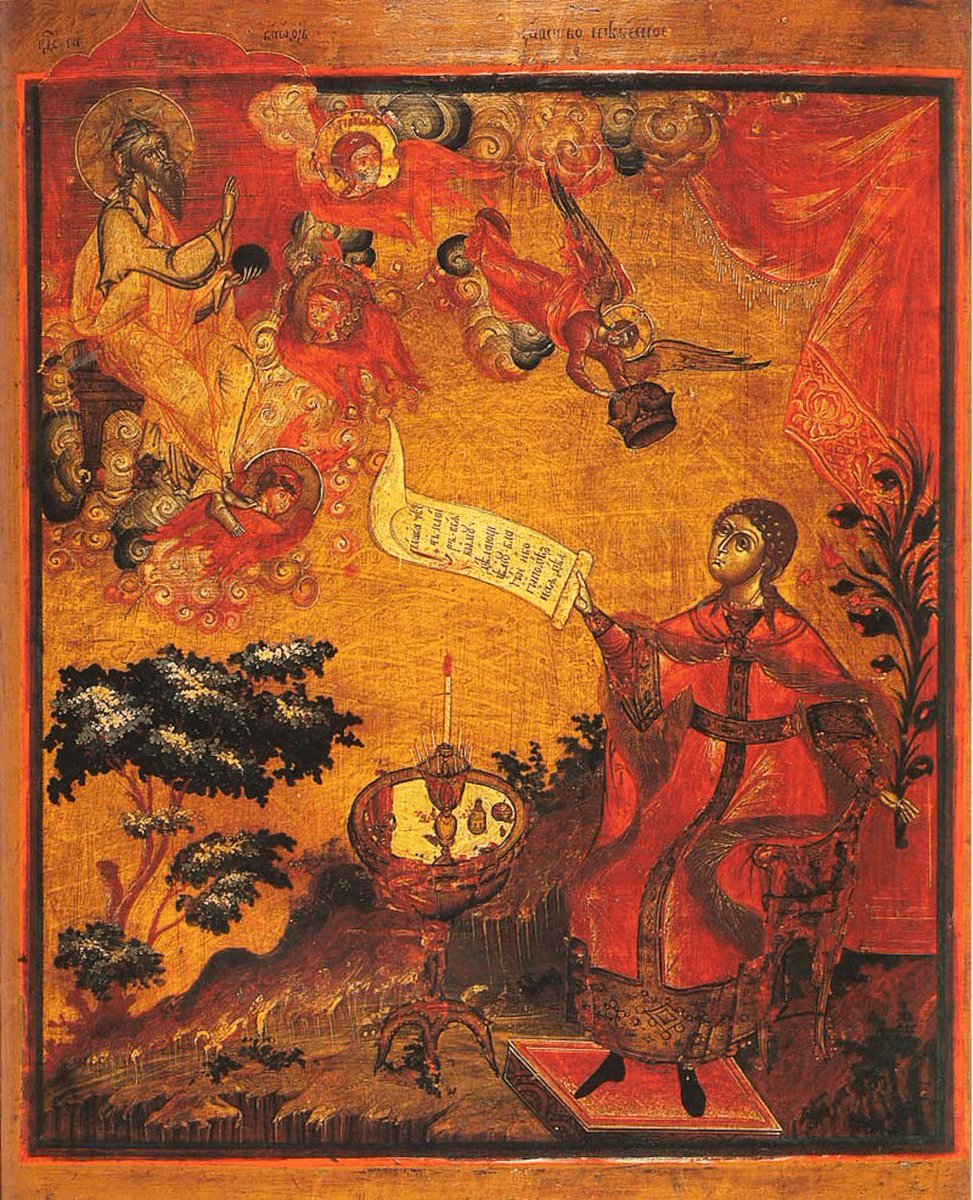
Icon of the Kingdom of Heaven
19th century Russian
State Museum of the History of Religion, St. Petersburg

What can this mean? This verse baffled me for years. How could it be, I thought, that people living at the time of Jesus have not yet tasted death? Surely all of them died by now.

If we read this without faith, it could read like an embarrassingly mistaken prediction of the time of the second coming – rather like all those doomsday dates that regularly get rolled out by various apocalyptic and fundamentalist groups - especially, I think, in this country.

The next date coming from Dr. F. Kenton Beshore is 2021. So, get ready, I guess. His previous prediction was 1988, but that embarrassment has not dissuaded him from making another prediction. I'll not go into his calculations.

The Lord is coming we know not when. Yet various Christians throughout the ages have made predictions as to what that date will be. Even some saints have gotten in on the act and made some predictions that turned out other than they expected.

But unlike all this merely human guesswork, surely the Lord Jesus Christ knows what he is talking about. And Jesus says to those standing with him almost 2,000 years ago that some of them will not taste death before they see the kingdom of God come in power. We know that everyone who was there all those years ago has by now tasted death. And we know that Jesus Christ, who is Truth himself, is not making an error here. He does not make errors. This leaves only one other possibility, that some who were standing there with Jesus did indeed see the kingdom of God come in power.

The Blessed Theophylact makes bold to name those Jesus means when he says "some standing here" and also to name the moment when they see the coming of the kingdom of God. He writes, 
Namely, Peter, James, and John, shall not die until [they see] at the Transfiguration the glory with which [Jesus] shall appear at the second coming. For the Transfiguration was nothing else than a foreshadowing of the second coming, and as he appeared shining then, so will he shine at the second coming, as will also all the righteous. 
To see the light of Jesus Christ on Mount Tabor is to see the coming kingdom of God as already come.

The Venerable Bede sees the coming kingdom of God also in another place. He writes, 
The present Church is called the kingdom of God, and some of the disciples were to live in the body until they should see the Church built up, and raised against the glory of the world.
If we can see the Church for what it really is, not obscured by the sin and corruption into which its worldly aspect has sunk, we would see it as the bride of Christ – one body with her bridegroom, who is the king of heaven and of earth.

To look upon Jesus on Mount Tabor and see in him the light of his Transfiguration; to look upon the Church and see in her the body of Christ; today, to look upon the cross and see there the king of glory enthroned  upon the cherubim; to see any of this, it is necessary to have eyes that see.

It's not a question of whether or not the Lord Jesus was right about the timing of the coming of the kingdom of God. It's a question of whether or not we have the eyes to see the truth that's all around us. It's a question of whether or not we have faith, which is the only way to know what's really going on. It's a question whether or not we have experienced the apocalypse.

We've forgotten what does the word apocalypse means. It doesn't mean the coming cataclysmic events surrounding the end of the world, at least not originally. The word apocalypse means "revelation" or, even more literally, an "unveiling." Some of you may remember a time when the Book of Revelation was commonly known as the Apocalypse of John. Apocalypse means Revelation. God revealing himself to us here and now.

Because he is here now. If we do not see him, it is not because he is not here, but because there remains a veil over our eyes, waiting to be lifted by his grace with the assent of our faith.

Today, we know from Jesus that there are some who have already seen the coming of the kingdom of God. So, why can't we see it? To that I say, who says we can't?

This is what this whole Byzantine Catholic way of life we’re trying to follow is meant to accomplish: the experience of God. This tradition is not a list of intellectual propositions to which we assent nor a series of rote behaviors we perform out of obligation or habit. It is tradition, not traditionalism, we have on offer here. “Tradition is the living faith of the dead; traditionalism is the dead faith of the living,” as Jaroslav Pelikan writes.

Our tradition passes on to us a bright and lively, warm and living experience of God. It opens our eyes to see the kingdom of God come in power. All this unceasing prayer and fasting, liturgy and sacrament, reading of scripture and the fathers is meant to unveil our eyes; to open our eyes to the light of Mount Tabor shining in all creation; to help us see the truth that God is with us and that his coming kingdom has come among us.

“The kingdom of God is not coming with signs to be observed. They will not say, “behold, here it is!” or “there it is!” for behold, the kingdom of God is within you” (Luke 17:21).

Sunday, August 26, 2018

An Invitation with Teeth

On Matthew 22:1-14

You know, for a wedding story, this parable is rather violent. Now, some of the guests invited to the wedding feast simply make light of it and – excusing themselves by this or that trifle – do not come. Others, however, shamefully seize and abuse and kill the servants whom the king sent bearing the glad news and invitation. Understandably outraged at this, the king sends in his troops. But they not only kill those heartless murderers, but also burn their entire city.

Having no guests left and finding his first-invited guests unworthy, the king invites in a multitude from the streets. This is where we come in, I expect. But the violence does not end here – for both the good and the bad now sit together at the feast – and the king makes sure the bad do not go unpunished.

He sees among the guests a man who has on no wedding garment and asks him how he got in so inappropriately dressed. The man says nothing. He is speechless. He has no defense. Some sources even say that the wedding garments would have been provided by the king in a situation like this. So what’s really going on here, once again, is refusal of the king’s hospitality.

So the king has him bound hand and foot and cast into the outer darkness where there is weeping and gnashing of teeth.

What is the meaning of all this violence? What kind of party is this? What party comes with such stakes? This is rather like getting a wedding invitation – but in fine print at the bottom is written, “come and celebrate with us or die.” It becomes rather clear that we are not talking here about the usual kind of wedding party. We might not want to be invited to a wedding like this – it sounds rather dangerous – but, like it or not, we are invited.

It is a free invitation to celebrate, but it’s an invitation you’d better accept. It’s an invitation with teeth. It is an occasion of great joy, but it is deadly serious. Those unwilling to partake joyfully will have hell to pay. Because this wedding feast, as Jesus says at the outset, is like the kingdom of heaven. The wedding garments we are to put on as we enter this feast are like those we put on at baptism and at the second baptism of holy repentance. That is, they are Christ himself, for all those who have been baptized into Christ have been clothed with Christ. To be thrown out of this wedding hall is to be thrown out the gates of heaven.  

But, you know, this party isn’t just exactly like heaven either. For one thing, it’s a party to which both the good and the bad have come. I’ve been to a few parties like that.… In fact, we’re at a party like that right now, if you think about it. This church – this Eucharistic celebration, is like a party to which both the good and the bad alike are invited. The sinners and the saints sit together in the pews…. For that matter, they’re usually sitting together in the same seat. If you’re wondering whether you’re a sinner or a saint, remember: you can be both. This struggle between the good and the bad happens mostly on the inside.

This parable reminds me of a passage in C.S. Lewis’ novel The Screwtape Letters, which I highly recommend. It’s framed as a series of letters from a senior demon named Screwtape to a junior demon – his nephew Wormwood – with advice on the best way to tempt a soul to keep him out of heaven and secure his place in hell. The demons sardonically call their victims “patients.”

Well, Wormwood gets in trouble one day when his “patient” converts to Christianity. Screwtape is mightily displeased. But, he assures his nephew, their hope of damning the poor soul to hell is not yet lost. “One of our great allies at present,” says Screwtape, “is the Church itself.”

You see, Screwtape is well aware of what Jesus is saying in today’s gospel: both good and bad guests fill the wedding hall – and the devils can use the bad ones to help corrupt the good. The Church in this world is a mixed bag. Don’t we know it.

Screwtape points out that the new Christian will get to his pew, look around himself and see just those neighbors “whom he has hitherto avoided.” You’ll want to “lean pretty heavily on those neighbors,” he advises Wormwood “It matters very little, of course, what kind of people that next pew really contains,” writes Screwtape. “Provided that any of those neighbors sing out of tune, or have boots that squeak, or double chins, or odd clothes, the patient will quite easily believe that their religion must therefore be somehow ridiculous... Never let him ask what he expected them to look like….”

It may be, of course, that “the people in the next pew” are actually good and holy people. Of course, if they’re not, writes Screwtape “– if the patient knows that the woman with the absurd hat is a fanatical bridge player or the man with squeaky boots is a miser and an extortioner – then your task is so much the easier.”

You see, the demons will use our sins not only to drag us down but also to drag others down with us if they can. Our neighbors see our sins and our hypocrisy and it sometimes convinces them that the Church itself is hypocritical or ridiculous or even evil. Of course, I’m reminded of that old retort to the common complaint that there are too many hypocrites in church: “Don’t worry, there’s always room for one more.”

So, let us not judge others. Let us look instead to our own sins.

That’s the point, I think. All are invited and welcome to the feast, regardless of their sinfulness. But those who accept the invitation have a serious duty. This love feast is not a free-for-all, come-one, come-all, do-as-you-please, orgiastic bacchanalia, no matter how it has been treated by members of the Church at all levels. This is a wedding feast – a celebration of commitment, fidelity, fruitfulness, life, and love. A wedding is where two become one, and at this wedding, we the Church become one with Christ our Lord. Those unprepared to celebrate these things – those unwilling to put on the wedding garment freely offered by our king – cannot remain in the kingdom of heaven. We are now before the gates of the kingdom of heaven and our king is inviting us in. His invitation is this: Repent and know the joy only Christ can bring.


This is a reworking of a sermon I preached two years ago: Celebrate or Die

Sunday, August 21, 2016

Celebrate or Die

Jesus likens the kingdom of heaven to a wedding feast (Matt 22:1-14). But, for a wedding story, his parable has a lot of murder and violence. Some of the guests invited to the wedding feast simply make light of it and – excusing themselves by this or that trifle – do not come. Others, however, seize and kill the servants whom the king sent bearing the glad news and invitation. In response, the king sends in his troops and kills not only those insensate murderers, but also their entire city.

Having no guests left and finding his first-invited guests unworthy, the king invites a multitude in from the streets. This is where we come in, I expect. But the violence does not end here – for both the good and the bad now sit together at the feast – and the king makes sure the bad do not go unpunished.

He sees among the guests a man who has no wedding garment and asks him how he got in so inappropriately dressed. If the man were guiltless, surely he would defend himself – protesting that he was invited by the king’s servants or that he was too poor to afford such finery. But the man says nothing. It would seem, then, that he has no excuse. So the king has him bound hand and foot and cast into the outer darkness where there is weeping and gnashing of teeth.

What is the meaning of all this violence? What kind of party is this? What party comes with such stakes? This is rather like getting a wedding invitation – but in fine print at the bottom is written, “Celebrate or die.” It becomes rather clear that we are not talking here about the usual kind of wedding party. We might not want to be invited to a wedding like this – it sounds rather dangerous – but, like it or not, we are invited.

It is a free invitation to celebrate, but it’s an invitation we’d better accept. It’s an invitation with teeth. It is an occasion of great joy, but it is deadly serious. Those unwilling to partake joyfully will have hell to pay. Because this wedding feast, as Jesus says at the outset, is like the kingdom of heaven. The wedding clothes we are to wear to this feast are those we put on at baptism. That is, they are like Christ himself, for, at baptism, we are clothed with Christ (Gal 3:27). To be thrown out of this wedding hall is to be thrown out the gates of heaven.  

But this party isn’t just exactly like heaven either. For one thing, it’s a party to which both the good and the bad have come. I’ve been to a few parties like that.

In fact, every Divine Liturgy is a party like that, if you think about it. Our Eucharistic celebration is like a party to which both the good and the bad alike are invited. The sinners and the saints sit together in the pews. For that matter, they’re usually sitting together in the same seat. If you’re wondering whether you’re a sinner or a saint, remember that you can be both. This struggle between the good and the bad happens mostly on the inside.

Jesus’ parable reminds me of a passage in C.S. Lewis’ novel The Screwtape Letters, which I highly recommend. It’s framed as a series of letters from a senior demon – Screwtape – to a junior demon – his nephew Wormwood – with advice on the best way to tempt a soul to keep him out of heaven and secure his place in hell. The demons sardonically call their victims “patients.”

Well, Wormwood gets in trouble one day when his “patient” converts to Christianity. Screwtape is mightily displeased. But, he assures his nephew, their hope of damning the poor soul to hell is not lost. “One of our great allies at present,” says Screwtape, “is the Church itself.”

You see, Screwtape is well aware of what Jesus is saying in today’s gospel: both good and bad guests fill the wedding hall – and the devils can use the bad ones to help corrupt the good. The Church in this world is a mixed bag.

Screwtape points out that the new Christian will get to his pew, look around him and see just those neighbors “whom he has hitherto avoided.” You’ll want to “lean pretty heavily on those neighbors,” he advises Wormwood “It matters very little, of course, what kind of people that next pew really contains,” writes Screwtape. “Provided that any of those neighbors sing out of tune, or have boots that squeak, or double chins, or odd clothes, the patient will quite easily believe that their religion must therefore be somehow ridiculous.… Never let him ask what he expected them to look like….”

It may be, of course, that “the people in the next pew” are actually good and holy people. Of course if they’re not, writes Screwtape “– if the patient knows that the woman with the absurd hat is a fanatical bridge player or the man with squeaky boots is a miser and an extortioner – then your task is so much the easier.”

You see, the demons will use our sins not only to drag us down but also to drag others down with us, if they can. Our neighbors see our sins and our hypocrisy and it sometimes convinces them that the church itself is hypocritical and ridiculous. Of course, I’m reminded of that old retort to the common complaint that there are too many hypocrites in church: “Don’t worry, there’s always room for one more.”

So, do not judge others. Look to your own sins.

That’s the point. All are invited and welcome to the feast, regardless of their sinfulness. But those who accept the invitation have a serious duty. This love feast is not a free-for-all, come-one, come-all, do-as-you-please, orgiastic bacchanalia. This is a wedding feast – a celebration of commitment, fidelity, fruitfulness, life, and love. A wedding is where two become one, and at this wedding, we the Church become one with Christ our Lord. Those unprepared to celebrate these things – those without a wedding garment – cannot remain in the kingdom of heaven. We are now before the gates of the kingdom of heaven and our king is inviting us in. His invitation is this: Repent, and know the joy only Christ can bring.

Holy Gate (Royal Doors), 16th century, 
Arkhangelsk Regional Museum of Fine Arts

Sunday, January 10, 2016

A reality to which we must respond


Sunday after Theophany

Christ is born! Christ is baptized! Christ is risen! Glory to Jesus Christ!

Today we are at a great convergence. It is the Sunday after Theophany, and so we are still remembering Christ’s baptism. And yet, according to one reckoning, it is also still the season of Christmas until the feast of the Encounter on February the 2nd, forty days after his birth. Meanwhile, today would be the first day leading into the Triodion – the Sunday of Zacchaeus – were it not for certain liturgical peculiarities due to Pascha being so early this year. There is no Sunday of Zacchaeus this year, but I think it’s still worth noting that the Great Fast is already right around the corner.

Time, the order of things, chronology, chronos is muddled, it seems. Simultaneous. Converged. It is as if all salvation history is happening at once. The first forty days of Christ’s newborn life is converged today with the forty days he fasted in the desert just after his baptism by John – which is a forty days that inspires our forthcoming Great Fast in preparation for Holy Week and Pascha, our commemoration of the death and resurrection of Jesus – the point of it all, the cause of our joy, our only hope.

Today’s gospel occurs immediately after Jesus’ forty days in the wilderness after his baptism by John in the Jordan. Jesus hears of John’s arrest and withdraws to Galilee, not out of fear, but to fulfill prophecy – and to there call forth the men that would be his apostles.

It is at this time that Jesus begins to preach. “Jesus began to preach and say, "Repent, for the kingdom of heaven is at hand.” These are the first words of his preaching and with them, he pays homage to John, his baptizer, the greatest of the prophets, his forerunner, who made straight his way. Jesus’ first kerygmatic words directly quote the preaching of John, who went before him to prepare his way.

"Repent, for the kingdom of heaven is at hand." These words are especially suitable today – on this day of convergence. What’s going on in the church calendar today reflects the timelessness of deeper reality. As does the imminence of the coming kingdom of heaven.

The Kingdom of Heaven is at hand. Jesus says this, as did John before him. But didn’t these preachers live and preach about 2000 years ago? How could the coming kingdom have been imminent then? Aren’t we still waiting for the kingdom? Don’t we pray, with every Our Father, “Thy kingdom come”?  We do, and our King is coming. But he has also already come. He is both already and not yet come. It is as if time is muddled. Simultaneous. Converged. It is as if all salvation history happens at once. God’s time is not like our time.

When John preaches that the kingdom of heaven is at hand, he preaches as one waiting for the coming king. When Jesus preaches the same thing, it is the very king who is preaching. The kingdom is indeed at hand when Jesus says that it is at hand – for he is the king and the kingdom is in his hands.

He is already come. He is in our midst whenever we gather in his name. He is now reigning in the hearts of those of us who believe.

We must not become like some of the fundamentalist prophecy enthusiasts of our era, obsessed with doomsday calculations and bible codes and what not. That, I think, is to miss the point.

In the Gospel of Luke, “the Pharisees [ask Jesus] when the kingdom of God [is] coming – [and] he answer[s] them, "The kingdom of God is not coming with signs to be observed; nor will they say, 'Lo, here it is!' or 'There!' for behold, the kingdom of God is in the midst of you" – or – it is “within you all” (Luke 17: 20-21).

God is to reign in our hearts. And we must make our hearts a suitable palace for our king. Origen observes that “The kingdom of heaven is not in a place but in disposition. For it is within us. John preaches the coming of that kingdom of heaven, which Christ the King will deliver up to God, even the Father” (Fragment 74). 

This is the reality to which Christ calls our attention with this – his first sermon – one sentence in length, but infinite in meaning. The kingdom of heaven is reality – not mere perception. Our perception, in fact, often misses it. We often fail to see that “The LORD is king for ever and ever; [and that] the nations shall perish from his land.” (Psalm 10:16). We often think that it is our worldly kingdoms or republics that are of primary importance and that deserve our most devoted attention.

But no, the truth is that the Lord is king and his kingship is over all the earth (cf. Psalm 22:28). In 2007, there was an effort in Poland to declare Jesus the king of Poland. Well, Jesus is king, but it is not by our fiat. He does not rule by the consent of the governed. Rather, the governed have being by the word of God, who is Christ, our king. The king of kings and lord of lords.

The kingdom of heaven is the world we are actually living in. It is the world that God so loved. It is the world we often cannot see because our vision is so clouded by sin. The kingdom of heaven is among us. It is imminent. The reign of God is in our hearts.

And this is a reality to which we must respond with repentance. If we do not repent, we cannot know the truth of God’s sovereign presence in our lives. He is present whether we know it or not. Repentance is how we come to know it. He is with us, and we must understand this and submit to him, for he is with us. Repentance – metanoia – is a turning toward the Lord and away from our consuming passions.

Away from gluttony and toward self-control.
Away from lust and toward desire for God.
Away from greed and the love of money and toward compassion for the poor.
Away from anger and toward goodwill and love for all. 
Away from dejection and toward joy.
Away from sloth and despondency and toward patience, perseverance, and thanksgiving
Away from vainglory and toward doing good in secret and contrite prayer
Away from pride and toward judging no one and regarding no one as beneath us.

These are the eight passions outlined by St. John Cassian, (whose leap day feast we incidentally get to celebrate this year on Feb. 29th) and their opposite virtues, which St. John of Damascus describes (On Virtues and Vices). Studying these can help us make a beginning of repentance. 

The kingdom of heaven is at hand. Therefore, let us repent.

Most Popular Posts this Month

Most Popular Posts of All Time