Showing posts with label Money. Show all posts

Sunday, December 2, 2018

A Needle is a Needle and a Camel is a Camel.

on Luke 18:18-27

I saw a comic strip recently. There's a preacher character standing in the pulpit before his congregation, rather like I am now standing before you, and he says, quoting Jesus, “It is easier for a camel to pass through the eye of a needle than for a rich man to enter the kingdom of God” – which is from the gospel we've just heard (Luke 18:25). And everyone in the congregation is looking aghast and worried. But then the preacher goes on to say, “And now I will tell you why that's not what he really meant.” And everyone in the congregation breathes a sigh of relief.

There's nothing new about this attempted dodge. Preachers have been trying to explain away this admittedly poetic image of Jesus since the early Church.

St. Cyril of Alexandria softens the blow a little bit by claiming that “by a ‘camel,’ [Jesus] doesn’t mean the animal of that name but rather a thick cable…. It is the custom,” claims St. Cyril, “of those well-versed in navigation to call the thicker cables ‘camels.’”[i] Okay, sure.

In modern times, it’s not uncommon to hear the claim that the “eye of the needle” was the name of a narrow gate into Jerusalem.

So, we’ve got some claiming that “camels” are thick cables and not animals and others claiming that the “eye of the needle” is a narrow gate and not the tiny hole on one end of a pin. It is difficult – but not impossible – to get a thick cable through the eye of a needle. And it is difficult – but not impossible – to get a camel through a narrow doorway. If we decide to agree with both of them, then getting the rich into heaven is no more difficult than passing a cable through a doorway! That’s downright easy!

Everybody’s trying to soften Jesus’ imagery here. Maybe we need not part with our riches after all – is the subtext.

from phatcatholic

But then there is, for example, St. John of Damascus, who writes,
“‘How hard it is for those who have riches to enter into the kingdom of God! It is easier for a camel to go through the eye of a needle than for a rich man to enter into the kingdom of God!’ When all the saints heard this command, they thought they should withdraw from this hardness of riches. They parted with all their goods. By this distribution of their riches to the poor, they laid up for themselves eternal riches. They took up the cross and followed Christ. Some followed [and were] made perfect by martyrdom…, while others by the practice of self-denial did not fall short of them…. Know that this is a command of Christ our King and God that leads us from corruptible things and makes us partakers of everlasting things.”[ii]

I think St. John of Damascus is closer to the mark on this one. While it is true that at times Jesus was given to the use of hyperbole – extreme exaggeration – to make his point. For example, elsewhere he says, “If anyone comes to me and does not hate his own father and mother and wife and children and brothers and sisters, yes, and even his own life, he cannot be my disciple” (Luke 14:26). Now, we know that Jesus teaches us to love one another, even as he has loved us (John 13:34), and he’s not contradicting that here. He’s using hyperbole to demonstrate how great must be the devotion we have to him as compared what we have to others. But, I don't think that's what's going on with the camel and the eye of the needle. I believe that what Jesus is saying here is literally true even if poetically expressed. Which is to say, the salvation of the rich is literally impossible for them. Harsh words. Bear with me.

These sorts of warnings against wealth were nothing new, by the way, biblically speaking. There is the proverb, “He who trusts in his riches will wither, but the righteous will flourish like a green leaf” (11:28). And our holy mother, Mary, the Theotokos, proclaims while pregnant with God, that the Lord “has filled the hungry with good things, and the rich he has sent empty away” (Luke 1:53).

It’s not that wealth is not a gift from the Lord. It is. But it is given to be used for his purposes. We like to pretend that our possessions are all our own accomplishment - as if we didn’t get every strength, talent, and opportunity we have from the Lord. We must learn gratitude and learn to recognize that every dollar we have is really the Lord’s. We are the stewards only and not the owners of our wealth. It is God’s wealth and meant to be used for his purposes, especially in this season of almsgiving. Let those who have give to those who have not. “The rich exist for the sake of the poor. The poor exist for the salvation of the rich,” says St. John Chrysostom. That is, the rich will be saved if they give to the poor. That is what their wealth is for.

Let’s not try to explain away Jesus’ admonition, but let’s take it to heart. When Jesus’ disciples hear what he has to say about the camel and the eye of a needle, they have the right instincts, which is not to question whether the Lord really means what he's saying but rather to see the full of implication and ask, “Who then can be saved?” When we hear Jesus say this hard word, we always want to say, “Oh sure the rich can to enter the Kingdom. You don’t really mean that, Jesus.” But his disciples at the time, rightly, took it the other way – “Then no one can be saved. What you’re saying, Jesus, is that this is impossible.” Yes, that’s right.

Notice that Jesus does not answer by saying, the poor only can be saved. Rather, he extends the dread impossibility of our salvation over all humanity saying, “For men it is impossible.” Not only for the rich is it impossible, but for all men and women it is impossible. See how he plainly says this now. A camel going through the eye of a sewing needle is impossible – not just difficult, but impossible – absurdly impossible. Period. And “impossible” is Jesus' own word to describe the situation. He means it. It is impossible. We cannot save ourselves. It’s as simple as that. It’s every bit as difficult as living forever.

“But for God all things are possible.” God alone could pass a camel through the eye of a needle. God alone can raise the dead. He can and he will. Because he loves us. Jesus, and not ourselves, is our savior. The archangel Gabriel says to Mary, “you shall call his name Jesus [which means ‘savior’], for he will save his people from their sins” (Matt 1:21).



[i] Commentary on Luke, homily 123
[ii] Barlaam and Joseph 15.128-29

Sunday, August 5, 2018

Forgive Everything

In a parable, our Lord Jesus Christ gives us a God’s eye view of sin and forgiveness (Matt 18:23-35).

An official owes his king ten thousand talents. The king is the Lord. You and I are the official. His debt represents our sinfulness. So, when Jesus describes this debt, he is actually describing our sinfulness, which concerns us personally and is worth considering carefully.
 
There are different estimates as to the actual value of ten thousand talents. We know that a talent was the largest unit of money at the time. It was worth about six thousand denarii, which was a day’s pay. 

So, a talent was more than 15 years of pay. So, even if a day’s pay was equivalent to less than half of the current minimum wage in Michigan, ten thousand talents would still be worth more than 2 billion dollars. Imagine the burden of a debt like that! It is an impossibly large sum – more than a laborer could make in two thousand lifetimes. 

It will help us to understand Jesus’ rhetoric a bit further if we also consider the word here for ten thousand – it’s μυρίος, which is the largest Greek numeral – and as such, it is sometimes used rhetorically and less technically to mean “countless” or “innumerable” – it’s where we get the word myriad. So the servant’s debt to his master is the largest numeral of the largest unit of money. In other words, it’s as big as it can be – that’s the point, I think.

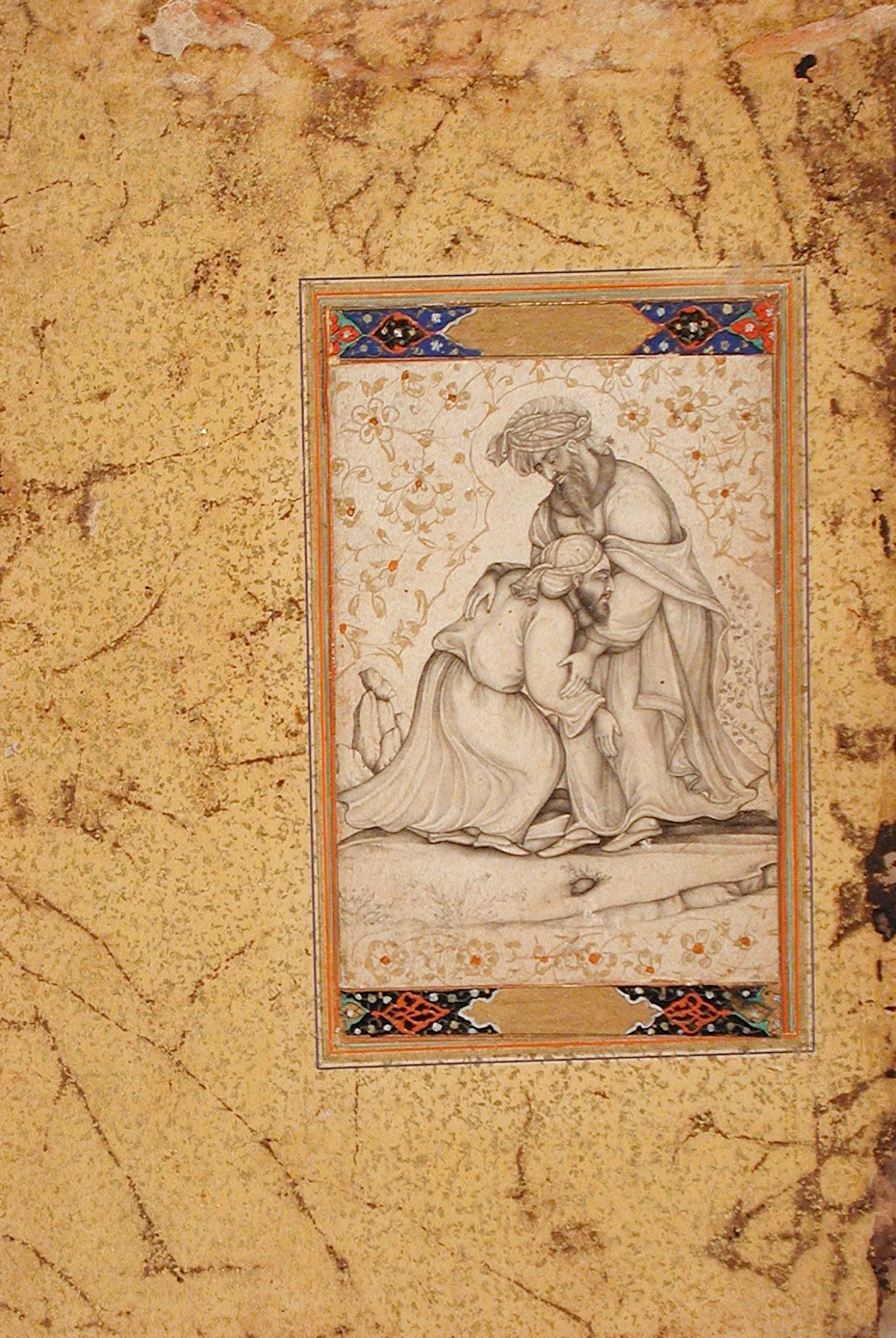
Mordecai and King Ahasuerus
India, Mughal, circa 1610
Ink with touches of color and gold
Paul Rodman Mabury Collection (39.12.76)
And it’s also possible that Jesus is making an allusion – because this isn’t the first time that the sum of ten thousand talents is mentioned in scripture. In the book of Esther, Haman, the enemy of the Jews, feeling himself insulted by the Jew Mordecai, offers to the Persian King Ahasuerus – also known as Xerxes – ten thousand talents of silver if he will agree to destroy all Jews (Esther 3:9).

Haman was indebted to his king ten thousand talents, just like the official in today’s parable. And for what? – for seeking “to destroy, to slay, and to annihilate all Jews”(Esther 3:13) – the people of God. So this sum of ten thousand talents here is blood money. The debt of the servant in today’s parable represents our sin  – and the wages of sin is death – and that death is born by the true Messiah of the Jews – Jesus Christ.

By our sins, we participate in the failed attempt to destroy Jesus, just as Haman, by his debt of ten thousand talents, participates in a failed attempt to destroy the Jews. In both cases, the Lord triumphs over sin and death. Through Esther, he delivers the Jews from oppression in Persia. And Jesus he raises from the dead. So there are meaningful parallels here, which show more clearly that this enormous debt is an image of sin and death.   

It is fitting that Jesus describes all our sinfulness with a parable about money – because the love of money is the root of all evil (1 Tim 6:10). But even if we think our sins don’t involve money, we mustn’t think that if that this isn’t about us – we must not leave this comfortably in the abstract.

We should feel invited to place ourselves in this parable as the servant, to examine our own consciences, and to discover our own sins against God and against our fellow servants. Sins perish in the light and thrive in the darkness – so we must name them and confess them to one another (James 5:16).

I cannot judge you. You and God alone know which sins trouble your hearts – and I can only know my own sins. We must all bring our sins to God in holy repentance, as the servant did at first – falling on his knees and begging for the patience and kindness of the Lord. When we do, we will receive the Lord’s forgiveness – which is more than the servant begged for.

Actually, when the extent of his debt is revealed, the servant stupidly asks for more time to pay back his king – it should be clear to us that this is a sum no servant could ever repay. It’s an absurdly large sum! This, I think, is how it must sound to the Lord if we ever say that we’ll make it up to him by being good people for the rest of our lives. That won’t make it up to him! That is good and necessary, but that doesn’t mean that it’s enough. Nothing we do can ever earn our union with God.

We are utterly and absolutely dependent upon his grace. Apart from the energies of God, there is no theosis. We do not partake of the divine nature by our own power, but by the power of God, with which we cooperate. We must make every effort to supplement our faith with virtue, but we must never think that our efforts can succeed unaided (2 Pet 1:3-5). They spring from, are supported by, and succeed in and only in the life of God, freely and gratuitously given by God.

So the king does not give his servant more time to pay him back, which would be impossible – no, he forgives the debt completely! He gives more than the servant asks for. The Lord is gracious and we depend upon his grace.

We must realize that our sin is like a debt too large for us to ever repay, and, having received the forgiveness of that debt, let us turn from our sin, repent, and sin no more. We should allow this seemingly inexcusable, impossible forgiveness and lovingkindness to prick our hearts so that we do not remain inert and insensible to our wickedness.[i] With all our hearts, let us turn away from the evils to which we cling and to which we are habituated and enslaved.

This turning, this repentance, this conversion, this μετάνοια begins, as our Lord demonstrates in this parable, with forgiveness. Not only with being forgiven, but also with forgiving others.

Our Lord taught us to pray, “forgive us our trespasses as we forgive those who trespass against us” (Matt 6:12). Or, a more literal translation is “Forgive us our debts as we forgive our debtors,” which closely ties the prayer to today’s parable of debts. So as we forgive, we will be forgiven. And if we are to have any hope for ourselves we must have the hope for others that forgiveness expresses.

After receiving the forgiveness of such an enormous amount, the servant should quickly and easily have followed his king’s example when a fellow servant begged for patience regarding a comparably small debt – a hundred denarii – a tiny fraction of what he had been forgiven.

The wrongs we suffer from our fellow servants – which really are wrongs – sometimes terrible wrongs – are nonetheless small when you compare them to the weight of our own sins against the Lord. So, let us remember our own sins and forgive others, as our heavenly Father forgives us.

Do not nurse hurt feelings or brood on wrongs. Do not let resentments grow in your hearts like weeds growing ever deeper roots. For, according to the measure with which you measure, it will be measured to you (Matt 7:2). If you would be forgiven, you must forgive – even those who don’t deserve it – even those who don’t ask for it – as Jesus and Stephen forgave those who were killing them even as they were driving the nails and throwing the stones (Luke 23:33-34; Acts 7:59-60). Let us imitate this indescribable love and forgive everything. 


[i] cf. Chrysostom, The Gospel of Matthew, Homily 61.1

Sunday, October 18, 2015

Who is the Sower?


Today’s Parable of the sower is among those that Jesus explains. He tells us that the seed is the word of God. And that the ground is all us folks. We’re like the dirt, which makes sense, given that we’re made of earth. Just as there’s different kinds of people, there’s different kinds of soil, and Jesus tells us what each kind represents.

The tramped down path from which the birds eat the seeds is like those easily deceived and distracted by the devil. 

The rocky soil in which no roots can take hold is like the quick and easy converts who like the good news but are unwilling to endure hardship for it and so as quickly turn away. Some act as if the baptistery has a revolving door. I’ve seen it many times.  

Pope Gregorius I dictating the gregorian chants
from the Antiphonary of Hartker
of the monastery of Saint Gall (Cod. Sang. 390, p. 13)
circa 1000
The soil full of thorns is like those consumed by the cares of this world. Like the rich man who went away sad when Jesus called him to generosity to the poor, for he was attached to many possessions (Matt 19, Luke 18). They were his master. St. Gregory the Great says “thorns are piercing and riches pleasurable. [But] riches are thorns because thoughts of them pierce the mind and torture it. When finally they lure a person into sin, it is as though they were drawing blood from the wound they have inflicted.”

Finally, the good soil is like those who hear the word of God and keep it. Like those who are doers of the word and not hearers only.

But Jesus doesn’t tell us who the sower is. Who is the sower?

There are a few different ideas about this. Some say that the sower is those who preach the word of God, those who gossip the gospel, those who, like the apostles, are sent into the world to proclaim the good news that Jesus, who is the word, has by his incarnation united God with humanity and by his death and resurrection has conquered sin and death. 

Certainly, when we preach this word of truth to the world, with our words and by our way of life, we will witness some who receive it wholeheartedly, like good soil receives a seed, and we will witness some who reject it out of hand, like the hard ground of a path which leaves seeds exposed to be trampled and for birds to eat, and we will witness every response in between.

And certainly, we must imitate the sower. Just as the sower scatters seed in every kind of soil, we must preach the word in the whole world, not only among those primed to listen. We must preach not only to the choir, but also to the workplace, and to the barroom, and to every place we frequent. We must put our lamp on a stand, not under a bushel, but that’s another parable.

It is a bit striking, don’t you think, that the sower even bothers to throw seed on the path and in the rocky soil and among the thorns? Is that the way a farmer plants? Indiscriminately throwing his seed all about? This sower scatters the seed everywhere, not just where it is likely to take root. This is born of a hope so hopeful that to the world it looks like folly. But you know, a path can be tilled. Rocky soil can be cleared. Thorns can be weeded. So we may yet hope for those who seem as yet unable to receive the word. We must keep sowing the seeds of the word among them. Our hope for them must be indefatigable.

Just seeds, mind you, does the sower cast into all conditions of soil. Only the seed of the word is offered to all. The fruit of that seed is yielded only in those who receive and tend it. Cast your seeds on rocky soil, yes, but not your pearls before swine.  

A seed is a small thing, but it is potent. Its potential is vast, but while yet a seed, it seems insignificant. This is the nature of the things we must say and do among those we hope to evangelize. Small things. A brief statement of our hope and our joy in the Lord. A small act of kindness and love.

This is the kind of sowing we can do, but I think that, as we do it, we will always discover that there are seeds of the word already present in every human heart. Someone has already been there! We imitate the sower, but we are not the first sower.

Patiently listen to those who seem hell-bent on rejecting all the things of God. Search for, in what they say and do, a seed of the word and you will usually find it already there, begging to be tended and nurtured. That is, they will already know something of love.

Everyone is loved, you know, even those who do not know they are loved. But even those who do not know it cannot help but be influenced by the fact of being loved. Even if it goes no further than a deep, unconscious recognition that they ought to be loved. That is a seed of the word. And to know that we are not made for suffering and death is a seed of the word. On some level, everyone knows these things, because the seeds of the word have been sown in them.

Who has sown them? Who is the sower?

John Chrysostom
miniature from Liturgies of John Chrysostom
and Basil the Great
,
Dujcev Research Centre - Sofia, Gr. 64, fol. 1v
18th century
Jesus identifies himself – the Son of man – as a sower in a different parable (Matt 13:37).  Regarding today’s parable, St John Chrysostom says, "The seed is the doctrine of Christ, the ground is the souls of men, and the sower is Christ Himself" (On Matthew, Homily 44). And after Chrysostom says something, it tends to be adopted by all, because he knows what he’s talking about.

But I’d like to point something out. Jesus doesn’t say that the seed is his “doctrine” exactly. He doesn’t speak of his διδαχή. He says that it is “the word of God – ὁ λόγος τοῦ θεοῦ.” The meaning is similar, but the difference is important – because who is the Logos of God? Jesus himself! Jesus is the seed. But if Jesus is the seed, is he also the sower? Well, why not? Jesus is the Good Shepherd and he is also the Lamb of God. He is the high priest, and he is also the sacrifice. So I think that he can also be both the Sower and the seed. 

Nonetheless, I also believe that the scripture and the parables of Christ can hold many complementary meanings. I believe that Jesus is the sower, and that we are also sowers in imitation of him. And I’d like to propose a third understanding of this parable.

Perhaps we can also understand the sower as God the Father. The Father is the source (ἀρχή) of the word. It is of the Father that the Son is begotten and from whom the holy Spirit proceeds. God the Father sends the word into the world by the power of his holy Spirit.

 The consummation of this sending is the incarnation of the word. “The word became flesh and dwelt among us.” But even before the incarnation and in every time and place, God plants the seeds of the word.

Justin Martyr
fresco by Theophanes the Cretan
and his son Symeon
in the Stavronikita Monastery
circa 1546
The holy martyr Justin the Philosopher says much about these seeds of the word. He believes that God has planted the seed of the word in every person and that the word that is within them is none other than the divine word who is incarnate in Christ. Even the pagan philosophers then, inasmuch as they are reasonable, and inasmuch as they know truth about anything, are dependent on Jesus Christ, even though they do not realize it. St. Justin writes, “Christ… is the Word of whom every race of men [are] partakers; and those who [live] reasonably [that is, according to the word] are Christians, even though they have been thought atheists” (First Apology, xlvi).  

Inasmuch as a person is on the side of truth and love, they are already Christ’s, for our God is truth and love. Our task, then, is not only to sow seeds but, perhaps more urgently, to tend the soil in which the Lord has already sown the seeds of his divinity.

Sunday, August 9, 2015

Ten Thousand Talents

Today in a parable, our Lord Jesus Christ gives us a God’s eye view of sin and forgiveness (Matt 18:23-35).

An official owed his king ten thousand talents. The king is the Lord. You and I are the servant. His debt represents our sinfulness. So when Jesus describes this debt, he is actually describing our sinfulness, which concerns us personally and is worth considering carefully.

There are different estimates as to the actual value of ten thousand talents. We know that a talent was the largest unit of money at the time. It was worth about six thousand denarii, which was a day’s pay. So a talent was more than 15 years of pay. Even if a day’s pay was equivalent to less than half of the current minimum wage in Indiana, ten thousand talents would be worth more than a one and a half billion dollars. So we are talking about a huge amount. Imagine the burden of a debt like that. It is an impossibly large sum – more than a laborer could make in two thousand lifetimes. 

It will help us to understand Jesus’ rhetoric a bit further if we also consider the word here for ten thousand – it’s μυρίος, which is the largest Greek numeral – and as such, it is sometimes used rhetorically and less technically to mean “countless” or “innumerable” – it’s where we get the word myriad. So the servant’s debt to his master is the largest numeral of the largest unit of money. In other words, it’s as big as it can be – that’s the point, I think.

And it’s also possible that Jesus is making an allusion – because this isn’t the first time that the sum of ten thousand talents is mentioned in scripture. In the book of Esther, Haman, the enemy of the Jews, feeling himself insulted by Mordecai, offers to the Persian King Ahasuerus – also known as Xerxes – ten thousand talents of silver if he will agree to destroy all Jews (Esther 3:9).

Haman was indebted to his king ten thousand talents, just like the official in today’s parable. And for what? – for seeking “to destroy, to slay, and to annihilate all Jews”(Esther 3:13) – the people of God. So this sum of ten thousand talents here is blood money. The debt of the servant in today’s parable represents our sin. And the consequence of our sin is death – and that death is born by the true messiah of the Jews – Jesus the Christ.

By our sins, we participate in the failed attempt to destroy Jesus, just as Haman, by his debt of ten thousand talents, participates in a failed attempt to destroy all Jews. In both cases, the Lord triumphs over sin and death. Through Esther, he delivers the Jews from oppression in Persia. And he raises Jesus from the dead. So there are meaningful parallels here. This enormous debt is an image of sin and death. 

It is fitting that Jesus describes all our sinfulness with a parable about money – because the love of money is the root of all evil. But we mustn’t think that if our sins don’t involve money that this isn’t about us – we must not leave this comfortably in the abstract.

We should feel invited to place ourselves in this parable as the servant, to examine our own consciences, and to discover our own sins against God and against our fellow servants. Sins perish in the light and thrive in the darkness – so we must name them and confess them.
I cannot judge you. You and God alone know which sins trouble your hearts – and I can only know my own sins. We must all bring our sins to God in holy confession, as the servant did at first – falling on his knees and begging for the patience and kindness of the Lord. When we do, we will receive the Lord’s forgiveness.

When the extent of his debt is revealed, the servant stupidly asks for more time to pay back his king – it should be clear to us that this is a sum no servant could ever repay. This, I think, is how it must sound to the Lord if we ever say that we’ll make it up to him by being good people for the rest of our lives. That won’t make it up to him! That is good and necessary, but that doesn’t mean that it’s enough. Nothing we do can ever earn our reunion with God. We are utterly and absolutely dependent upon his grace. Apart from the energies of God, there is no theosis. We do not partake of the divine nature by our own power, but by the power of God, with which we cooperate. We must make every effort to supplement our faith with virtue, but we must never think that our efforts can succeed unaided (cf. 1 Pet 1:4-5). They spring from, are supported by, and succeed in and only in the life of God, freely and gratuitously given by God.

So the king does not give his servant more time to pay him back, which would be impossible – no, he forgives the debt completely! He gives more than the servant asks for. The Lord is gracious and we depend upon his grace.

We must realize that our sin is like a debt too large for us to ever repay, and, having received the forgiveness of that debt, let us turn from our sin, repent, and sin no more. We should allow this seemingly inexcusable, impossible forgiveness and lovingkindness to prick our hearts so that we do not remain inert and insensible to our “natural wickedness.”[i] With all our hearts, let us turn away from the evils to which we have become habituated and enslaved.

This turning, this repentance, this conversion, this μετάνοια begins, as our Lord demonstrates in this parable, with forgiveness. Not only with being forgiven, but also with forgiving others.

Our Lord taught us to pray, “forgive us our trespasses as we forgive those who trespass against us.” Or, a more literal translation of the Lord’s Prayer is “Forgive us our debts as we forgive our debtors,” which closely ties the prayer to today’s parable of debts. So as we forgive, we will be forgiven. And if we are to have any hope for ourselves we must have the hope for others that forgiveness expresses.

After receiving the forgiveness of such an enormous amount, the servant should quickly and easily have followed his king’s example when a fellow servant begged for patience regarding a comparably small debt – a hundred denarii – a tiny fraction of what he had been forgiven.

The wrongs we suffer from our fellow servants – which really are wrongs – sometimes terrible wrongs – are nonetheless small when you compare them to the weight of our sins against the Lord. So forgive others, as the Lord forgives you. Do not nurse hurt feelings or brood on wrongs. Do not let resentments grow in your hearts like weeds growing ever deeper roots. For, according to the measure with which you measure, it will be measured to you (Matt 7:2). If you would be forgiven, you must forgive. Even those who don’t deserve it. Even those who don’t ask for it. But especially those who do.

In light of the great blessing and forgiveness shown him, the unmerciful servant’s unwillingness to forgive his fellow servant who begs for patience is inexcusable. It is so offensive to his king that he rescinds his earlier forgiveness, and turns the servant over to the jailers till he should pay all his debt, which, according our holy fathers Apollinaris and John Chrysostom, is another way of saying “forever,” because the debt is immeasurable and is more than he could ever repay.

The king’s action here reveals something about forgiveness I believe we should notice. You often hear the expression, “forgive and forget” – and this maxim is often held up as a Christian ideal. You should know first of all that this phrase is nowhere in scripture. And when the Lord says to Isaiah that he will not remember sins (43:25; cf. Heb 8:12), I don’t think we should understand this to be a blank space in God’s omniscience. I think it means rather poetically that he puts aside the sins he has forgiven and does not cause us to suffer their full consequence. He still knows what we have done, for he knows everything. And the king in today’s parable demonstrates this. Remember that the king is Jesus’ own image of God. Yet, after he has forgiven the servant’s debt, he clearly still knows its amount – because after the servant is unmerciful the king turns him over to the jailers after all – till he should pay it back. When justice demands it, the king is able to remember the debt.

We should actually find comfort in this because, even if we are unable to forget a wrong completely, this does not mean we cannot forgive. Forgiveness is possible, even when forgetting is impossible.

And thank God, because if we do not forgive, the king will turn us over to the jailers forever. Apollinaris writes that these jailers represent “the angels entrusted with our punishment.” Still worse than this punishment is another: Jesus says, “So also my heavenly father will do to every one of you, if you do not forgive your brother from your heart.” As Chrysostom points out, Jesus does not say “’your father’ [or ‘our father’] but ‘my father.’ For it is not proper for God to be called the Father of one so who is so wicked and malicious.”[ii]  The greater punishment is to lose our familial relationship with God, gained by our baptism and our faith. It is a rejection of both to condemn our brothers and sisters – to damn instead of to bless – to have an unforgiving heart – to rejoice in the suffering of our enemies.

So we must remember our own sins and forgive others their sins against us. Then, as we forgive, our heavenly Father will forgive our sins against him, which are far greater. So let us imitate “the indescribable love of God” and forgive everything.  


[i] cf. Chrysostom, The Gospel of Matthew, Homily 61.1
[ii] Ibid 61.4

Most Popular Posts this Month

Most Popular Posts of All Time