Showing posts with label Resurrection. Show all posts

Sunday, March 24, 2019

The Gospel of the Cross


Before we process with it to the tetrapod on for the Veneration, the Holy Cross is on the holy table in the place where the gospel usually rests. The typicon instructs us to place it there before Vespers the night before the Veneration of the Holy Cross. It rests on the holy table all night long in the place of the Holy Gospel. How can anything take the place of the Holy Gospel? Nothing can. But that Holy Cross contains within itself the whole gospel.


What is the gospel?

Christ is risen from the dead. By death, he tramples death and to those in the tombs, he grants life.

That’s the gospel.

We’re about halfway to the great day when we get to sing those words - halfway to Pascha. This week is the midpoint of the Great Fast. And here, in the middle of the fast, in the middle of the church, stands the cross.  

Only in and through the cross is the gospel of resurrection available to us. The only way to life is through death.

Jesus says today that whoever loses their life for his sake and for the sake of the gospel will save it. That sounds like the cross, doesn’t it? The way to the gospel is the way of the cross. The way to life in Christ is death in Christ. We are baptized into his death so that we might also rise with him.  

But then Jesus says that there are some who will not taste death before they see that the kingdom of God has come with power (Mark 9:1).

Most of us hear that and think that sounds pretty good. We think, "Hey, I hope I get to be one of those people who doesn't have to taste death." But, if we're saying that, it's like we haven't been listening to what Jesus is saying about the cross.

Are we following him, or aren’t we? To go after Jesus means to embrace the cross. Would we rather not taste death unless first we see the kingdom of God? Unless we have proof? Do we need to be impressed with power first? Must we see to believe?

Jesus says that if we want to come after him, we must lose our life  (Mark 8:35) and let him save it instead of trying to save ourselves. Those of us who try to save ourselves are lost. We fail as saviors. There is one savior, and his name is Jesus Christ.

Is anything in our life or even our whole life more precious to us than life in Christ? Are we afraid to lose it? Or even to lose worldly things or comfort, or position, or human respect, or power?

Are we ashamed of him or of the cross ? Do we care more for the esteem of our fellow humans than for being the beloved of God? Do we regard the opinions of this adulterous and sinful generation to be of some great weight (Mark 8:38)?

When Jesus calls a generation adulterous, it’s worth remembering that we are adulterous whenever we are unfaithful to God by failing to keep his commandments. Whenever we hold anything or anyone or our own lives higher than God in our hearts, that is adulterous.
It’s worth periodically examining our priorities so that we may repent when they get out of whack. So that we may return again to the Lord and renew our focus on him.  

The way of the cross is the way of repentance, which “is the beginning, middle, and end of the Christian way of life,” as St. Gregory Palamas says.

Fascinatingly, to be marked with the cross was a sign of repentance even before Christ. In the prophecy of Ezekiel, those who sigh and groan over the sins of Jerusalem are marked with this sign on their foreheads (Ezekiel 9:4; Jerome Commentary).

Let us be unashamed of Jesus Christ and of his cross. Wear a cross to remind others and yourself that you’re a Christian. Make the sign of the cross whenever you pass by a church or a cemetery or a funeral, whenever you hear a siren or pass by an accident, before you eat a meal. Fill your whole life with reminders of the cross.

And do not forget even for one day that your own true life was created upon that cross – your life in Christ was born there and, if you embrace that cross, it will continue with him forever. For that it is worth giving up everything.

Sunday, October 7, 2018

Pray for the dead, and God will raise them up.

The Lord always chooses to heal us, to save us, to deliver us, and to raise us up from the dead through the prayers and intercession of one another. Silouan the Athonite observes, “When God wants to have mercy on someone, he inspires someone else to pray for him, and he helps in this prayer.” Why does God do this? Could he not act for our good directly and without this intercession? Of course he could! He's God! But this is not how he chooses to act. Maybe he wants to teach us something. Maybe he wants to teach us to love one another by giving our intercessory prayer, which is an expression of our love for one another, so much power.  

Never doubt the great power of your prayers for those you love – for your family, your neighbors, your friends, and your enemies. Pray for them – for everyone you can think of. Fervently. Those who are critical of prayer – saying, “We need your action, not your prayers” – have no faith in God. Do not be persuaded or intimidated by them. It's true that active service is also needed and that God calls us to it. It’s not to be neglected. In addition to prayer, we must also give drink to the thirsty and food to the hungry, clothes to the naked and shelter to the homeless. But this never negates the power of prayer.

Our prayer beseeches God, who is mighty. He can overcome obstacles we cannot even touch or fathom. For example: death. I can and should give a hungry person food, but can I raise the dead? Only if I pray for those who have died – because it is Christ, the life of all, who raises the dead. I can bury them with prayers for their resurrection and I can help them in no other way but by the power of prayer.  

Today, the Lord, who alone gives life to the dead, overcomes the death of the only son of the widow of Na’in. Let me call your attention to certain details of this story. The young man who had died is the only son of his mother. And Jesus is the only son of his mother. "The Virgin's son meets the widow's son," as St. Ephrem the Syrian says.[i]  So there is immediately a connection between our Lord and this dead young man.  

The death of the young man had crushed his mother. She was weeping. Jesus knew that he was also going to die and that his death would pierce his own mother's heart with sorrow. So when he saw this grieving mother, he had compassion on her. That is, I think he saw in her sorrow a foreshadowing of the sorrow his own mother would feel when he would die. To have compassion is to suffer with someone. Jesus is able to suffer with this woman perfectly and completely knowing that his own mother is headed for the same pain.

It was for this widowed mother and on her behalf that Jesus raises the young man from the dead. The Lord saw her, had compassion on her, and therefore told the young man to arise. For the sake of the tears of the mother, Jesus gives life to her dead son. For the sake of the tears of his mother, Jesus will give life to us who have been dead in our sins.

His mother is also our mother because we are in Christ. St. Ambrose writes, "We are members of his body, of his flesh and of his bones. Let the pious mother grieve, let the crowd, too, help…" Our love and prayers for one another are truly helpful. Never believe they are not. They lead to resurrection. The Lord works his miracles through them and because of them. All you who are in Christ wield great power and authority over sin and death. They cannot defeat you in him who is the life. “Already at the funeral you will arise.  Already will you be released from the sepulcher. The attendants at your funeral will stand still. You will begin to speak words of life. All… will praise God, who has bestowed upon us such great help for the avoidance of death.”[ii] And all this because you were loved and prayed for by others. By your mother. If not your earthly mother, then certainly by your heavenly mother.

Mary prays for us. Let us also pray for one another, especially for those who have died. When we attend funerals, let us bring Christ with us in our hearts, because when Christ comes to a funeral, as we see today, he brings life to those who have died and he, who alone can, dries the tears of those who mourn.


[i] Commentary on Tatian's Diatessaron 6.23.2
[ii] Exposition of the Gospel of Luke 5.92.

Friday, September 14, 2018

The Bitter is made Sweet by the Cross

The Israelites were in the wilderness for three days with no water. And then, when they found a place with water, it was so bitter they could not drink it. So they named that place Marah, which means “bitter.” Dying of thirst, the Israelites then murmured against Moses, saying, "What shall we drink?" And so Moses cried to the Lord and the Lord showed him a tree. Moses took the wood of this tree and threw it into the water – and the water became sweet (Exodus 15:22-25).


We heard this story in the first reading of Vespers last night. This is because it is a prefiguration of the cross, which we exalt today. The tree shown to Moses by the Lord is a type of the cross. The bitter water that the Israelites find after three days with no water is like the bitterness of our lives of sin and suffering and death. When Moses throws the wood into the bitter water, it becomes sweet. And when we accept the cross into our sinful lives, which lead to death, our lives become sweet and our deaths lead to everlasting life in Christ.

Apart from our sweet Lord Jesus, life is surely bitter. It is a place like Marah.

Interestingly, the name of Mary may have the same root as Marah. We're not actually sure what the name Mary means. It may mean “longed-for-child” or “beloved.” Unfortunately, I don’t know any Hebrew, so I can only tell you what other people think it might mean. But, in any case, it may also mean “sea of bitterness.” This is a rather shocking possible meaning for the name Mary – at least for us Christians who love and venerate Mary. I was shocked when I first heard it suggested that Mary means “bitter.”

But that meaning begins to make a great deal of sense in the context of this story from Exodus. Mary was conceived and born in the ordinary way – and she was conceived and born into a world before the incarnation of her son. So, her human nature did not yet know that it was to be personally joined with the divine nature in her son, Jesus Christ. Mary is the bitter water of fallen humanity made sweet by the entrance of divinity inside her. The bitterness of the human nature that Mary is born into is made sweet by the son she bears, who enters into that humanity through her. Through her, God takes on our flesh and even its mortality, first embracing death, even a bitter death on a cross, and then conquering it in his sweet resurrection.

Death, without the cross, is everlasting, and that is a bitter pill to swallow. But today, on the cross, and nowhere else does Christ enter into death, and, by his death, he tramples death. And that is sweet. Now, in paradox of the cross, death has become the way to life.

This is fully accomplished only in and through the cross. And if we will partake of that sweetness, we must follow the way of the cross. We must drink the water we thought was bitter – the water of self-sacrificial love – and we will find that it has been made sweet by the wood of the cross.

Sunday, May 7, 2017

Rise

Christ is risen! And now Jesus is telling us to rise. The Risen Lord raises us.

To the paralytic, Jesus says "Rise – take up your pallet, and walk” (John 5:8). Jesus says "Rise" to a paralytic in each of the four gospels.

To Aeneas, Peter says, "Jesus Christ heals you; rise and make your bed” (Acts 9:34).

And to the disciple Tabitha, Peter says, “Tabitha, rise” (Acts 9:40).

Rise. Rise. Rise.

Saint Augustine says that this is the word of healing - "the conferring of the cure."[i] To rise is to be healed, made whole, restored to the fullness of life. This makes a lot of sense if we are illuminated. And by that I mean baptized, chrismated, and communed in the Lord Jesus Christ.

It’s not happenstance that the healing of the paralytic in John takes place next to a pool, which, when stirred by an unseen spirit, brings healing of body to one submerged in it (John 5:4). This is a type or prefiguration of baptism. We are buried with Christ in death by being submerged in the waters of baptism, which have been stirred and "sanctified by the power, action, and descent of the Holy Spirit,"[ii] so that we will rise up with Christ out of death into everlasting life by rising up out of the waters of baptism.

Several of the fathers[iii] also point out that this pool is where the priests would wash the animals to be sacrificed to the Lord in the temple. This further strengthens the image of baptism evoked by the Sheep Pool. Because we who are baptized are baptized into the sacrificial death of Jesus, the Lamb of God – whose death destroys death and raises us up from death to everlasting life.

You see, when we are baptized, we are like the paralytic hearing the word of the Lord - "Rise". Before baptism, we are still paralyzed – that is restricted, not free, but enslaved to death and to the consequences of our mortality – to the bodily passions and sin. But through baptism, God fills our lives with grace – with the life of God, with his own energies, which free us from our enslavement to these things.

Maybe we lose sight of our own freedom sometimes. Because we often fall again, pining after the fleshpots of Egypt, wishing we were enslaved again with full bellies, or wishing we were paralyzed again, because when we were paralyzed all we had to do was lie around. Now that we can walk, we must carry our pallet. And that's hard work. We must do the work of living the life in Christ. And it isn't always easy. So sometimes like a dog returns to its vomit we return to our sin, even after we've been baptized and freed from it.

But if we do, our Lord who loves us unconditionally comes to us again in the second baptism of holy repentance. In this holy mystery, it is as if he says to us again, "Rise, take up your pallet and walk." Again healing us with the word "Rise." And again he follows that with the commission to be about the work of God.

This is like when he forgives the adulterous woman (John 8:1-11). He forgives her saying, "Neither do I condemn you; go." She can go. She is free to go. She will not be subjected to punishment for her sin. But he continues, "and sin no more." Now that we've been forgiven, we are free to live a sinless life – a holy life – a grace-filled life – a life impossible without grace but made possible by grace. It is God's own life he invites us to live.

This is part of what Jesus means I think by telling the paralytic to take up his pallet and walk. This is a meaningful command. We know that this healing takes place on the Sabbath. And we know that the Jews said it was not lawful to carry a heavy burden on the Sabbath. Did Jesus forget? I don't think he did. I think every word he speaks is well thought-out, profoundly meaningful, and inspired.


It is worth recalling that Torah nowhere explicitly forbids carrying an item from one place to another on the Sabbath. Torah forbids work on the Sabbath. But what is work? Later, Mishnah strives to answer this question. Mishnah developed to serve as “a fence around Torah”[iv] – to make it so that if a pious Jew follows Mishnah, he cannot come even close to breaking Torah. So later, after the time of Christ, Mishnah would outline 39 types of work forbidden on the Sabbath including carrying an object from one house to another.[v] But all this was still in dispute at the time of Jesus. And, in any case, these are human laws built around Torah and not Torah itself. Jesus above all has the authority to supersede Mishnah. And he himself is the word of God before all ages and is himself the source of Torah.

Jesus knew he was commanding the paralytic to break this Mishnah regarding the Sabbath. He does know everything after all. So I believe he had a good reason for telling him to do this. Or many good reasons.

Saint Ephrem the Syrian points out that it would have been a great miracle just for Jesus to say to the paralytic, "arise and go" even if he had not also had him take up his pallet and walk "Would it not have been a miracle that he, who was not able to turn himself about on his bed, should arise easily and go?" But he also makes him carry his bed. Why? Ephrem writes that this is "to show that he had given him a complete healing..., not like the sick who come back to health gradually.... Even if he were silent," Ephrem writes, "his bed would cry out."[vi] So the carrying of the bed demonstrates to all the totality and immediacy of the healing available in Jesus Christ.  

Saint Caesarius of Arles offers a more allegorical interpretation which I quite like. He says that taking up our pallet means to carry and govern our bodies. (Sermon 171.1) You see, before he encountered Christ, the paralytic was carried about by his pallet. It bore him. But after he encounters Christ and confesses to him his weakness – saying “there is no one to put me in the pool when the waters are stirred” – after this, Christ says to him, “Rise, take up your pallet, and walk.” Now he carries the pallet. Now he carries that which had carried him. He bears it.

This is so like the bodily passions of our bodies subject to death. Before Christ or without Christ our bodily passions – hunger, lust, sloth, and so on – rule over us. We go where they say – do what they want - obey them. We are not free. But Christ frees us. In him, we are free. But notice, he does not tell us to cast away the pallet – the body, or even in some sense the passions. But to rise, take them up, and walk. Our bodies and even our passions can be redeemed and restored to their true nature and purpose in Jesus Christ, in whom we are free, in whom these things are not our masters, in whom we are the masters of these things.

Our passions and appetites and impulses are distorted by sin. They are run amok – drunk with power – having been given by us disordered dominion over our whole lives. As for example when we allow fear of the difficulty involved in making a virtuous choice to prevent us from so doing. And we take the easy way out. But I don't believe that the passions and impulses and appetites in us are in themselves contrary to our true nature. With Saint Isaiah the Solitary, I believe these come originally from God and so are good in essence. But we need to carry them rather than them carrying us. Our passions must, with God's help, “be educated, not eradicated…, transfigured, not suppressed…, used positively, not negatively.”[vii] Having risen in Christ, we must carry our pallets rather than being carried by them.


[i] Tractates on the Gospel of John 17.7
[ii] special petition in the Litany of Peace before the blessing of the baptismal waters
[iii] E.g. Theodore of Mopsuestia, Augustine, Alcuin
[vi] Commentary on Tatian's Diatessaron 13.2.
[vii] G.E.H. Palmer, Philip Sherrand, and Kallistos Ware, eds., “Glossary,” in The Philokalia: The Complete Text, Volume One (London: Faber and Faber, 1979-1995), 364.

Sunday, October 9, 2016

Regarding the Dead in the Light of Resurrection


Jesus, his disciples, and a great crowd following them come to the city of Na’in, which exists to this day – a small village near Nazareth at the foot of Mount Tabor. As they approach the gates of the city, a funeral procession pours out through them. The only son of a widow had died.

These funeral processions could be a spectacle. When a loved one would die, a crowd would soon gather because the dead were usually buried immediately. There were people professionally dedicated to mourning those who died – sort of like funeral directors of the first century – accompanied by flute players, and people weeping and wailing loudly as they process and carry the departed one to the place of burial (cf. Matt 9:23; Mark 5:38; Luke 8:52).  

Jesus comes upon this scene in Na’in and he has compassion.

Notice how the Jews carry the body out of the city gates. They take the body away from us. They don't keep the body here with us where we live. This is of course a common approach toward dead bodies even now. And it was common in the ancient world also among both pagans and Jews.

Dead bodies were regarded as unclean by the Jews. For the Lord had said to Moses and Aaron that any who touch a dead body or even go into a tent where a person has died shall be unclean seven days (Num 19:11, 14). Therefore, priests, who had to remain ritually pure at all times so that they could serve in the temple, especially had to keep their distance from the dead (Lev 21).

It's important to bear that in mind when we see Jesus, our great High Priest, go near the body of the dead man and touch his funeral bier out of compassion. The bearers stood still (Luke 7:14). And no wonder, for such an act would have surprised them.

Among the Jews, the mitzvah to accompany the deceased to burial is more important than most other obligations, which is why they would willingly accept that period of uncleanness on behalf of their loved ones. Even a priest would do so if it was for his own son or other close relation (Lev 21:2). But for a stranger? That is unusual.

It would have been customary for Jesus and those with him to turn and escort the funeral procession a short distance to show respect for the man who had died and sympathy for his mother and the other mourners. But for Jesus, who was not of this man's family, to defile himself by reaching out and touching the bier and stopping the procession was far from customary. He does this out of compassion and in so doing teaches us a new attitude toward the dead.

Think about what Christians do with the dead. Do we also avoid them and keep them in a separate place? No. No, we go into to the catacombs to worship God there. We use the tombs of our martyrs as our altars. We commune with those who have died. We believe in the communion of the saints. We bring their bodies inside our churches and put them in our altars. We venerate relics. We kiss the bones of our saints. Our attitude toward the dead is different because we follow Jesus who raises the dead.

And the first person he ever raised from the dead was the only son of a widow in Na’in at the foot of Mount Tabor. Jesus touches the bier and says to the dead man, “I say to you, rise.” And the young man sits up. The one who gave him life gives him life again. The one who speaks life into being in the beginning speaks life into being again.

This is the first time that Jesus raises the dead, but it's not the last. Three times he raises the dead before he himself dies and rises from the dead.

He later raises the daughter of Jairus, practically at the moment of her death (Matt 9:18–26, Mark 5:21–43, Luke 8:40–56).

He raises this son of the widow from Na’in, who had died earlier that day.

And he raises Lazarus who was four days in the tomb and beginning to decay (John 11:39).

Sometimes doctors have to say they were too late to save someone, but it’s never too late for the Lord. When Lazarus is dying, Jesus waits four days before coming to him. Already he has risen the dead but still people don't understand and so they think it a pity he had not come sooner (John 11:37). Still, people are bound up so temporally in their thinking. It’s now or never, we think, but in Christ there is forever.

These resurrections prefigure our own coming resurrection. It makes no difference to the Lord who made Adam out of dust whether we have just died or have turned back to dust. He will raise up because he has compassion on us.

He is rightly called the Lover of Mankind. He alone can end our weeping.

Jesus has compassion on the widow and he tells her, “Do not weep.” Maybe everyone around her was telling her that – “Don't weep.” Sometimes people say that more for their own comfort than to comfort the afflicted one. It is not something I would recommend saying to a mother who has just lost her son. But Jesus alone has the authority to say “Do not weep.” For Christ alone, the Word of God, words bring into being. When he says to the widow, “Do not weep,” he knows what comfort he alone can give. He alone can give her back her son and so he alone can righteously say, “Do not weep.”

When he later comes to the house of Jairus and the crowd is beginning to mourn the little girl, Talitha, with wailing and weeping, and the flutes are beginning to sound, Jesus has compassion on them and he says “Do not weep.”

Later Jesus comes to Bethany and sees Mary weeping over her brother Lazarus, already four days in the tomb. And, deeply moved, Jesus weeps (John 11:35). Now, he who alone has the authority to say, “Do not weep,” weeps. So he is with us even in our weeping. And he raises Lazarus also from the dead.

Before his own death and resurrection, Jesus raises these three. Then, at the moment of his death, “the tombs were opened, and many bodies of the saints who had fallen asleep were raised” (Matt 27:52).

All of this is to show that Jesus's resurrection is not exclusively a revelation of his own divinity and unique power over death. It is that. But his resurrection is more than that too. His resurrection is for us. In him, we rise from the dead.

If we really believe this, it changes things for us. It changes the consequence of everything for us if we remember that after we die we will rise again and live forever in Christ. We are infinite and everlasting. You only live once, they say, but in Christ you live again forever. I'm telling you, this erases our fear of death and changes our perspective about everything.

It might change what you want to put on your bucket list, for example.

It should change our attitude toward politics. You know someone rightly said that here we have no lasting city, but we seek the city that is to come (Hebrews 13:14).  And the Letter to Diognetus says that, to Christians “every foreign land is a homeland, and every homeland is a foreign land.” Death and resurrection erase distinctions we think are so important.

The resurrection should change our attitude about wealth. What is the point of saving and accumulating great wealth, I wonder, except to increase our comfort on this earth? This earthly and temporal life becomes pretty inconsequential when held up against eternal life (cf. Matt 6:19-20).


The resurrection changes everything. So let us remember the resurrection and be changed by it. 

A version of this article appears on Catholic Exchange

Sunday, March 20, 2016

Between Two Resurrections

Palm Sunday

“Lazarus! Come out!” So Jesus calls to his friend who has died, over whom he has wept, and who has lain four days in the tomb. Cyril of Jerusalem points out, “One day had passed, and a second, and a third: his sinews were decayed, and corruption was preying already upon his body.”[1] And yet Lazarus does come out, still wearing his grave clothes, but as alive and well as you or me.

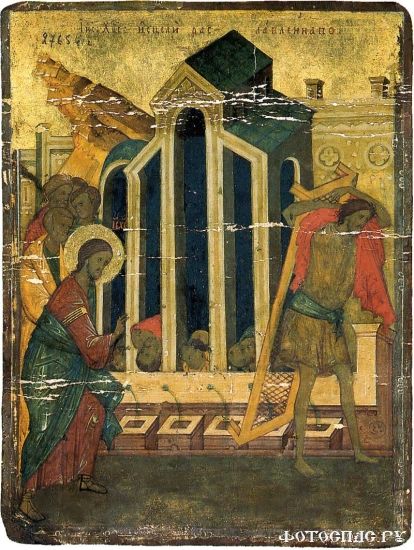
Resurrection of Lazarus. Private coll., Athens. 12-13 c.
When the One Who, in the beginning, speaks life into being tells one of us, his creatures, to live, though we lie in a tomb, we will live. Whether we have been dead four days, like Lazarus, or four thousand years, we will heed this command of our master. When the one who made us out of dust tells us to arise, though our bodies have turned to dust, we will arise. Dust cannot resist the divine word at resurrection time. 

The resurrection of Lazarus was yesterday and the resurrection of Jesus is next Sunday. Between these two resurrections is today and Holy Week. Today, Palm Sunday, is inextricably linked to yesterday, Lazarus Saturday. Liturgically, they form a unit all their own, between the Great Fast and Holy Week. So, though we rightly call today Palm Sunday in commemoration of Christ’s triumphant entry into Jerusalem as King and Messiah, let’s not forget the place of Lazarus in all of this, who appears at the beginning, the middle, and the end of today’s gospel.

The gospel begins with Lazarus, who had been dead, eating supper with Jesus and his disciples. This is one of the signs of the resurrection of the body. Only a truly embodied person eats food. Jesus will repeat this sign after his own resurrection, when he will eat broiled fish with his disciples in Jerusalem (Luke 24:42). By this sign, we know that Lazarus and Jesus are truly risen in the body and not merely ghosts or visions.  

And then, in the middle of the gospel, we learn of a further connection between Jesus and Lazarus. Not only are the chief priests now plotting to put Jesus to death, but also Lazarus, “because, on account of him many of the Jews were going away and believing in Jesus.”

According to tradition, Lazarus, unlike Jesus, escapes their plot and lives on another thirty years. When he dies a second time, they lay him in a sarcophagus on which they write, “Lazarus of the four days and the friend of Christ.” For four days, Lazarus knew death, which no one else among the living has ever known. The Synaxarion says he never spoke of it and some say he never laughed again until he saw a man stealing a clay pot. And then he laughed, saying, “One earth steals another” (cf. Sanidopoulos).

And then at the end of today’s gospel, after Jesus’ triumphant entry into Jerusalem, we learn why the great crowd is so exultant and why they hail Jesus as their king: because he has raised Lazarus. This miracle more than all the others convinces multitudes that Jesus is the Christ. By raising Lazarus, Jesus shows that he can raise us all and that he will save us – even from the last enemy, even from death. This divine triumph even over death is the sign that brought so many to belief in Jesus.

And this belief of the people is what motivates the Pharisees and chief priests to take action against Jesus. They see that, due to this great sign, many are believing in Jesus and they fear that this will provoke the Romans to come and destroy them. The high priest Caiaphas, though motivated by cowardice, unintentionally prophesies, saying, “It is expedient for you that one man should die for the people, and that the whole nation should not perish” (John 11:50). And so, in the gospel of John, they plot to put Jesus to death as a direct result of his resurrection of Lazarus. 

Jesus’ resurrection of Lazarus leads today to his triumphant entry into Jerusalem – but it will soon lead also to his death. Quite directly, Jesus lays down his own life in exchange for giving life to his friend Lazarus. There is no greater love. Ultimately, Jesus lays down his life to give life to us all. It is good to be a friend of Christ Jesus. Even though you die, he will give you life.

Today, we sing again the Troparion of Lazarus from yesterday:
Christ our God, before your passion you confirmed our common resurrection when you raised Lazarus from the dead. Therefore, like the children, we carry the symbols of victory and cry out to you, the Victor over death: Hosanna in the highest! Blessed is he who comes in the name of the Lord.

I believe that, through Lazarus, Jesus has something to teach us about death. When Lazarus dies, Jesus weeps. And then, he raises Lazarus from the dead. This is our perfect model for how to approach death.

First, death is an occasion for weeping. It is a sorrowful thing. It is a terrible thing. It is an unnatural thing. It is the last enemy. It is not a natural part of life. It is not “going to a better place.” It is a thing to be lamented. It is a thing to put an end to.

Nevertheless, for each of us there is a time to die (Eccl. 3). For Lazarus, there are two times to die. And for Jesus, there is a time to die. The death of Jesus is like no other, because he alone is Life. And so death cannot keep him in his clutches. When life enters into death, it is death that dies at last.

 Loretta Lynn sings, “Everybody wants to go to heaven, but nobody wants to die.” And that’s mostly right, and for good reason. Jesus did not want to die. And he wept again when his time for death drew near to him in Gethsemane. “In the days of his flesh, Jesus offered up prayers and supplications, with loud cries and tears, to him who was able to save him from death, and he was heard for his godly fear.” (Heb 5:7).  

So in the face of death, first we weep, as Jesus weeps, and then, after our weeping, we accept death. We embrace the cross, as Jesus does. We learn to love our enemy. And then, on the other side of that gaping chasm of Hades, there is hope, because Jesus, the way and the life, has gone there first. In him, there will be a restoration of all things to right. After death, there comes a better life with the resurrection. It is not better for us to be dead. It is not better for our souls to be “freed” from our bodies. It is better for us to rise in Christ and live again in bodies freed from mortality. So, yes, we grieve in the face of death, but we do

not grieve as others do who have no hope. For since we believe that Jesus died and rose again, even so, through Jesus, God will bring with him those who have fallen asleep…. For the Lord himself will descend from heaven with a cry of command, with the archangel's call, and with the sound of the trumpet of God. And the dead in Christ will rise first… and so we shall always be with the Lord. Therefore comfort one another with these words (1Th 4:13-18).

Bottom of Form

[1] Cyril of Jerusalem, “Lecture V - Of Faith,” in Nicene and Post-Nicene Fathers (Series 2): The Catechetical Lectures of St. Cyril, ed. Alexander Roberts et al., vol. 7, Cyril of Jerusalem, Gregory Nazianzen (Grand Rapids, MI: Hendrickson Pub, 1996), 31

Sunday, February 21, 2016

The natural unity of our bodies and our souls

On Mark 2:1-12 
Second Sunday of the Great Fast
Our Holy Father Gregory Palamas

When we look at each other – especially when we look at strangers or people on the street – we often don’t really see the person before us. We might see someone in our way, someone we have to wait behind in line at the grocery story, or we might see the apparent poverty of a beggar, or the struggles of a blind person preparing to cross at a busy intersection.

We may tend to see the condition of human bodies, while having little regard for human spirits. We may be attracted to some and repelled by others. We may automatically judge one other on the basis of appearance.

We may keep our heads down in a crowd, afraid of making eye contact, because sometimes that’s the moment when we see a bit more than the body, which can be unnerving or make demands upon us. Jesus even says that “the eye is the lamp of the body,” which, if sound, fills the whole body with light. So when we look another in the eye, sometimes we see not only a body, but also catch a glimpse of the light (or the darkness) that fills a body.

But when Jesus looks at us, he always sees us entirely as we are. When four men lay down their paralyzed friend before him on a pallet, Jesus sees the man. If it had been one of us, most would first have seen the man’s paralysis. But that is not what Jesus first sees. Rather, he sees their faith, and he says to the man immediately, “My son, your sins are forgiven.”  

When Jesus looks at the scribes sitting there, he doesn’t only see their silent lips, but sees in his spirit that they question him in their hearts. Again, he sees the whole person before him, whether they are filled with light or with or darkness. He knows us inside and outside. He knows us in spirit and in body. 

Jesus then demonstrates that he does also see the paralytic’s need for healing and he tells the man to rise, take up his pallet, and go home. So Jesus is able to see the whole man and he can see that he needs two kinds of healing. He needs healing of both body and soul. He needs to rise and walk, but he first needs forgiveness of his sins.  

These things do not exist in isolation from one another. As long as we are living this life, we need continual healing of both body and soul. We need repentance, which is therapy for our soul, as much as we need any kind of physical therapy for our bodies. Our need for forgiveness and our need for healing are really the same need, because our bodies and our souls are not two separate things but one thing, mysteriously interconnected.

Our holy father Gregory Palamas, who we always remember and celebrate on this second Sunday of the Great Fast, recognizes the gift of healing as one of those charisms of the Spirit that “operate through the body.” He writes,

“Healings and miracles never take place unless the soul of the one exercising either gift be in a state of intense mental prayer and his body in perfect tune with his soul…. The communication [of the Spirit] takes place… not only during the mental prayer of the soul, but also at moments when the body is operating.”[i]

Our bodies and souls work in conjunction to bring God’s healing into our lives.
Palamas writes about this in his work on “the Hesychast method of prayer and the transformation of our bodies.” The Hesychasts’ prayer does not disregard the body, but incorporates both breath and posture into prayer. We pray in spirit and in body. And we experience God in spirit and in body. Because we are spirit and body. And because God, who is spirit, has become man, who is body and spirit. 

We are body and spirit at the same time. Our bodies and souls are meant for each other. We are a psychosomatic unity. We are not only bodies animated by electrical impulses and controlled by our brains, as the materialists would have it. Nor are we only immaterial spirits inhabiting or trapped in bodies that confine us until our release from them at death, when they will pass away, as the Platonists and Gnostics would have it.

A soul is the life of a body and the human soul is also an immortal and everlasting spirit, which means that the body – though it dies, and thus experiences an entirely unnatural separation from its soul – will naturally rise again and live forever. There will be resurrection. It’s not the resurrection that is unnatural; it is death that is unnatural. Resurrection is a natural response to the unnatural reality of death.

Our veneration of relics – of the dead bodies of the saints – of the relics of St. Gregory Palamas – is not merely a remembrance of what they were but also an expectation of what they will be again. Our bodies will rise again. Our bodies have a place in everlasting union with our immortal souls.

I emphasize this because both materialism and disregard for the body have strong footholds in our culture and even among some people in the church. These ideas deny or ignore the resurrection and the natural unity of our bodies and our souls. And it is essential to our faith to get right this this understanding of our human nature – this Christian anthropology. 

If you gloss over the importance of our bodies as well as our souls, you miss the whole purpose of Christ’s resurrection. You miss what he has accomplished for us by rising from the dead in his body – which is our salvation - our salvation - the salvation of us who are bodies and are souls and are spirits.

Let me give some examples of the disregard for our bodies found all around us. First, one from our culture: a few times I’ve seen this new-agey bumper sticker (maybe you have too), which states, "We are not human beings having a spiritual experience. We are spiritual beings having a human experience."

Second, one from among Christians: C.S. Lewis is often misquoted as saying: ““You don’t have a soul. You are a soul. You have a body.” When you see this quote floating around the internet, be aware that he never said this.[ii]

These quotes are both half-truths. It is true that we are spirits. It is true that we are souls. I don’t merely have a soul, I am a soul: that much is true. But I am also a body. It is the way that God has made us from the beginning. And it is part of the human nature that God takes on in his incarnation.

Finally, an example regarding attitudes toward fasting. The great fast is a great time for reflecting on the importance of both body and spirit in human nature. A coworker of mine and I were discussing the great fast and she told me about how, at a local community she used to belong to, they would emphasize that we are to fast from fear. They’re not wrong that we are to fast from fear. Paul told us to have no anxiety about anything. And John teaches us that perfect love casts out fear. This kind of fear, as opposed the holy fear of the Lord, is born from a failure to trust in God. To that I would add that we are to fast also from all the other sins and vices of the spirit: malice, envy, rage, despair and so on. 

But we must not emphasize these things over and against the fast of the body, I don’t think. Whatever good we do in spirit, we must echo with our bodies. Because we’re not spirits trapped in flesh, we’re flesh with spirit breathed in by God. Physical matter isn’t a problem and it isn’t an illusion. Rather, it is a means by which God unites us to himself.


[i] “The Hesychast method of prayer and the transformation of our bodies,” 13. The Triads, 53.
[ii] http://www.firstthings.com/blogs/firstthoughts/2014/01/the-spiritualist-origins-of-you-dont-have-a-soul-you-are-a-soul

Sunday, January 10, 2016

A reality to which we must respond


Sunday after Theophany

Christ is born! Christ is baptized! Christ is risen! Glory to Jesus Christ!

Today we are at a great convergence. It is the Sunday after Theophany, and so we are still remembering Christ’s baptism. And yet, according to one reckoning, it is also still the season of Christmas until the feast of the Encounter on February the 2nd, forty days after his birth. Meanwhile, today would be the first day leading into the Triodion – the Sunday of Zacchaeus – were it not for certain liturgical peculiarities due to Pascha being so early this year. There is no Sunday of Zacchaeus this year, but I think it’s still worth noting that the Great Fast is already right around the corner.

Time, the order of things, chronology, chronos is muddled, it seems. Simultaneous. Converged. It is as if all salvation history is happening at once. The first forty days of Christ’s newborn life is converged today with the forty days he fasted in the desert just after his baptism by John – which is a forty days that inspires our forthcoming Great Fast in preparation for Holy Week and Pascha, our commemoration of the death and resurrection of Jesus – the point of it all, the cause of our joy, our only hope.

Today’s gospel occurs immediately after Jesus’ forty days in the wilderness after his baptism by John in the Jordan. Jesus hears of John’s arrest and withdraws to Galilee, not out of fear, but to fulfill prophecy – and to there call forth the men that would be his apostles.

It is at this time that Jesus begins to preach. “Jesus began to preach and say, "Repent, for the kingdom of heaven is at hand.” These are the first words of his preaching and with them, he pays homage to John, his baptizer, the greatest of the prophets, his forerunner, who made straight his way. Jesus’ first kerygmatic words directly quote the preaching of John, who went before him to prepare his way.

"Repent, for the kingdom of heaven is at hand." These words are especially suitable today – on this day of convergence. What’s going on in the church calendar today reflects the timelessness of deeper reality. As does the imminence of the coming kingdom of heaven.

The Kingdom of Heaven is at hand. Jesus says this, as did John before him. But didn’t these preachers live and preach about 2000 years ago? How could the coming kingdom have been imminent then? Aren’t we still waiting for the kingdom? Don’t we pray, with every Our Father, “Thy kingdom come”?  We do, and our King is coming. But he has also already come. He is both already and not yet come. It is as if time is muddled. Simultaneous. Converged. It is as if all salvation history happens at once. God’s time is not like our time.

When John preaches that the kingdom of heaven is at hand, he preaches as one waiting for the coming king. When Jesus preaches the same thing, it is the very king who is preaching. The kingdom is indeed at hand when Jesus says that it is at hand – for he is the king and the kingdom is in his hands.

He is already come. He is in our midst whenever we gather in his name. He is now reigning in the hearts of those of us who believe.

We must not become like some of the fundamentalist prophecy enthusiasts of our era, obsessed with doomsday calculations and bible codes and what not. That, I think, is to miss the point.

In the Gospel of Luke, “the Pharisees [ask Jesus] when the kingdom of God [is] coming – [and] he answer[s] them, "The kingdom of God is not coming with signs to be observed; nor will they say, 'Lo, here it is!' or 'There!' for behold, the kingdom of God is in the midst of you" – or – it is “within you all” (Luke 17: 20-21).

God is to reign in our hearts. And we must make our hearts a suitable palace for our king. Origen observes that “The kingdom of heaven is not in a place but in disposition. For it is within us. John preaches the coming of that kingdom of heaven, which Christ the King will deliver up to God, even the Father” (Fragment 74). 

This is the reality to which Christ calls our attention with this – his first sermon – one sentence in length, but infinite in meaning. The kingdom of heaven is reality – not mere perception. Our perception, in fact, often misses it. We often fail to see that “The LORD is king for ever and ever; [and that] the nations shall perish from his land.” (Psalm 10:16). We often think that it is our worldly kingdoms or republics that are of primary importance and that deserve our most devoted attention.

But no, the truth is that the Lord is king and his kingship is over all the earth (cf. Psalm 22:28). In 2007, there was an effort in Poland to declare Jesus the king of Poland. Well, Jesus is king, but it is not by our fiat. He does not rule by the consent of the governed. Rather, the governed have being by the word of God, who is Christ, our king. The king of kings and lord of lords.

The kingdom of heaven is the world we are actually living in. It is the world that God so loved. It is the world we often cannot see because our vision is so clouded by sin. The kingdom of heaven is among us. It is imminent. The reign of God is in our hearts.

And this is a reality to which we must respond with repentance. If we do not repent, we cannot know the truth of God’s sovereign presence in our lives. He is present whether we know it or not. Repentance is how we come to know it. He is with us, and we must understand this and submit to him, for he is with us. Repentance – metanoia – is a turning toward the Lord and away from our consuming passions.

Away from gluttony and toward self-control.
Away from lust and toward desire for God.
Away from greed and the love of money and toward compassion for the poor.
Away from anger and toward goodwill and love for all. 
Away from dejection and toward joy.
Away from sloth and despondency and toward patience, perseverance, and thanksgiving
Away from vainglory and toward doing good in secret and contrite prayer
Away from pride and toward judging no one and regarding no one as beneath us.

These are the eight passions outlined by St. John Cassian, (whose leap day feast we incidentally get to celebrate this year on Feb. 29th) and their opposite virtues, which St. John of Damascus describes (On Virtues and Vices). Studying these can help us make a beginning of repentance. 

The kingdom of heaven is at hand. Therefore, let us repent.

Sunday, March 2, 2014

Creedal Foundations and the Resurrection of the Dead in the Apostolic Fathers

                   The writings of the Apostolic Fathers are the earliest extant patristic texts. One, the Didache, was possibly written as early as 50 (though some scholars date it closer to 150) and the latest, Second Clement, was likely complete before 170 (Galli, 10-14). They are called apostolic because they are by (or about, in the case of the Martyrdom of Polycarp) figures who likely had direct experience of the apostles. This is more likely in some cases than in others, but at any rate, the recently living apostles of Jesus Christ certainly directly influenced the era in which these Fathers wrote. This earliest age of Christianity significantly predates the formulation of the creeds that have since endeavored to ensure some degree of doctrinal unity within Christianity.
               The closest things to a creed found in the writings of the Apostolic Fathers are in the epistles of Ignatius of Antioch, who, writing before 117, approvingly observes that the Smyrnæans are 
“fully persuaded with respect to our Lord, that He was truly of the seed of David according to the flesh, and the Son of God according to the will and power of God; that He was truly born of a virgin, was baptized by John, in order that all righteousness might be fulfilled by Him; and was truly, under Pontius Pilate and Herod the tetrarch, nailed [to the cross] for us in His flesh. Of this fruit we are by His divinely-blessed passion, that He might set up a standard for all ages, through His resurrection, to all His holy and faithful, whether among Jews or Gentiles, in the one body of His Church” (86). 
This statement of Christian belief parallels significantly the order and content of the creed that would eventually develop at the councils of Nicaea and Constantinople (see page 10), and so it may be reasonable to suppose that the later councils built the creed, in small part, upon this foundation, of course filtered through centuries of baptismal creedal formulations.
Joanne McWilliam Dewart suggests a different reading of the resurrection in this statement of Ignatius. She reads, “Through the [rather than ‘His’] resurrection for his saints and faithful” (McWilliam Dewart, 47, emphases mine), as though Ignatius means to refer to the resurrection of the just and not simply of the resurrection of Christ. Ignatius’ omission of reference here to universal resurrection may or may not imply, as McWilliam Dewart suggests, that Ignatius believed in resurrection exclusively for the just (37).
While Ignatius might imply that God will not raise the unjust, the Didache states this plainly. Being primarily a guide for living according to “the way of life” (377), the Didache has very little to say about the resurrection of the dead, but what it does say is interesting. It ends with a simple apocalypse similar to that found in the Gospel of Mark (Mark 13:14-37) and it is in this context that it makes its only statement about the resurrection: “And then shall appear… the resurrection of the dead, yet not of all, but as it is said: The Lord shall come and all His saints with Him” (382, emphasis mine). The Didache is here interpreting a passage in Zechariah, which states, “Then the LORD your God will come, and all the holy ones with him” (Zech 14:5). The Didache erroneously identifies “coming with the Lord” with “resurrection,” rather than with “reigning with Christ Jesus” (cf. 2 Tim 2:12) or with the “resurrection of life” (John 5:29) This interpretation is contrary to the understanding of the Church, as it would develop in the following centuries.
One important and distinctive article of the Christian faith expressed in the Nicene-Constantinopolitan Creed is that, “we look forward to a resurrection of the dead and life in the age to come” (Constantinople I, 24). Importantly, this “resurrection of the dead” does not include a qualification like that found in the Didache and consequently implies a resurrection of all the dead. Interestingly, this article was not included in the creed from the first council of Nicaea in 325 (Nicaea I, 5), but the first council of Constantinople added it in 381. Clearly, the Church only gradually realized the necessity of including this statement in the creed. Perhaps the first council of Nicaea considered it sufficient to attest to the resurrection of Christ, in which all resurrection is accomplished. The first council of Constantinople, however, encountered the need to clarify this belief further. Of course, the real foundation of this belief is Sacred Scripture, but to what extent do the Apostolic Fathers, hundreds of years before Nicaea, maintain and pass down the scriptural belief?
Although not without occasional ambiguity, there is ample support, in fact, for belief in the resurrection of the dead among the Apostolic Fathers, bearing in mind that the purpose of their writings was not doctrinal formulation, but more often exhortatory. Clement of Rome, in his epistle to the Corinthians, written in 96 or 97, offers a reasonably lengthy discussion of the resurrection of the body, considering that this is not the primary intention of his writing. During the course of this discussion, he associates the resurrection of the Lord Jesus Christ with the coming resurrection. He writes, “There shall be a future resurrection, of which He has rendered the Lord Jesus Christ the first-fruits by raising Him from the dead” (Clement, 11). The Apostolic Fathers frequently us this image of Christ as the first fruits, which implies that others will rise as He did (McWilliam Dewart, 36). The image also appears in Paul’s first Epistle to the Corinthians (1 Cor 15:23). Clement further states that “the Lord continually proves [this] to us” through the testimony of nature’s numerous and continuous “resurrections.” He gives the cycle of night and day and the cycle of sowing and harvesting of grain as examples. (11). He also compares resurrection of the flesh to the fabulous life cycle of the phoenix (12). The fleshly and physical nature of these analogies suggests that Clement probably understands resurrection to be embodied and not shadowy, as would the contemporarily competing Gnosticism. Clement’s citation of Job as scriptural proof for the reality of the resurrection further strengthens the understanding of its physicality. He paraphrases the passage of Job that says, “After my skin has been thus destroyed, then from my flesh I shall see God” (Job 19:25-26). Clement’s cyclical analogies, however, do not repeat his initial association of resurrection with that of Christ. Consequently, it is not entirely clear whether Clement understands the universal resurrection as primarily caused by Christ’s resurrection and triumph over death, or as primarily a function of good created nature. Furthermore, Clement never in his epistle specifically declares that resurrection is universal, as do certain other Apostolic Fathers, but rather limits his discussion to the positive resurrection of the just. Clement does not directly imply that resurrection was limited to the just, as did Ignatius, arguably; he simply leaves the issue of the resurrection of the unjust unaddressed.
That resurrection will take place for all people, Ignatius may actually imply in his Epistle to the Ephesians, which, in the course of a reflection on the newly established kingdom of God, states, “God… meditated the abolition of death” (57). Ignatius’ use of the term “abolition” as opposed to, for example, “relaxation” implies a total and complete end to the finality of death. For the abolition of death to be complete, the resurrection of all the dead would be necessary. However, declarations of Ignatius’ actual understanding of this issue, considering how scant his discussion of it is, are conjectural at best.   
Despite his possible ambiguity on the universality of resurrection, Ignatius does provide some further patristic support for the orthodox Christian belief in the bodily resurrection of the dead, which the council would later describe in the symbol of faith. He provides this foundation primarily in his discussion of the bodily resurrection of Christ contained in his Epistle to the Smyrnæans, in which he writes, “I know that after His resurrection also He was still in the flesh, and I believe that He is so now” (Ignatius, 87). He then quotes a passage from the apocryphal Gospel of the Nazarenes, which echoes a passage in the canonical Gospel of Luke, in which the eleven apostles, having seen the risen Lord, believe Him to be a spirit, to which the Lord replies, “See my hands and my feet, that it is I myself; handle me, and see; for a spirit has not flesh and bones as you see that I have" (Luke 24:39). Ignatius maintains and passes on this scriptural basis for belief in the resurrection of the flesh, writing also, “After his resurrection He did eat and drink with them, as being possessed of flesh” (87). This emphasis is typical of Ignatius, who is consistently careful, against Docetism, to affirm the fleshly character of the resurrection of Christ and the essential unity of the body and the spirit in the human person (McWilliam Dewart, 48-49).
Ignatius, more clearly than Clement, connects the resurrection of Christ with the resurrection of others in his Epistle to the Magnesians, writing, “[On] the Lord’s Day…, our life has sprung up again by Him and by His death” (62). He reaffirms this point still more clearly in his Epistle to the Trallians, in which he writes, “Jesus Christ… was also truly raised from the dead, His Father quickening Him, even as after the same manner His Father will so raise up us who believe in Him by Christ Jesus” (70). Here, once again, Ignatius provides a passage open to an accusation of denial of the resurrection of nonbelievers.
To this possible interpretation, Polycarp, whom Ignatius greatly admired[1], provides a possible corrective. In the context of exhorting deacons, youths and virgins to a virtuous life, Polycarp reminds his readers of the purpose in acting in ways that are pleasing to God: that in the resurrection, they may “reign with Him” (2 Tim 2:12). Some of those God raises, by inference, will not reign with Him. In his Epistle to the Philippians, likely written before 120, Polycarp writes, 
“If we please Him in this present world, we shall receive also the future world, according as He has promised to us that He will raise us again from the dead, and that if we live worthily of Him, ‘we shall also reign together with Him,’ provided only we believe” (Polycarp, 34). 
 In this statement, belief does not necessarily appear as a prerequisite to resurrection, but rather only as a prerequisite to “also” reigning with the Lord.  
Polycarp offers the Church a more poignant testimony to his sure faith in the coming resurrection during his martyrdom. As he is preparing to hand his body over to be burned, he offers his prayer to God: 
O Lord God Almighty, the Father of thy beloved and blessed Son Jesus Christ…, I give Thee thanks that… I should have a part in… the resurrection of eternal life, both of soul and body, through the incorruption [imparted] by the Holy Ghost” (Martyrdom of Polycarp, 42). 
 In Polycarp’s reference to the “resurrection of eternal life,” he implies, in agreement with the Gospel according to John, of whom Polycarp is traditionally considered a disciple, that there is also another kind of resurrection, a “resurrection of condemnation” (John 5:29), and not all those who are raised will also inherit eternal life. In fact, this is the faith as the Church would come to understand it, despite certain implications to the contrary in other apostolic writings (for example, in the Didache and Ignatius[2]), which is why the creed would later refer to the resurrection “of the dead” and not only of the saved.
However, another statement of Polycarp, found in his Epistle to Philippians, tends in the same direction as Ignatius and one could interpret it as a denial of universal resurrection. He writes, “He who raised [our Lord Jesus Christ] up from the dead will raise up us also, if we do His will” (33, emphasis mine). This could imply, of course, that if we do not do His will, He will not raise us. Polycarp wrote this epistle about forty years before his martyrdom. Read from the point of view of the later account of his martyrdom (or even within the context of the rest of the epistle), Polycarp may simply be saying that the Father will not raise those who do not do His will to eternal life, but rather to condemnation. A certain Pionius (copying Caius, copying Irenæus, a disciple of Polycarp (Polycarp, 43)) wrote the Martyrdom of Polycarp not long after Polycarp’s death, probably around 155. It is not entirely clear whether the “resurrection of eternal life” spoken of in this later document is a more mature expression of the Christian faith from an older Polycarp or an idea read into Polycarp’s words by one of the copyists that passed down the account of his martyrdom. Neither is it entirely clear that the author intended by this phrase the implication of a “resurrection of condemnation” as discussed above. However, regardless of what Polycarp’s or his disciples’ understandings may have been, the Church would ultimately accept universal bodily resurrection prior to the final judgment as the true belief. 
The homily commonly ascribed to Clement clearly defends this orthodox belief. It states, “Let none of you say that this very flesh will not be judged, nor rise again…. For just as you were called in the flesh, you will also come to be judged in the flesh” (Second Clement, 519). Second Clement clearly insists that the resurrection precedes the final judgment and, consequently, that there will be, as it says in Scripture, a resurrection “both of the just and the unjust” (Acts 24:15).
As is found in the other writings of the Apostolic Fathers, the primary purpose of Second Clement is to encourage the faithful in righteousness. Therefore, even as it admits that salvation is not universal among those who will rise from the dead, it uses the resurrection as a means of encouragement for those who are suffering and may be tempted to forsake the faith. 
“Even if for a little time they suffer evil in the world, they shall enjoy the immortal fruit of the resurrection. Let not then the godly man be grieved, if he be wretched in the times that now are; a blessed time waits for him” (Second Clement, 522). 
 In Second Clement, reminders of the future fleshly resurrection serve both as a consolation to the just (“we… receive the reward in this flesh”) and a warning to the unjust (“you will… be judged in the flesh”) and in both cases serve to exhort the faithful to “repent with the whole heart” and to “practice righteousness” and obedience (519, 523). Further demonstrating belief in the bodily resurrection of the ungodly, Second Clement describes their condemnation in explicitly material terms, quoting Isaiah as a description of their torment, “their worm shall not die, their fire shall not be quenched” (Isa 66:24), and stating, “those that have gone astray and denied Jesus through their words or through their works, how that they are punished with grievous torments in unquenchable fire.”
As is clear from the multiplicity of perspectives found among the Apostolic Fathers on this subject of the resurrection of the dead, while it is certainly the case that the creeds that would develop later do have a foundation of a sort in their writings, the need for clarification that the creeds would later seek to answer was already present in the sub-apostolic age. This need only intensified with the passing of time and the strengthening of various heretical movements, such as Gnosticism and Docetism, which were already present when the Apostolic Fathers were writing. Ultimately, the Church convened councils and settled this matter as well as many others that had been in dispute even from the earliest times. Now, at every liturgy, every orthodox Christian professes, in the Nicene-Constantinopolitan Creed, expectation of the coming resurrection of the dead. Every orthodox Christian owes their knowledge of this truth of the faith to the Scripture, and also to the Apostolic Fathers and to the subsequent Fathers of the Ecumenical Councils who worked to preserve and pass down this and, in truth, the entire Christian faith.


[1] Ignatius wrote to Polycarp, “I may be found [your] disciple in the resurrection” (Ignatius, 96; Galli, 123).
[2] McWilliam Dewart claims these works hold this perspective (37).


from the Epistle of Ignatius to the Smyrnæans

from the Nicene-Constantinopolitan Creed
fully persuaded with respect to our Lord,

that He was truly of the seed of David

We believe in… one Lord Jesus Christ,

according to the flesh, and the Son of God according to the will and power of God;

the only begotten Son of God, and born of the Father before all ages….

that He was truly born
of a virgin,
was baptized by John, in order that all righteousness might be fulfilled by Him;

And was incarnate of the Holy Ghost and of the Virgin Mary and was made man;

and was truly, under Pontius Pilate and Herod the tetrarch, nailed [to the cross] for us in His flesh. Of this fruit we are by His divinely-blessed passion, that He might set up a standard for all ages,

was crucified also for us under Pontius Pilate, suffered and was buried;

through His resurrection,

and the third day rose again….

to all His holy and faithful [followers], whether among Jews or Gentiles, in the one body of His Church.

And one holy, catholic, and apostolic Church….

we look for the resurrection of the dead….


Works Cited

Clement of Rome. “The First Epistle of Clement to the Corinthians.” Ante-Nicene Fathers. Ed.
            Alexander Roberts and James Donaldson. Vol. 1. Grand Rapids: Wm B. Eerdmans
            Publishing Company, 1885. 5-22. Print.

“Constantinople I.” Decrees of the Ecumenical Councils. Ed. Norman P. Tanner. Vol. 1.
            Washington: Sheed & Ward, 1990. 21-36. Print.

“Didache.” Ante-Nicene Fathers. Ed. Alexander Roberts and James Donaldson. Vol. 7. Grand
            Rapids: Wm B. Eerdmans Publishing Company, 1885. 377-382. Print.

McWilliam Dewart, Joanne. Death and Resurrection: Message of the Fathers of the Church 22.
            Wilmington: Michael Glazier, 1986. Print

Galli, Mark. The Apostolic Fathers. Chicago: Moody Publishers, 2009. Print.

Ignatius. “The Epistles of Ignatius.” Ante-Nicene Fathers. Ed. Alexander Roberts and James
            Donaldson. Vol. 1. Grand Rapids: Wm B. Eerdmans Publishing Company, 1885. 49-126.
            Print.

 “Martyrdom of Polycarp.” Ante-Nicene Fathers. Ed. Alexander Roberts and James Donaldson.
            Vol. 1. Grand Rapids: Wm B. Eerdmans Publishing Company, 1885. 37-44. Print.

“Nicaea I.” Decrees of the Ecumenical Councils. Ed. Norman P. Tanner. Vol. 1. Washington:
            Sheed & Ward, 1990. 1-20. Print.

Polycarp. “The Epistle of Polycarp to the Philippians.” Ante-Nicene Fathers. Ed. Alexander
            Roberts and James Donaldson. Vol. 1. Grand Rapids: Wm B. Eerdmans Publishing
            Company, 1885. 33-36. Print.

“Resurrection of Christ” and “Resurrection of the Dead.” A Dictionary of Early Christian
Beliefs. Ed. David W. Bercot. Peabody: Hendrickson Publishers, Inc., 1998. 558-564. Print.

“Second Clement.” Ante-Nicene Fathers. Ed. Alexander Roberts and James Donaldson.
            Vol. 7. Grand Rapids: Wm B. Eerdmans Publishing Company, 1885. 509-523. Print.

Most Popular Posts this Month

Most Popular Posts of All Time