Showing posts with label Love. Show all posts

Sunday, November 17, 2019

Prepare to stand in the glory of the Lord.

Now we are fasting. Now we are simplifying our lives. Now we give to those in need what we save by fasting and simplifying our lives.
Now we examine our consciences in peace. Now we confess and repent of our own sins. Now we are reconciled with God and with the Church. Now we do penance.
Now we remove distractions and keep our eyes fixed on Jesus. Now we strip away what does not matter and give ourselves over to the one thing that does.
Now is the time.
Now we pray.  Now we try to learn what it means to pray unceasingly. Now we spend less time watching television and more time reading scripture. Now we come more often to the church to pray and worship God.
Because now our lives are demanded of us.
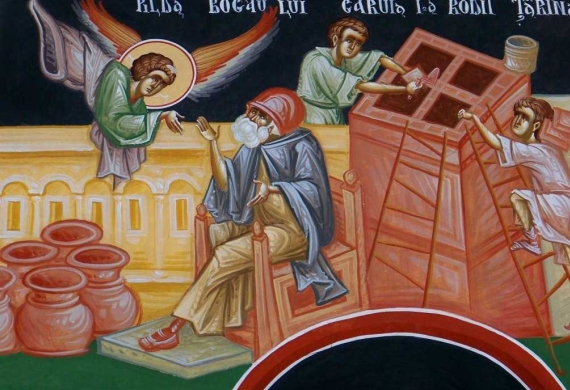
Image result for icon of the rich fool
God will say to those unprepared to stand in his glory, “Fool! This night your soul is required of you.” (Luke 12:20). It does not do to make preparations for this passing life while neglecting to prepare for the everlasting life that is to come. Pope Benedict XVI observes, “This life is not everything. There is an eternity. Today it is very unmodern to say this, even in theology.” But it remains true, and the weight of the eternal is infinitely greater than the weight of all the years of our earthly life.
How can we prepare for that limitless life and the unfathomable glory of God? He has made the way simple for us. He is the way.
The Philip’s Fast, which we have now begun in preparation for the Nativity of Jesus Christ, is a season of preparation for the coming of the Lord into the world. The Lord is coming into the world.
One morning, we will wake up and it will feel like Christmas morning when we were children, because the Lord will have come into the world. Anyway, that’s how it will feel if we have prepared for him. Either way, that day is coming.
This Philip’s Fast is another chance to prepare. I had the opportunity this week to meet up online with several of my old seminary chums. It was a group video chat, so I could see all of them as well as talk to them, even though we were all over the country. Such technological marvels we live among these days. Real life is like an episode of Star Trek. Anyway, unlike the rest of them, I didn’t have a camera, so they couldn’t see me like I could see them. All they could see of me was a photo taken a few years ago. So, I pointed out that I’d gained about 20 lbs. since that photo had been taken. Fr. Lewis chided me, “That doesn’t sound very ascetical, John.” And so I affably retorted, “Well, it’s a good thing we’re starting the Philip’s Fast now. Thank God there’s always another chance to repent.”
“Yeah,” said Fr. Dcn. Tom, “until there’s not.”
There won’t, in fact, always be more time. “The great day of the Lord is near – near and hastening fast” (Zeph 1:14). This Philip’s Fast is another opportunity to prepare and repent. Let’s not squander this chance. How many more will there be? What we do as a Church in these fasting seasons teaches us how to live our lives in preparation for the last things and the everlasting things.
Here’s the thing: the day is coming when we will stand in the glory of the Lord. This is true whether or not we prepare for that glorious day. If we do not prepare (by living the life of God and cooperating with his grace) our experience of that glory will be painful – like staring straight into the sun. But, if we first allow ourselves to be transfigured, little by little, by God’s own energies, then we will truly live this life he is giving us, and, on that day, we will be the glory of God.
“The glory of God is man truly alive,” as St. Irenaeus says. Jesus says to his Father, “I have given them the glory you gave me, so that they may be one, as we are one” (John 17:22). You see, this glory of God makes us one with one another just as God, who is three Persons, is one.
What unifies us is the same as what unifies God: love. God is love (1 John 4:8). So, the way to prepare to stand in the glory of God, the way to become the glory of God, to become one as the Persons of God are one, is to love one another. This is the simple way.
We all want to be loved, and that’s as it should be, I believe. Even God wants to be loved. And he made all of us lovable. All of us. You are lovable and God loves you. Love one another as he loves you (John 13:34). Then you will be prepared to stand in his glory and receive his love not as a searing fire but as a transfiguring light.

Sunday, February 24, 2019

The Least


on Matt 25:31-46

Each of us has someone that we love the least. Maybe this is an enemy who has done us harm. Someone who abused us in various ways or humiliated us. On the other hand, maybe it's just someone God has put into our lives that we simply ignore.

We may not even know who it is that we love the least. In fact, it's likely that we don't – because it's precisely someone that we're ignoring when we ought to be loving them.

Someone we ought to care for as a friend or a brother or a sister, but we neglect them because they distract us from our personal goals. Someone lying outside our gates like Lazarus, who we step over as we go about our daily life. We think we're minding our own business maybe – but, really, we're failing to recognize in this other person the image of God.

On the other hand, it might be your wife for your husband or your mother or your father or your son or your daughter or your brother or sister that you love the least. Whoever it is, we all have someone we love the least.

This is who Jesus means, I think, when he says, whatsoever you do to the least of my brethren, that you do unto me (Matt 25:40). The least of Jesus's brethren are those of his children we love the least. And we are all God's children. Let us commit ourselves to welcoming and caring for all of God's children. This would a good plan for us, because it is on our caring for one another, above all, that we will be judged.

There will come an end of all things – the second coming of Jesus Christ – and the final judgment of each and every one of us, as we hear in today's holy gospel.

Russian c. 1660 in Yaroslavl

Let’s let fear of this judgement spur us to begin to love one another – especially those we love the least. When our love is perfected, it will cast out of us any need of fear (cf. 1 John 4:18). Until then, let us have a little fear.

Let us embrace whatever is necessary to motivate us to forgive those who have wronged us and try to do what good we can for them. Sometimes this means only that we pray for them and for all blessings upon them because we ourselves are powerless to intervene in any direct or material way. Many times, however, there is direct good that we can do – food, and clothing, and shelter that we can provide – and we neglect to do so at our peril.

Today, Jesus describes that peril as fire and punishment (Matt 25:41, 46). Elsewhere, he describes it as weeping and gnashing of teeth where the worm never dies and the fire is not quenched and as the outer darkness.

We have many ways avoiding the fulfillment of God's command to give to him by giving to the least of his brethren – to those we love the least. Sometimes, we are cleverer than the rich man who stepped right over Lazarus in brazen indifference to that brightly shining image of God lying at his own doorstep. That is, sometimes we pack up and move.

Americans are especially good at this. Rather than loving the neighbors we find ourselves surrounded by and working to provide for them whatever they may need, we can just move to another city, another town, or another neighborhood where the neighbors leave us alone because they just want to be left alone too. Where we share an unspoken mutual agreement to ignore each other in exchange for not being bothered by the inconveniences of others' needs. Pretty as neighborhoods like this may be, they are in some cases a thin disguise, the façade of an edifice of hell, a whitewashed tomb, you might say. Such may be a neighborhood built out of the desire to escape people we find uncouth or undesirable – people elsewhere known as the least.

Wherever we find ourselves, however, it is not too late. God always puts people in our lives with needs so that we will have an opportunity to give. The needs and even the begging of others is not the nuisance to us it may seem to be, but a gift and an opportunity from our Lord himself to show our Lord himself that we welcome him and care for him and love him.

“Do not neglect to show hospitality to strangers, for thereby some have entertained angels unawares” (Heb 13:2).

It takes only a fraction of a moment to repent, to begin to love, to work for and seek the good of the ones we love the least.

We know that our Lord is the Lover of mankind. We know that he is merciful and kind and that he forgives all who repent. Yet, woe to those of us who take this knowledge of his merciful loving kindness – his ḥesed – and let it become an excuse for us to be unloving, thinking, “Oh, God will forgive me. I need not care for others.”

We must not forget that our God is awesome, mighty, and powerful beyond all measure. True paternal love, such as his, is not a spoiling and overindulgent love. God our father is not afraid to discipline us. In his love for us, he wants to make us into great men and women by his grace – by any means necessary. And greatness consists above all and becoming like God, who is love.  

Are you love? Am I love? If we are not yet love, we are not yet God. If we are not yet love, then let us have a little fear. If we do not love and also have no fear of God, we are damned. There is indeed something to fear. We damn ourselves by our failure to love and our failure to fear God.

Today's reminder of the coming Last Judgement exists to call us to repentance. Repent, forgive, and be forgiven. Today is Judgement Sunday. In one week is Forgiveness Sunday. God is both just and merciful – the end and the beginning.

We will be judged and we will be given every opportunity to repent. We are even now being given the opportunity to repent. Today. Let us not waste this one as we may have wasted many that have come before. There will be a final opportunity – we know not when – and it may be this.

Sunday, November 11, 2018

God has become our neighbor

The lawyer looks for justification in the letter of the law. I’ll spoil the surprise for you right at the beginning – he’s not gonna find it there.

He knows the law as well as Jesus, insofar as it is written and they have both read it.

We have all read it as well, I hope. The law we’re talking about here is the Torah, which is the first five books of the Bible. If you have not yet read them all, read them! Somewhere along the line, it got out that we Catholics don't read the Bible – but our own saints would beg to differ.  St. Jerome, for example, admonishes us to exercise and feed our minds daily with Holy Scripture. “May your hands never set the Holy Book down,” he says. We should read on even into the night, he says. “Let sleep find you holding your Bible, and when your head nods let it be resting on the sacred page.” Well, anyway, read it!  We are not illiterate any longer, most of us. That was our only excuse for not reading scripture. If we can read, that is first of all so that we can read the scripture, which God has given us. When Jesus asks the lawyer, “What is written in the law?” the answer should be as ready on our lips as it is on the lawyers.

“
Hear, O Israel: The Lord our God is one Lord; and you shall love the Lord your God with all your heart, and with all your soul, and with all your might." That’s from Deuteronomy  (6:4-5). And “Love your neighbor as yourself.” That’s from Leviticus (19:18). It also says in Leviticus that those who keep the commandments of the Lord shall live (18:5).

What is necessary for life is love of God and neighbor. For everlasting life, what is necessary is love of God above all with your whole heart, soul, strength, and mind and love of neighbor as of yourself. Love is what is needed. This is the true center and purpose of the law. Love – not attention to detail – Love – not cleverness – Love – not a great memory – Love.

We don’t enter into life even by fighting evil – but by love. St. Porphyrios says “You don’t become holy by fighting evil. Let evil be. Look towards Christ and that will save you. What makes a person saintly is love.” Anyway, you can’t drive the darkness out of a room by arguing with it or by waving your fists around. The only way is to turn on the light. Only love – and not vain energy, effort, will, or struggle – can fill our hearts with light and give us life. Stop trying to fight and instead Love himself reign over your heart. Anyway, if it came down to fighting, he’s the only one who could win the fight anyway. Only grace will save us, not our effort. Only love.

So the lawyer knows these words about love. He’s read the sacred page, at least. It’s a start. But his approach to the words is all wrong. He tries to twist the ambiguity that words have to justify his own lack of love. “Who is my neighbor?” He asks.

Words are ambiguous, but being clever about words and attentive to detail will not give us life. That may be the way out of an earthly prison when we’ve committed a crime and come before a human judge – to find some loophole or ambiguity in the law that’s gonna get us off the hook.  But it is not so with God.

The lawyer seems to imagine that if he can just define "neighbor" in a way that excludes all those to whom he has not been neighborly, he’ll escape the judgment. Perhaps that is a way to escape the judgment of men, but the Lord sees our heart. His parable of the Good Samaritan cuts right through the confusion about words that the legalist tries to introduce. While legalism darkens truth, our Lord is the light and the life.


It turns out that the lawyer already knows the truth. We all already know, if we are honest and examine our hearts, that we have sometimes been unloving. When Jesus asks him at the end, "Who, in your opinion, was the neighbor to the man who fell in with the robbers?" The lawyer is able to answer, "The one who treated him with compassion." We already know the truth of it, and we're not going to hide it from the Lord. We do not love him as we should. We do not love one another as we should.

How often do I hear someone say in confession, "I have been unloving?" Not very often, I can tell you. Yet this is the only sin – the sin behind every sin. Failure to love. Lack of love. If we were just to confess being unloving, we will have confessed every possible sin we may have committed by that one word. Then, we can go into the particulars of how we have failed to love without any anxiety about forgetting something. Love – and not a particularly good memory – is what gives us life. If we were loving, we would not sin. It is the light that casts out the darkness.

The Good Samaritan is a model of love and compassion. This story pricks our consciences – and rightly so. We ask ourselves, are we the Priest, the Levite, or the Samaritan? Have I neglected my neighbors or shown them compassion?

What we need to realize is that, really, we are the man half dead on the road. We are half dead because we are unloving, or not as loving as we should be, and that is death and darkness in us. We are immortal spirits and mortal bodies – half dead and half alive. Alive as immortal creatures of God and doomed to die due to our sins. And who is the Good Samaritan really? Above all, he is Jesus. Jesus is the one who shows perfect mercy, love, and compassion.  He is our God and has become our neighbor. Let us love him who first loved us (1 John 4:19).


Sunday, September 2, 2018

Practice the Preaching

A Pharisee – a lawyer – asks Jesus to tell him the greatest commandment.

This is meant as a test or – the word also means – a temptation. Little does the Pharisee know that he is testing the Lord his God. Jesus is Lord. And, by testing him, the lawyer is breaking the law in ignorance: “You shall not test the Lord your God,” it says in the law,[i] but that is not the greatest commandment. And so Jesus does not point this out, as he did to the devil in the desert, who also tested him.[ii]

Jesus is patient with these Pharisees. This is the fourth and final time they test him in the gospel of Matthew. He answers their questions. The questions are good, even if the motive behind them is not. Jesus tells us later to “practice and observe whatever [the Pharisees] tell [us], but not what they do; for they preach, but do not practice.”[iii] (This distinction is also worth remembering in our own day about some who preach Christ.) It is for their hypocrisy and not for their teachings that Jesus denounces the Pharisees.

A rabbi once came to our seminary in Pittsburgh to give a presentation. During the Q and A, a member of the staff asked the rabbi what he thought of Jesus. And the rabbi shocked all by saying, “Jesus was a Pharisee.”

We are so used to hearing the name of Pharisee associated with all that is evil that this idea could sound blasphemous. If you look up the word ‘pharisaic” in the dictionary, it says “hypocritically pious.” And Jesus is most certainly not this, but that isn’t what the rabbi meant.

The rabbi meant that if you study first-century Judaism and compare the teachings of Jesus with the teachings of the various Jewish factions, you will find that Jesus agrees more with the Pharisees than with the other groups.

For example, Jesus accepts the prophets as well as the law as from God – so do the Pharisees, unlike the Sadducees, who hold that only the law – that is, the Torah, the Pentateuch, the first five books of the Bible – Genesis, Exodus, Leviticus, Numbers, and Deuteronomy – only these books and no others – are scripture inspired by God and binding upon the people of God. So dispute about the canon is nothing new. In our day, we have Protestants denying the inspiration of certain books of Scripture. In Jesus’ day, it was the same – though of course about different books.

And Jesus teaches the coming resurrection of the dead – so do the Pharisees, unlike the Sadducees, “who say there is no resurrection,”[iv] because it is not as clearly and directly described in the Torah as it is in the prophets and later writings – though Jesus does point out that even a proper understanding of Torah reveals the resurrection.[v]

And finally, Jesus knows which is the greatest commandment of the law – so do the Pharisees. They agree about this. The lawyer is asking Jesus a question to which he already knows the answer – an old lawyerly trick.

The greatest commandment is “you shall love the Lord your God with all your heart, and with all your soul, and with all your mind.”[vi] The Pharisees know this - because this, my dear brothers and sisters in Christ, is the Shema, the principal words of the law, found in Deuteronomy:

"Hear, O Israel: The LORD our God is one LORD; and you shall love the LORD your God with all your heart, and with all your soul, and with all your might. And these words which I command you this day shall be upon your heart, and you shall teach them diligently to your children, and shall talk of them when you sit in your house, and when you walk by the way, and when you lie down, and when you rise. And you shall bind them as a sign upon your hand, and they shall be as frontlets between your eyes. And you shall write them on the doorposts of your house and on your gates.”[vii]

These words from Deuteronomy are among those contained in the Pharisees’ phylacteries. A phylactery is a little leather box containing a scroll with these words – the Shema. They literally bind these to their foreheads and to their arms when they pray. You may remember how Jesus later criticizes how the Pharisees make their phylacteries broad, so as to be seen by men,[viii] rather than so as to always remember this greatest commandment, which is their true purpose. 

So this commandment is certainly not new to the Pharisees. They have heard it and prayed it daily since they were children. Jesus did not fail the Pharisees’ test. He knows the answer as well as them.

But he doesn’t stop there with the rote answer. Rather, he reveals something more about how it must be lived. He draws a correspondence between this great commandment and a second commandment, from Leviticus. “A second is like it,” he says. And that is, “You shall love your neighbor as yourself.” Some had noticed before that there is a verbal correspondence between these two commandments that joins them: each begins “you shall love.…”  Of course, they have more in common than that. Jesus is making a very striking point about these two commandments. Loving our neighbors is like loving God because God has made humans like God. In his image and likeness he has made us.

Sometimes, during the Divine Liturgy, the reality of God’s presence in us becomes strikingly apparent. For one example, there are prayers prescribed for the priest and deacon to say quietly before the holy doors before the beginning of the Divine Liturgy. At a certain point, the rubrics say that the priest and the deacon are to bow to the faithful. While they bow, they are praying part of Psalm 5: “I will bow down before your holy temple in awe.” 

Notice this. The rubric says to bow to the people, and the text says we are bowing to the temple. I don’t think that’s a coincidence. As Paul writes to the Corinthians, “Do you not know that you are God's temple and that God's Spirit dwells in you?”[ix] Therefore, how can we love God if we do not love one another - when God dwells in our neighbors?

For another example, at the beginning of the Divine Liturgy, the deacon censes all the icons of the church. Toward the end of this great incensation, he censes the people. It has occurred to me that this is not something separate from the incensation of the icons. Rather, it continues the incensation of the icons, because you all are also icons of God. An icon is an image, and God has made you in his image.

The image of God in us is indestructible. No sin can destroy it. It is who we are in our very being. We are in his image, but we are after his likeness. Some have suggested that we lose our likeness to God through our sin. But Jesus restores our likeness. In him, we can again become like God. Because he has identified himself with us. He, who is the Lord, has become man.

Jesus reveals this when he teaches the Pharisees something more about the Messiah – about himself – by interpreting David’s Psalm messianically. The Messiah is the one who sits at the right hand of the Lord, and Christ points out that the one who sits at the right of the Lord is also the Lord: “The Lord says to my Lord, sit at my right hand.” So he who is truly our Lord and God has become the messiah of Jews and the savior of all humanity.

Though it was always true, now in Christ it is fully revealed, that we must love our neighbor if we are to love God, because, in Christ, God is become our neighbor. Many of the Pharisees were failing to love their neighbors, neglecting “justice and mercy and faith”[x] and so, Jesus reveals, they were not really loving God after all. So let us follow the teaching of the Pharisees to love God with all our hearts, all our souls, and all our minds, but let us not fail as they fail to love our neighbors as ourselves. “Let us be doers of the word and not hearers only.”[xi]


[i] Deut 6:16; cf. Matt 4:7; Luke 4:12
[ii] Matt 4:1,7
[iii] Matt 23:3
[iv] Matt 22:23
[v] Matt 22:31-32
[vi] Deut 6:5; Matt 22:37
[vii] Deut 6:4-9
[viii] Matt 23:5
[ix] 1 Cor 3:16
[x] Matt 23:23
[xi] James 1:22

Thursday, March 29, 2018

What return can I make to the Lord?

Our Lord has given himself to us. Have we given ourselves to the Lord? 

Just four days ago, it was Annunciation – God became man, taking flesh from the Virgin. God became man. Have we become God? Not yet, right? Yet, that is why he joined our human nature – so that we may become partakers of his divine nature because he loves us and wants to be with us.

To love someone you have to go out to meet them where they are – like the father who ran out to meet his prodigal son returning home to him at last. To love someone you have to see yourself in them – to “love your neighbor as yourself.” Now, when God looks at humanity, he does see himself – because now he is also human. He has run out to meet us where we are. He has given himself to us completely. He offers us actual union with himself if we will but take the first few steps toward home. Tonight he prays to his Father for us who believe in him: that we may all be one, as he and his Father are one, and that we may be one in them (John 17:21).

Do we take up this offer? Do we do our small part of showing up, of turning to him, of cooperating with his grace? This is called synergy. As Paul says, “We are fellow-workers (synergoi) with God' (1 Cor 3:9a). It’s really all the work of the Lord because we are the work of the Lord. We are “God’s field [and] God’s building” (1 Cor 3:9b).

But he’s given us freedom. Without freedom, there is no love and no repentance (and the Lord is in love with the beauty of repentance). So, if we will join with God, we must freely work with God rather than vainly strive against him. Tonight, he shows us how to work with him. Tonight, he freely gives himself to us and in so doing shows us how to freely give ourselves to him.

Cathedral of Monreale

Tonight, he washes his apostles’ feet. Do we wash each other's feet? This becomes a way for us to give ourselves to our creator and our God.

Behold: the creator washes the feet of his creatures. It is clear at this moment, that the creator of all things has emptied himself completely for the love of his creatures. He washes even the feet of Judas, whom he knows will betray him. Are we selective about who we will serve and humble ourselves before? Jesus is not.

“He who made the lakes, the springs, and the seas… washes the feet of his disciples; in his infinite mercy, he lowers himself, and he draws us up.”* The maker of water shows why he truly made it. “The Wisdom of God, who holds back the great waters… today pours water into a basin.”† He lowers himself and serves those whom he loves with water. He makes all things for love.

Jesus’s example of emptying himself and lowering himself is nothing less than a path to theosis for us. To become one with God above, we must lower ourselves as he did. He “humbled [himself] and washed the feet of [his] disciples, thus preparing them to walk in the divine footsteps.”‡ To walk this path is to walk “the most excellent way of humility”§ in imitation of the one “who wraps the heavens with the clouds [and yet] now wraps himself with a towel.”** This is truly “the model of humility,” which any who would follow Christ must imitate.†† If we would imitate Christ Jesus, we must have in us “the same mind that was in Christ Jesus, who emptied himself, taking the form of a slave” and then we will truly become the body of Christ (Phil 2:5).

Tonight, he gives us his body and blood to eat and drink. Have we become the body of Christ?

With Eucharist, Jesus radically breaks down our perceived barriers and divisions and fills all creation with his grace. He comes like a bridegroom in the middle of the night. Unexpectedly, in the midst of the darkness of this Holy Week, there shines the brightness of this Great and Holy Thursday. The “bridal chamber” is “completely engulfed with light.”‡‡ Though until this day we have been wearing dark garments – not wedding garments – in penitence, now, tonight, at his last supper, the Lord gives us the Eucharist, which is – in no small way – a consummation of God’s marital union with humanity.

 “The true Wisdom of God initiates his friends into the mysteries. He prepares a table filled with spiritual food, and, for the faithful, He fills the cup of immortality.”§§ The mystery of the Eucharist is nothing less than the bread of eternal life, given to us today. This is the very means of union with God.

Jesus says,
“Take and eat, this is my Body; you shall find food for your faith;”
“Take and drink, this is my Blood; you shall find food for your faith;”
“Dwell in me, and you shall find food for your faith.”***

We eat and drink the body and the blood of Christ so that we may come to dwell in him. Jesus gives us the Eucharist in order to bring his people into himself.

He gives us himself in this way. We take of him and eat and drink. By this means and by the descent of the holy spirit upon us, we become the body of Christ. As the body of Christ, we may give ourselves completely to God, as he does upon the cross.
Tomorrow, he dies for us. Can we even stay awake to watch and pray with him for one hour?

He gives us everything and gives us himself completely. Do we give him anything? Do we accept even inconvenience for him, let alone death? Is it too much to ask that we spend time with him? Can we be bothered at all? Or, are we like the disciples who keep nodding off in the midst of his agony as he awaits his betrayal?

He delights even in a small movement toward him on our part. If we but begin to move toward him, he runs out to meet us. We must cooperate with his grace, but there is nothing symmetrical about this relationship. Even our cooperation is enabled by his grace. His grace is everything and is altogether trustworthy.


[*] Sessional Hymns at Matins, Triodion 565
[†] The fifth ode, Triodion 566
[‡] Triodion 565
[§] From the dismissal at every service for Holy Thursday, e.g. Triodion 572
[**] Triodion 566
[††] Triodion 566
[‡‡] Hymn of Light
[§§] The first Ode of Matins, Triodion 564
[***] From the third ode, Triodion 565

Wednesday, March 7, 2018

Weeding our own Garden - or - Don't Garden Drunk

To be honest, most of us have had the experience of having too much to drink. Many people have experienced this, of course. It's a rather common phenomenon for a person who has never had alcohol before – and who doesn't yet understand how it affects people – to drink a bit too much at first and to become drunk.

Well, Noah was apparently the first person to ever drink wine. He was the first to plant a vineyard (Gen 9:20) and when he drank the wine, he became drunk and lay uncovered in his tent (9:21). Given his inexperience and the inexperience of the whole human race at this point, this is really an unsurprising and predictable result.

Nonetheless, it is a shameful and embarrassing situation for a father to be discovered drunk and naked by his son and this is what happened to Noah when Ham walks in (9:22). Further unspeakable indecencies may be hinted at by some Hebrew euphemisms in the text but the situation is difficult enough without all that. And, regardless, if we have ears to hear, I think this story teaches us both the importance of sobriety and the proper way to regard others in their sins.

Deliberately getting drunk is a sin. As Catholics, and therefore as adversaries of teetotalers and Puritans, we may not say this often enough for fear of being lumped in with them, so I'll say it again: deliberately getting drunk is a sin. Alcoholism is a disease. Accidentally getting drunk is an involuntary sin or an infirmity.

In each case, we stand in need of healing. Our Lord, who alone can heal us, offers us this healing both directly and through one another, through our prayer and support for one another, through the Holy Mysteries of repentance, of anointing, and of communion in his holy body and blood.

Sobriety, however, does not only refer to the moderation of our use of alcohol. First of all, there are many other addictions. I think almost everyone is addicted to something: to alcohol or drugs, to pornography or sex, to food or sugar, to video games or social media, or to our countless passions. All these things offer us a momentary release or escape from our pain. Those who suffer less are less susceptible to addictions, by the way. There's always a pain at the root of an addiction. So, we addicts stand in need of a healing of the root.

Yet, the way to healing and to life shown to us by Jesus Christ is counterintuitive – it is the way of the cross. We're more inclined to run to our addictions and away from our pain, but the way out is through. This is the only real way out to where we want to go – to "a place of light, joy, and peace where there is no pain, sorrow, nor mourning" – through the cross. We must deny ourselves and embrace the very thing that hurts us – as Jesus embraces his cross (Mark 8:34). Usually, this means loving and forgiving an enemy, just as Jesus forgave those who were crucifying him, even as they were driving the nails into his hands and feet (Matt 5:44; Luke 23:34). He did not wait for them to apologize. This is the way of the cross – the way to healing and everlasting life. Unforgiveness, on the other hand, is a kind of drunkenness of the soul.

Sobriety is a spiritual condition. In the spiritual life, sobriety is also known as "watchfulness" or "νῆψις". This is the opposite of a drunken stupor. We must stay awake, be alert, vigilant, and watchful over our own hearts, lest we get drunk on our passions.

When the weed of unforgiveness or resentment, or anger (like the anger of Noah when he knew what his youngest son had done to him) begins to take root in our hearts, we must pluck it out before it has time to grow deep roots (Gen 9:24-27). If, for example, we wait for someone to apologize before we will forgive them, we may find that, even if they do eventually apologize, our resentment will have by then grown too strong for us to overcome – its roots too deep for us to dig up. If we are drunk like Noah was drunk – that is, if we are deeply imbued in our passions and addictions – we will lack the careful attention needed to weed the garden of our hearts without uprooting the herbs and vegetables and flowers of holiness and virtue and goodness which the Lord has planted in us.

We must always keep careful watch over our own gardens, but it is not our business to go rooting around in someone else's garden. "Yes, O Lord and King, let me see my own sins and not judge my brothers and sisters" (The Prayer of St. Ephrem). Ham looked upon the nakedness and drunkenness of his father and he told his two brothers about it – instead of keeping his mouth shut (Gen 9:22).

"A prudent man conceals his knowledge,
           but fools proclaim their folly...
He who guards his mouth preserves his life;
            he who opens wide his lips comes to ruin" (Prov 12:23;13:3).

"Lord and Master of my life, spare me from... idle chatter" (The Prayer of St. Ephrem).

Shem and Japheth, on the other hand, acted rightly and with respect for their father. They "took a garment, laid it upon both their shoulders, and walked backward and covered the nakedness of their father; their faces were turned away, and they did not see their father's nakedness" (Gen 9:23). We must never look greedily upon the sins or weaknesses or infirmities of others, whether it is to laugh at them or to puff ourselves up – saying like the Pharisee "Thank God I am not like this sinner" (Luke 18:11). Rather, like Shem and Japheth, let us avert our eyes from the sins of others and focus on repenting for our own sins.

This is not to say that there is never a time to lovingly admonish the sinner or correct the wayward, but these actions are always taken for the good of the other and never for exalting the self by comparison. That is how we can discern whether or not we should say something.   

Sunday, February 19, 2017

Feed the Goats

At other times, Jesus says he does not come to condemn the world but to save the world (John 3:17; 12:47). The word is κρίνω, to separate, or to judge. He did not come to judge us. But here today he comes in his glory with all his angels and sitting on his glorious throne before all the nations and he separates us into two groups (Matt 25:31-33). It seems he's making a judgment – a κρίσις, a separation – and that this is his coming "day of judgment" (Mat 12:36).

In the parable, he is separating sheep from goats as would a shepherd (25:32). And much is often made of the difference in character between a sheep and a goat. I have to admit I have pretty limited experience with farm animals, but I have encountered both sheep and goats. I once held a lamb, and I found it to be the most receptive, docile, and pleasant creature I've ever touched. And then once in a petting zoo, I encountered a goat. I became particularly well acquainted with its horns as it butted me, trying – successfully – to get me to drop the feed I was carrying and run. So my own experiences prejudice me against the goat and in favor of the sheep. And I'm therefore tempted to go along with the usual narrative that we ought to be more like sheep and less like goats.


But I want to challenge this narrative just a bit. I'm not sure that the Lord really has anything against goats. God made them too, you know. And a goat can't help being a goat any more than a lamb can help being a lamb. They are as God made them, and God did not make us for damnation. He made us for himself, out of love.

So, pushing the metaphor too far, you might end up with something rather like Calvin's heretical doctrine of double predestination, wherein God creates some for salvation and others for damnation – wherein the theological virtue of hope is rendered really rather pointless.

So I think we should see this separation of animals rather as a simple image of judgment than as a commentary on the character and destiny of goats. And this is important because it affects how we regard one another. We might be tempted to regard our enemies as hopeless, irreformable goats, but this is not a Christian attitude toward anyone. Certainly, it’s not our job to judge the goats. And our attitude toward others, our regard for others, and our relationship with others is really the heart of this parable.  

The light of Christ illumines every relationship. When all the nations gather before the glorious throne of our King and our God and his light shines upon us, the reality of all our deeds toward others will be brought into his light. It isn't that Jesus is condemning anyone, but rather that some condemn themselves by living without love of others.

Fr. Thomas Hopko says that “it’s important to see that the judgment is simply the presence of Christ.” This is like a judgment with no judge. If we love Christ in the least of his brethren, to be in his presence is our salvation. To be in the presence of Christ is also judgment.

God is love. If we come into the presence of love himself unlovingly, our own hearts stand in judgment against us. In his presence, what we do in secret, which our Father sees in secret, is brought into his light and our own actions judge us (cf. Matt 6:3-6).  Christ does not condemn us. We condemn ourselves every time we fail to welcome the stranger, even if the stranger is a foreigner or of a different race or follows a false religion, even if we’re a bit afraid of him. We condemn ourselves every time we fail to visit the sick, even if they’re irascible, and the imprisoned, even if their crimes are heinous. We condemn ourselves every time we fail to clothe the naked, to feed the hungry, and give drink to the thirsty, even if they seem like goats to us (Matt 25:42-43).

This is what the judgment comes down to: How do we treat each other? Do we love each other? I've been teaching our first graders about this greatest commandment. Love God and love your neighbor as yourself - as yourself. This is remarkable. The command is not to love your neighbor as you love yourself, as it is sometimes rendered. Rather, it is to love your neighbor as yourself (Lev 19:18; Matt 22:39; Mark 12:31: Luke 10:27).

It's true that we should love ourselves, but it's all wrong and unhealthy to imagine that this means that we should have a preferential love for ourselves over and against our neighbors. In fact, this doesn’t make any sense and the very opposite is the case. It is in our neighbors – our enemies and our friends – that we find our very selves. You won't find yourself in the mirror. It's just cold glass - an illusion. We find ourselves in our spouses, in our brethren, in our friends, and even in our enemies.

Love your neighbor as being your very own self. If you are hungry, what do you do? You go get something to eat. If your neighbor is hungry, what should you do? Go and get him something to eat. This is how we can find ourselves and come to know ourselves – in other people. The other kind of self-love is a sin condemned by the fathers because we, like God, are essentially relational. That is, totally cut off from others, we have no selves. Our selves exist in relationship – even in relationship to the least of Christ’s brethren.

Who are the least of Christ's brethren? This is an important question because Jesus says that it is on how we treat these that we are judged. I think that the least of Christ's brethren are whoever we love the least. Who is your worst enemy? Who do you dislike most? It is based on how you treat that person or group of people that you are judged. The love we have for the Lord and his Christ is equal to the love that we have for the person or persons we love the least.

We’re not to worry about whether or not a person is a goat or a sheep – and therefore worthy of our love – before we decide to love them. Judgment is not our job, thank Christ. The presence of Christ is the judgment. And Christ chooses to identify himself with the least of his brethren. What we do to those we love the least we actually do to Christ.

He also gives us a new commandment to love each other as he has loved us. We are to love as Christ loves. We are to be as Christ to others. This puts Christ on both sides of the equation – both in the self and in the other. So, as Christ, we are to love the least of his brethren – as Christ. Christ is all, and in all (Col 3:11). Glory to Jesus Christ.


Sunday, November 13, 2016

Love the Stranger as Yourself

The Hospitality of Abraham,
Constantinople, late 14th century

A lawyer – that is, a scholar of Torah – asks Jesus what he has to do to live forever (Luke 10:25). Life forever is what Jesus offers, so how do we get it? It's a fair question. Well Jesus says to the man, you already know. Really he says, “What does it say in the law?” (Luke 10:26). You already know Torah and the Torah comes from the Father. The law is to be believed. The answer is already there. And, indeed, the lawyer does know. And he quotes to Jesus the greatest commandment: "You shall love the Lord your God with all your heart, and with all your soul, with all your strength, and with all your mind; and you shall love your neighbor as yourself" (Luke 10:27; Deut 6:5; Lev 19:18).

I love this. In another place, another lawyer – to test Jesus – asks him, “What is the greatest commandment?” And Jesus gives him the answer (Matt 22:35-40). He was asking Jesus to test him – to see if he knew his Torah – to see if he was really up to snuff. Because if he was who he said he was, then this is something he should know. This is something that the Pharisees and scholars of the law knew, which is made clear today when the roles are reversed and it is Jesus asking the question and the lawyer answering. Of course, Jesus does know what the Pharisees and lawyers already know. But he also knows more than they do.

Then, desiring to justify himself, the lawyer says to Jesus, “And who is my neighbor?" (Luke 10:29). This is something that Jesus knows but the lawyer doesn’t – and it’s something we also forget. He knows who our neighbors are. And he tells the parable of the Good Samaritan to illustrate the point – that our neighbors are not to only those of our own people, or our own country, or political party, or our own religion – that our neighbors include foreigners and heretics and heterodox and our enemies and – to me this is in a way even more startling – strangers. Strangers are our neighbors. 

Today, many in this country are looking at their neighbors, most of whom are strangers, as enemies because of how they voted. As Brother Isaac said recently, “Politics divide. Love in Christ unites!” He advises us, and I think we should listen:
Do something kind for a stranger today.
If you are happy about the results of the election, do something kind for a stranger today.
If you are sad or angry about the result of the election, do something kind for a stranger today.
If you are ambivalent about the result of the election, do something kind for a stranger today.
Our lens is always the Empty Tomb![1]

Love of strangers is a path to healing and even resurrection. The way to eternal life is love of God and neighbor. And Jesus reveals to us today that strangers are our neighbors. Love them.
“Love is patient and kind. Love does not envy or boast; it is not arrogant or rude. Love does not insist on its own way; it is not irritable or resentful; it does not rejoice at wrong.” Everything love is not sounds like a description of our political landscape, doesn’t it? “But love rejoices in the right. Love bears all things, believes all things, hopes all things, endures all things. Love never ends” (1 Cor 13:4-8).
The Good Samaritan loved his neighbor and he was a neighbor to the man who fell among the robbers (Luke 10:36-37). Even though the man was probably a Jew coming from Jerusalem – and Samaritans and Jews were at enmity with one another for both religious and ethnic reasons (Luke 10:30). And furthermore, the man was a stranger to him. It seems they never spoke – before, during, or after. But the Samaritan had compassion on him (Luke 10:33). And he loved him.

It's clear how much he loved him by the extent of inconvenience to which he was willing to subject himself for him. The Samaritan was on his own journey, but he leaves behind his own priorities to seek the good of the other even at significant personal expense of both time and money, tending the man's wounds with oil and wine and bandages, carrying him on his own beast to an inn, and paying the innkeeper two day's wages to see to the man's care (Luke 10:33-35). All this for a stranger.
When we are busy and distracted with pressing concerns, it can be easy to justify ourselves, as the lawyer did, telling ourselves that “we gave at the office” or that we will help a stranger next time, but this time we’re too busy with “matters of consequence.”[2] Well, bear in mind whose voice is actually justifying our neglect. Metropolitan Kallistos teaches us a way to distinguish between the voice of the devil and the voice of the Lord: the devil always says, “yesterday” or “tomorrow,” but the Holy Spirit always says “today.”[3]
Pious Christians laudably expend much energy in avoiding sin and not giving into temptation. Unfortunately, the habit of not giving into impulses sometimes seems to get transferred to good desires too. If you’re tempted to give, go ahead and give into it. Never resist the urge to give. Don’t avoid the eyes of strangers for fear that you’ll be tempted to give them something. Be as reckless with your kindness as you are neptic with your anger. Love both those that make you angry and those that inspire you to give – both your enemies and strangers. 
An enemy is often someone we already have strong feelings about – so they’re often on our minds – while strangers are people we're often hardly aware of. Many of us often make small decisions to avoid being troubled by strangers. A decision to look the other way as we pass them on the street. Especially if it's apparent that they're going to ask us for something – probably money – probably for drugs.

I have never come across a person stripped and beaten on the road left for dead. It's an extreme example that Jesus gives us. He likes those. I have often come upon someone with a need that I recognize. If somebody's coming up to you asking for money, let me tell you, they are in need. There's a probability that they're not in need of that which they seek. But they are in need. And to turn away from that need is unloving of the stranger. And Jesus reveals to us today is that the stranger is our neighbor.

If you have ever turned away from a person in need because you were in a hurry to get to your job or to some other obligation or pleasure – and I confess that I have – ask yourself, how would you have responded to their need if they were a loved one? Would you have turned from them if it was your son or your daughter or your husband or your wife? Would you have turned away from them if you loved them?

Jesus reveals to us today that the stranger is our neighbor. And the greatest commandment tells us to love our neighbor.

Maybe you shouldn’t always give people what they are asking for. Many people argue that persuasively, though at the same time don’t forget that Jesus says to “give to everyone who begs from you” (Luke 6:30).

Give to everyone who begs from you. Maybe don’t give everyone money, but give to them what they do need. Give your shirt also to the one who takes your coat (Luke 6:29). Give drink to the thirsty, food to the hungry, shelter to the homeless, coats to the freezing, kindness and patience to strangers. And give love to all your neighbors, whether or not they’re from your neighborhood.

Even if your church’s neighborhood is not your neighborhood, the strangers who live all around it are still your neighbors. Even if your job is far from home, all those around you at work are your neighbors, even if they voted the other way. If you go out to eat, your servers and the jerks in the parking lot are all your neighbors. Jesus has revealed to us that our neighbors are not only our own people, but everyone – not only нас, but all. 

Loving our neighbors is part of loving God. Our Holy Father John Chrysostom, whose feast is today, is often quoted as saying that if you cannot find Christ in the beggar at the church door, you will not find him in the chalice.

And that extends also to everyone you meet, I believe. The image of God is in every person and that image is wholly lovable, however obscured it may be. Everyone wants to be loved by all, no matter what they say defensively, because they have been hurt.

Wanting to be loved is not a weakness. Even God wants to be loved and God is not weak. God wants to be loved and he takes the guise of the stranger. As you love strangers, that is how you love God. Remember when three strangers came to Abraham and how he ran out to meet them and bowed before them, washed their feet, and fed them bread cakes and milk and curds, and killed for them the choice calf (Gen 18:2-7). Only after did he realize he was showing hospitality to angels and to God himself. These three – men or angels – are our image of the Trinity, famously painted by Rublev. And at first they were strangers.

God, the only true Lover of us all, alone fully deserves love. But we are made in His image, and as such we also desire to love and to be loved by all, even strangers. Do unto strangers as you would have them do unto you. Love strangers as you would have them love you. Love the stranger as yourself.


[1] Br. Isaac Hughey’s Facebook Page. Accessed November 9th, 2016. 
[2] Antoine de Saint Exupéry, The Little Prince, chapters 7 and 13.
[3] Bishop Kallistos of Diokleia (Ware), Discovering the Inner Kingdom, (Oakwood Publications, 1997), 9. 

Most Popular Posts this Month

Most Popular Posts of All Time