Showing posts with label Hesychasm. Show all posts

Sunday, July 8, 2018

Faith of the Blind


on Matt 9:27-35. Seventh Sunday after Pentecost

Today, two blind men teach us much about faith and about prayer.

When they encounter Jesus, they don’t exactly ask what you might expect – for sight or for healing. Rather, they follow him, calling out, “Have mercy on us, Son of David!” Now, mercy is healing, but it also more than healing.

Eventually, Jesus asks them, “Do you believe that I am able do this? So, not only, “Do you believe I can heal you?” but really also, “Do you have faith that I can have mercy on you?” Jesus is not asking these blind men merely what they think of him or who he is in their opinion – he is asking them about their faith – about whom they know him to be in their hearts. And they confess their faith that he is the one who can have mercy on them in their blindness. They do believe and, according to their faith, Jesus touches their eyes and opens them.

The Two Blind Men, detail, 6th Century Mosaic, Sant' Appollinare Nuovo, Ravenna

What drove Jesus to ask the two blind men about their faith? Well, first they followed him for quite some time, it would seem, as he walked from the house of a ruler back to his own house. This was probably quite a way, because Jesus likely wasn't staying in the same neighborhood as such a socially significant person. This in and of itself is a marvel: though they were blind, they were able to follow Jesus all the way to his house. They could not see him, but yet they went wherever he went. Now, maybe they had help, or maybe they were following him by sound, or maybe they simply knew the way to his house – the Gospel doesn’t say – but regardless, I think it is a good image of faith that, though blind, they could still follow Christ. They could see him, not with the eyes of the body, but with the eyes of faith. According to their faith, they could see already. Perhaps this is why they ask for mercy and not only for their sight. “Blessed are they who have not seen, but have believed.”

And all the while as they were following him, they were crying out, “Have mercy on us, son of David!” This kind of prayerful petition, repeated again and again, ought to seem familiar to us who follow Byzantine tradition – for here is one of the roots of the Jesus Prayer. I hope you all know the Jesus Prayer and pray it daily:

Lord Jesus Christ, Son of God, have mercy on me, the sinner.

We can hear in this, I think, an echo of the blind men’s prayer: “Son of David, have mercy on us.” But it is also similar in the way that they prayed it – crying and saying their prayer while following after Jesus. It seems to me that they did not cry out their prayer only once, but continuously and repeatedly as they followed Jesus.

In our hesychast tradition, under the guidance of our spiritual fathers and mothers, we pray the Jesus prayer so frequently that the prayer becomes a part of our very breathing – and of the beating of our hearts so that we can aspire to pray unceasingly, as Paul teaches us (1 Thess 5:17). Again and again in peace we pray to the Lord for mercy – as did these two blind men before us.

Their way of prayer also evokes the uncomfortable parable of the widow and the unjust judge in Luke (18:1-8). Not once does the widow plead for justice, but repeatedly. Not once do the blind men cry out for mercy but continuously.

It seems sometimes like we have to nag the Lord; we have to bend his ear; we have to keep after him. Of course, this is only how it seems to us humans. Repetition, I think, helps evoke the eternal for us temporal creatures. And it helps us forgetful creatures to remember. Anyone memorizing lines for a play or multiplication tables for a math test knows the necessity of repetition for a human mind. If we creatures are to remember our creator and our God, we must often repeat our prayer to him and our calling upon his holy name. Lord Jesus Christ, Son of God, have mercy on me, the sinner.

It is only after the widow has often plead for justice that the judge gives her a just judgement and it is only after the blind men have followed Jesus quite a way calling out for mercy and followed him into his house that he asks them if they have faith. Only after they have demonstrated faithfulness to some extent does he ask if they have faith. We must be persistent. We must persevere in the faith even when it seems we get no answer to our prayer the first time or the second time or the seventh time we pray. Pray again! Do not lose heart. Keep following after Jesus with a pure heart – not just in the hope of some material reward, mind you, but in the hope of mercy. This is our petition: for mercy, for healing, for eternal life, and for union with God. 

The physical blindness of these two men has also for us, I believe, a spiritual meaning. We are the blind men – until we through faith receive the grace and mercy of the Lord, for which we must continually cry out. Our vision of all things is darkened until we see them in the light of Christ.

Only in the light of Christ is it possible to see things as they really are.

Only in the light of Christ can we understand the true meaning of the Torah and the prophets.

Only in the light of Christ can we see and love our enemies as images of God.

Only in the light of Christ can we find any meaning in our suffering because without Christ and his cross, all suffering is meaningless. Only in Christ and in his cross can suffering become a means of union with God – because only in Christ and in his cross does the impassible God suffer with us

Only in the light of Christ can we see that for us even death is but falling asleep in the Lord and that the great dawn of resurrection is coming, when we will awaken.

Without the light of Christ, we are blind. And so, according to our faith and due to our unceasing prayer, Christ will open our eyes.

This is a reworking of a sermon I preached three years ago: Jesus Opens our Eyes 

Sunday, February 25, 2018

Time Alone and Time with Others

My how we need each other! How dependent upon one another the Lord has made us!  The paralyzed man in the gospel needed his friends (Mark 2: 1-12). Through their help and because of their faith, he is forgiven and healed. 

True, we are ultimately dependent on the Lord for everything and we may rely on him to provide.

We are like helpless baby birds in a nest, unable to fly, waiting with mouths open, for our mother bird to bring us back the food that sustains us. She has left us for a time. And her absence may fill us with longing for her return. But we may hope for that return expectantly. And trust in it. And know that she is coming back and that she is bringing with her the stuff of life. And that when she comes, she will not only feed us but she will also teach us to fly.

Our Lord is like this mother bird. He does not fail us. When the Israelites were hungry in the desert, the Lord rained manna down upon them – bread from heaven. Let us never forget the care he shows for us – the good he gives us directly and personally.

We must keep a direct and personal relationship with God alive. In obedience to Jesus Christ and in imitation of him, we must go often into our room and close the door – or go away to lonely places to pray and be alone with God.

Yet, meanwhile, wherever two or three are gathered in his name, there he is in the midst of them. And also, whatever we do for the least of his brethren – that we do for him.

Our real need for solitude with God does not exclude the importance of coming together – of praying together – or of attending to each other’s needs. The truth is, we need both time together and time alone. God is with us at all times. By his grace, let us come to know and experience his ever-present presence.

Saint Gregory Palamas Fresco 
in Saints Three Church in Kastoria
15th century
This tension between our need for solitude and our need for community has been lived out especially by monastics since the beginning. The earliest monastics were hermits and anchorites who dwelt alone in caves and huts in the desert and the wilderness. Yet, they were very soon organized into communities. Because, as St. Basil says, “If you live alone, whose feet will you wash?” There is a need to serve your brother and sister as well as a need for solitude to do battle in your own heart.

The holy Hesychasts strongly emphasize this need for solitude – but they do find a balance. Our holy father Gregory Palamas, who devoted much of his life to the defense of the holy Hesychasts, lived alone and practiced great askesis usually for five days out of the week, coming down to celebrate the Eucharist and to have fellowship with the brothers only on Saturday and Sunday and on great feast days.

In prayerful time alone with God, we can really experience God, who communicates himself to us in our whole being – spirit and body. As St. Gregory teaches us, God allows us really to experience himself in his energies  – to see his uncreated light in our hearts. He gives us himself – reveals himself to us – not just a created thing like himself, but his own uncreated energies. Grace is not a thing God gives us but is really himself – his own life – life in the Spirit, and life in Christ – which he enables us to live.


Our real experience of God in solitary and silent prayer in no way excludes the experience of God we have through others. We need both. St. Gregory sees the Hesychasts’ experiences of God through their solitary practice of the Jesus prayer united to their breathing (which is one means, but not the only means toward experiencing God) as possible for them because of the grace of baptism, which is a holy mystery of the Church and only possible through others. God is always working through his people. 

So it is with the paralyzed man. God provides forgiveness and healing, and he does it through the intercession of the man’s friends. We are dependent on God for everything, but he has also made us dependent on each other.

Those of us who are healthy and strong in body sometimes pretend that we are independent individuals, but this paralytic does not have that option. He is able to do nothing with his body but lie upon his bed. He is dependent upon his friends, who feed him and wash him and clothe him while he waits for the Lord to come – like a helpless baby bird crying out for the return of the mother bird.

But in this case, the Lord waits for the friends of the paralyzed man to help him – and to go to great lengths – climbing onto a roof, dismantling it, and lowering their friend on his pallet before Jesus. Only then and under these circumstances, does Jesus forgive and heal the man. 

In this way, the Lord shows us that, as good and important as it is, solitary prayer alone is not enough. This isn’t a “Jesus-and-me” spirituality that he’s revealing to us. We also need the prayer, action, and intercession of others, just as the paralyzed man needed his friends. Because of their faith, Jesus forgives the man’s sins and heals his paralysis.  

The blessed Theophylact suggests that the Lord forgives and heals many not only on account of their faith but also on account of the faith of those who bring them to the Lord for healing.[i] The gospel says, “When Jesus saw their faith, he said to the paralytic, "My son, your sins are forgiven.” It does not say, “when Jesus saw his faith” but “their faith.” It’s in the plural.

Think of this the next time someone asks you “Why can’t I just confess my sins to Jesus in prayer? Why do I need to go to a priest?” Jesus does want us to come to him alone in prayer, but he also made us to need each other. We are not individuals in division from one another with private pipelines to God. We are persons in relationship with one another with a communal connection to the Lord which is what we know as the Church.

The friends of the paralytic are like priests to him. They bring him to Jesus for forgiveness and healing. When we confess or when the priest anoints us, this is what happens. The priest lays us before Jesus for healing. We confess to Christ before His icon with the priest at our side – as a necessary witness to the confession. Because it is when Jesus sees our faith – not just the faith of one but the faith of more than one – that he says “your sins are forgiven.”

The paralytic’s useless body reveals his dependence on others – a dependence we all share spiritually, even if our bodies are strong. Spiritually, we are lost without others, without community, without the Church. Even the good and necessary experience of God we have when we are alone is made possible by the faith of others and the mysteries of the Church.


[i] Theophylactus, Bl. Theophylact's Explanation of the New Testament, trans. Christopher Stade, vol. 2, The Explanation of the Holy Gospel According to Mark (House Springs, MO: Chrysostom Press, 1993), 24.

Wednesday, February 21, 2018

Nodding in the Presence of the Lord

Kain – unstet und flüchtig
by Wilhelm Groß, 1956/57

"Cain went away from the presence of the Lord, and dwelt in the Land of Nod, east of Eden" (Genesis 4:16). “Nod” means wandering, so this means that Cain became a wanderer, just as the Lord had said he would (4:12). Note here that Cain had been in the presence of the Lord. Otherwise, how could he go away from it?

Cain was a sinner and a son of those cast out from the Garden of Eden, yet he had been in the presence of the Lord. It is interesting to note that the first time the word "sin" is used in Scripture, it is not used in reference to Adam and Eve – the oft-called original sinners – but to their son Cain. Before Cain sins, he is angry and jealous of his brother Abel, whose offering the Lord had accepted while rejecting the offering of Cain (4:4-5). Seeing this anger, the Lord says to Cain, "Sin is lurking at the door. Its desire is for you, but you must master it" (4:7). We would do well to remember this when we are angry.

The Psalmist says, "Be angry and do not sin," so the feeling of anger is not a sin (Ps 4:4). And, in fact, it has a good purpose. St Isaiah the Solitary writes, as recorded in the first text on the first page of the Philokalia, "Without anger, a man cannot attain purity: he has to feel angry with all that is sown in him by the enemy." This is the right use of our anger – and our incensive power, as many fathers call it. Our anger is to be used against the demons and our evil thoughts and our own sins. The Psalmist says, "Be angry and do not sin; commune with your own hearts on your beds and be silent" (4:4). You see, it is against the evil powers in our own hearts that we must be angry. If we are able to be silent and still and at peace, it is because we are waging war in our own hearts.

Our anger is useful but it is also dangerous. When we are angry, sin is lurking at the door – and also when we are hungry or lonely or tired or in any other way weakened. We must be watchful because these things will lead us into sin if we have no self-control – if we have not mastered our passions but they have mastered us.

Today, anger also leads Lamech into sin. A young man strikes him and vengefully he kills him for it (Gen 4:23). An unmastered anger blinds us to all justice and proportion and turns us into monsters.

Before Lamech, anger led Cain into sin, just as the Lord warned him it would if he did not master it, and he killed his own brother. Yet despite all this, note again that it was Cain who went away from the presence of the Lord. It was not the presence of the Lord that went away from Cain.

The Lord had cast his parents out of the Garden and away from the Tree of Life for breaking his commandment, but still the Lord was present to Cain. The Lord did not regard the offering of Cain, which Cain had offered only in the course of time rather than from the firstlings as did Abel[i], but still the Lord was present to Cain and spoke to him and warned him and told him how he was to avoid sin by mastering his anger. Even after Cain failed to do this and murdered his brother, the Lord continued to speak to him. He punished him,[ii] but he tempered his punishment and would not let Cain be killed for what he had done, even though this is what he deserved. In the end, it was Cain who went away from the presence of the Lord. It was not the presence of the Lord that went away from Cain.

Do not turn away from the presence of the Lord. No matter what sins you may have, turn to the Lord. That's what conversion means – to turn to the Lord. When you turn to him, you will find that he has not turned away from you.


[i] “Honor the Lord… with the first fruits of all your produce” (Prov 3:9).
[ii] “The Lord reproves him whom he loves” (Prov 3:12).

Sunday, February 21, 2016

The natural unity of our bodies and our souls

On Mark 2:1-12 
Second Sunday of the Great Fast
Our Holy Father Gregory Palamas

When we look at each other – especially when we look at strangers or people on the street – we often don’t really see the person before us. We might see someone in our way, someone we have to wait behind in line at the grocery story, or we might see the apparent poverty of a beggar, or the struggles of a blind person preparing to cross at a busy intersection.

We may tend to see the condition of human bodies, while having little regard for human spirits. We may be attracted to some and repelled by others. We may automatically judge one other on the basis of appearance.

We may keep our heads down in a crowd, afraid of making eye contact, because sometimes that’s the moment when we see a bit more than the body, which can be unnerving or make demands upon us. Jesus even says that “the eye is the lamp of the body,” which, if sound, fills the whole body with light. So when we look another in the eye, sometimes we see not only a body, but also catch a glimpse of the light (or the darkness) that fills a body.

But when Jesus looks at us, he always sees us entirely as we are. When four men lay down their paralyzed friend before him on a pallet, Jesus sees the man. If it had been one of us, most would first have seen the man’s paralysis. But that is not what Jesus first sees. Rather, he sees their faith, and he says to the man immediately, “My son, your sins are forgiven.”  

When Jesus looks at the scribes sitting there, he doesn’t only see their silent lips, but sees in his spirit that they question him in their hearts. Again, he sees the whole person before him, whether they are filled with light or with or darkness. He knows us inside and outside. He knows us in spirit and in body. 

Jesus then demonstrates that he does also see the paralytic’s need for healing and he tells the man to rise, take up his pallet, and go home. So Jesus is able to see the whole man and he can see that he needs two kinds of healing. He needs healing of both body and soul. He needs to rise and walk, but he first needs forgiveness of his sins.  

These things do not exist in isolation from one another. As long as we are living this life, we need continual healing of both body and soul. We need repentance, which is therapy for our soul, as much as we need any kind of physical therapy for our bodies. Our need for forgiveness and our need for healing are really the same need, because our bodies and our souls are not two separate things but one thing, mysteriously interconnected.

Our holy father Gregory Palamas, who we always remember and celebrate on this second Sunday of the Great Fast, recognizes the gift of healing as one of those charisms of the Spirit that “operate through the body.” He writes,

“Healings and miracles never take place unless the soul of the one exercising either gift be in a state of intense mental prayer and his body in perfect tune with his soul…. The communication [of the Spirit] takes place… not only during the mental prayer of the soul, but also at moments when the body is operating.”[i]

Our bodies and souls work in conjunction to bring God’s healing into our lives.
Palamas writes about this in his work on “the Hesychast method of prayer and the transformation of our bodies.” The Hesychasts’ prayer does not disregard the body, but incorporates both breath and posture into prayer. We pray in spirit and in body. And we experience God in spirit and in body. Because we are spirit and body. And because God, who is spirit, has become man, who is body and spirit. 

We are body and spirit at the same time. Our bodies and souls are meant for each other. We are a psychosomatic unity. We are not only bodies animated by electrical impulses and controlled by our brains, as the materialists would have it. Nor are we only immaterial spirits inhabiting or trapped in bodies that confine us until our release from them at death, when they will pass away, as the Platonists and Gnostics would have it.

A soul is the life of a body and the human soul is also an immortal and everlasting spirit, which means that the body – though it dies, and thus experiences an entirely unnatural separation from its soul – will naturally rise again and live forever. There will be resurrection. It’s not the resurrection that is unnatural; it is death that is unnatural. Resurrection is a natural response to the unnatural reality of death.

Our veneration of relics – of the dead bodies of the saints – of the relics of St. Gregory Palamas – is not merely a remembrance of what they were but also an expectation of what they will be again. Our bodies will rise again. Our bodies have a place in everlasting union with our immortal souls.

I emphasize this because both materialism and disregard for the body have strong footholds in our culture and even among some people in the church. These ideas deny or ignore the resurrection and the natural unity of our bodies and our souls. And it is essential to our faith to get right this this understanding of our human nature – this Christian anthropology. 

If you gloss over the importance of our bodies as well as our souls, you miss the whole purpose of Christ’s resurrection. You miss what he has accomplished for us by rising from the dead in his body – which is our salvation - our salvation - the salvation of us who are bodies and are souls and are spirits.

Let me give some examples of the disregard for our bodies found all around us. First, one from our culture: a few times I’ve seen this new-agey bumper sticker (maybe you have too), which states, "We are not human beings having a spiritual experience. We are spiritual beings having a human experience."

Second, one from among Christians: C.S. Lewis is often misquoted as saying: ““You don’t have a soul. You are a soul. You have a body.” When you see this quote floating around the internet, be aware that he never said this.[ii]

These quotes are both half-truths. It is true that we are spirits. It is true that we are souls. I don’t merely have a soul, I am a soul: that much is true. But I am also a body. It is the way that God has made us from the beginning. And it is part of the human nature that God takes on in his incarnation.

Finally, an example regarding attitudes toward fasting. The great fast is a great time for reflecting on the importance of both body and spirit in human nature. A coworker of mine and I were discussing the great fast and she told me about how, at a local community she used to belong to, they would emphasize that we are to fast from fear. They’re not wrong that we are to fast from fear. Paul told us to have no anxiety about anything. And John teaches us that perfect love casts out fear. This kind of fear, as opposed the holy fear of the Lord, is born from a failure to trust in God. To that I would add that we are to fast also from all the other sins and vices of the spirit: malice, envy, rage, despair and so on. 

But we must not emphasize these things over and against the fast of the body, I don’t think. Whatever good we do in spirit, we must echo with our bodies. Because we’re not spirits trapped in flesh, we’re flesh with spirit breathed in by God. Physical matter isn’t a problem and it isn’t an illusion. Rather, it is a means by which God unites us to himself.


[i] “The Hesychast method of prayer and the transformation of our bodies,” 13. The Triads, 53.
[ii] http://www.firstthings.com/blogs/firstthoughts/2014/01/the-spiritualist-origins-of-you-dont-have-a-soul-you-are-a-soul

Sunday, July 12, 2015

Jesus Opens Our Eyes

Today Jesus asks the two blind men, “Do you believe I can do this?” (Matt 9:28)

Christ healing the two blind men
Mosaic  in Sant'Apollinare Nuovo, Ravenna, Italy, 6th century
Do what exactly? Heal them of their blindness? Well, yes and no. The blind men do not exactly and directly ask for sight or for healing. Rather, they follow Jesus, calling out, “Have mercy on us, Son of David!” So Jesus is not only asking them “Do you believe I can heal you?” but also, “Do you believe I can have mercy on you?”

They do believe and, according to their faith, Jesus opens their eyes. This is marvelous and extraordinary just on the face of it, but the more we meditate on this exchange and this miracle, the more profound we realize it is. Scripture is like this – with layers upon layers of revelation from the Holy Spirit to us, his Church.

Maximus the Confessor
mosaic in Nea Moni, 11th century
When Jesus asks the blind men if they believe that he is able to have mercy on them – he is not asking them if, in their opinion, he can do this. His words are stronger than that. He is asking them if they have faith in him. In English, the word “belief” can connote either faith or opinion, which is unfortunate because faith and opinion are almost antonyms. St. Maximus the Confessor rightly teaches that “faith is a true knowledge”[i] – a gift of knowledge of the truth – which is not only an intellectual assent to authentic dogmatic propositions, but also relationship with him who says, “I am the way, the truth, and the life” – Jesus Christ our Lord (Luke 14:6). To have faith is to know the Lord, who is the truth and love himself – whereas to have an opinion is merely to regard an idea as probable – not certain and not known. So, again, Jesus is not asking these blind men merely what they think of him or who he is in their opinion – he is asking them about their faith – about who they know him to be and they confess their faith that he is the one who can have mercy on them in their blindness.

I ask you, who is it that can open the eyes of the blind and give voice to the dumb? It is the Messiah and the Lord. Because the blind men had faith in this Son of David, as they professed, I believe that they know this too. Though they call him son of David, for that is who he is, they know that they ask for mercy from the Son of God – for that is who he is.

What drove Jesus to ask the two blind men about their faith? Well, first they followed him, crying aloud for mercy. They followed him for quite some time, it would seem, as he walked from the house of a ruler to his own house. This in and of itself is a marvel: though they were blind, they were able to follow Jesus to his house. They could not see him, but yet they went wherever he went. Now, maybe they had help, or maybe they were following him by sound, or maybe they simply knew the way to his house – the Gospel doesn’t say – but regardless, I think it is a good image of faith that, though blind, they could still follow Christ. They could see him, not with the eyes of the body, but with the eyes of faith. According to their faith, they could see already.

And all the while as they were following him, they were crying out, “Have mercy on us, son of David!” This kind of prayerful petition ought to seem familiar to us in the Byzantine Church – for here is one of the roots of the Jesus Prayer. I hope you all know the Jesus Prayer and pray it daily:

Lord Jesus Christ, Son of God, have mercy on me, the sinner.

We can hear in this, I think, an echo of the blind men’s prayer: “Son of David, have mercy on us.” But it is also similar in the way that they prayed it – crying and saying their prayer while following after Jesus. The words here – κράζοντες καὶ λέγοντες – are present participles which describe continuous, ongoing action. In other words, they did not cry out their prayer only once, but continuously and repeatedly as they followed Jesus. In our hesychast tradition, under the guidance of our spiritual fathers and mothers, we pray the Jesus prayer so frequently that the prayer becomes a part of our very breathing – and of the beating of our hearts – so that we can aspire to pray unceasingly, as Paul teaches us (1 Thess 5:17). Again and again in peace we pray to the Lord for mercy – as did these two blind men before us.

Their way of prayer also evokes to me the uncomfortable parable of the widow and the unjust judge in Luke (18:1-8). Not once does the widow plead for justice, but repeatedly. Not once do the blind men cry out for mercy but they cry aloud continuously.

It seems sometimes like we have to nag the Lord, that we have to bend his ear, or that we have to keep after him. Of course, this is only how it seems to us from our limited human perspective. Repetition, I think, helps to simulate the eternal for us temporal creatures. And it helps us forgetful creatures to remember – in this case – our creator. Anyone memorizing lines for a play or multiplication tables for a math test knows the necessity of repetition for a human mind. If we humans are to remember God, we must often repeat our prayer to him and our calling upon his holy name. Lord Jesus Christ, Son of God, have mercy on me, the sinner.

It is only after the widow has often plead for justice that the judge gives her what is good and right and it is only after the blind men have followed Jesus quite a way calling out for mercy and followed him even into his house that he asks them if they have faith. Only after they have demonstrated faithfulness to some extent are they asked if they have faith. We must be persistent. We must persevere in the faith even when we get no answer to our prayer the first time or the second time or the seventh time we pray. Pray again! Do not lose heart. Keep following after Jesus with a pure heart – not just in the hope of some material reward, mind you, but in the hope of mercy – of healing, eternal life, and union with God.

The physical blindness of these two men has also for us, I believe, a spiritual meaning. We are the blind men – until we through faith receive the grace and mercy of the Lord, for which we must continually cry out. Our vision of all things is darkened until we see them in the light of Christ.

Only in the light of Christ is it possible to see things as they really are.

Only in the light of Christ can we understand the true meaning of the Torah and the prophets.

Only in the light of Christ can we see and love our enemies as images of God.

Only in the light of Christ can we find any meaning in our suffering because without Christ and his cross, all suffering is meaningless. Only in Christ and in his cross can suffering become a means of union with God – because only in Christ and in his cross does the impassible God suffer.

Only in the light of Christ can we see that for us death is but falling asleep in the Lord and that the great dawn of resurrection is coming.

And so, without the light of Christ, we are blind. And, according to our faith, Christ will open our eyes.


[i] Maximus the Confessor. “Chapters on Knowledge.” Maximus Confessor: Selected Writings. New York: Paulist Press, 1985. 1:9; 130.

Wednesday, June 5, 2013

4) Knowledge of God according to Maximus the Confessor

go back

St. Maximus the Confessor 
The first sentence of the first century of Maximus the Confessor’s work, Chapters on Knowledge states that God is “incomprehensible” and “not discernable by any being on the basis of any natural representation.”[13] This begins a long apophatic listing of what God is not “insofar as it is possible for us to know” what he is not.[14] So then, Maximus understands knowledge of God to be possible.

How is it possible to know the unknowable God? Firstly, “no knowable object can compare in any way with [God].”[15] God is not like anything that exists. He is being and beyond being. Knowledge of created beings is demonstrable, but knowledge of God is both indemonstrable and “clearer than any demonstration.”[16] This knowledge is a divine gift.
God gives to those who are devout a proper faith and confession which are clearer than any demonstration. For faith is a true knowledge from undemonstrated principles, since it is the substance of realities which are beyond intelligence and reason.[17]
Maximus here identifies the divine source of the knowledge of God. Only God can make himself known, as he does in the person of his Son incarnate among us (cf. John 1:18). Faith is a freely given gift of God. Yet it is not a gift given to all, but only to those “who are devout.” This is the remarkable reality – to know God, we must live the faith devoutly, not merely profess it with our lips or assent to it with our rational minds. Having stepped out in faith and followed the Lord, he gives us no mere guesses, but certain assurance of his relational presence in our lives. Faith is the substance of reality, and it is not, as many suppose, whimsical and defiant belief.

Evagrius
MS 285 c. 1485
Armenian Patriarchate
Kaffa Monastery
In calling faith “the substance of realities,” Maximus clearly draws on Hebrews: “Now faith is the substance (ὑπόστασις) of things hoped for, the evidence of things not seen” (Heb 11:1). It is not a far cry from this passage in Hebrews to understanding faith as “a true knowledge.” The term “substance” attests to the truth and essential reality of what one hopes for and believes in faith and the term “evidence” attests to the justification of that hoped for and believed in truth. Faith, then, is the justification of true belief. “Faith is a true knowledge.” Yet, faith as true knowledge does represent a development of the doctrine of the knowledge of God. “In speaking of faith as true knowledge, Maximus is clearly correcting Evagrius, who saw the two as different realities.”[18] 

Apparently, it was difficult for Evagrius to accept, just as it is difficult for many contemporary thinkers to accept, the full implication of Hebrews’ teaching on faith. Perhaps this is because so many limitedly understand faith as mere belief or strong opinion. There is a problem in English with the term “I believe,” which commonly translates πιστεύω. “I believe” carries multiple senses. It can mean either “I have faith” or “I have an opinion.” This range of meaning is not so wide with the Greek term, πιστεύω. Пιστεύω comes from πίστις, which means “faith.” Пιστεύω is usually translated “I believe,” but more literally it means, “I have faith” and cannot really mean, “I have an opinion.” Yet, there are semantic problems with this term in Greek as well. Belief is an act of human will, while faith is a gift of God. Yet, we humans must cooperate with God in receiving this gift and he has given us the freedom to resist it absolutely.

Maximus identifies two hindrances to the attainment of “the knowledge of divine contemplation.” Firstly, those who fail to find knowledge despite searching for it with toil “fail because of a lack of faith.”[19] Faith is the primary means of knowledge. Secondly, they fail because they are “foolishly in rivalry with those who have knowledge.”[20] Humility and asceticism are prerequisites, along with faith, for the attainment of knowledge of God.

It is not enough simply to believe the truth about God – believers must also live the faith. Only faith truly lived is true knowledge. “The one who seeks knowledge for the sake of display” will not succeed.[21] One who would attain knowledge must first prepare “by practice, first on the body, then on the soul.”[22] Significantly, the external and ascetic bodily practice of the virtues (πρακτική) precedes that action in the soul. This is “an indispensible prerequisite of contemplation,” which is, “the perception or vision of the intellect (νοῦς) through which one attains spiritual knowledge (γνῶσις)."[23] To come to the knowledge of God, it is first necessary to act according to the way of faith. Remarkably, here is an epistemology not entirely caught up in the life of the mind, as if reason and rationality were the sole things worthy of consideration when it comes to such an abstract notion as knowledge. Believers in Christ must truly live out their faith in all humility and love if they are to know anything of God. Mere philosophizing will attain to no true knowledge of God, who we can only truly know by authentic direct experience.

continue
_____________________________________________
[13] Maximus Confessor. “Chapters on Knowledge.” Maximus Confessor: Selected Writings. New York: Paulist Press, 1985. 1:1; 129.
[14] Ibid. 1:2; 129.
[15] Ibid. 1:8; 130.
[16] Ibid. 1:9; 130.
[17] Ibid. 1:9; 130.
[18] Berthold, George. “Notes.” Maximus Confessor: Selected Writings. New York: Paulist Press, 1985. 171.
[19] Maximus. 1:19; 132.
[20] Ibid. 1:19; 132. 
[21] Ibid. 1:20; 132.
[22] Ibid. 1:20; 132.
 [23] G.E.H. Palmer, Philip Sherrard, and Kallistos Ware. “Glossary.” The Philokalia. Vol. 2. London: Faber and Faber, 1981. 381.

Tuesday, June 4, 2013

3) There are Two Kinds of Knowledge

go back

1) There is the knowledge of reason (διάνοια), which logically “draw[s] conclusions or formulate[s] concepts deriving from data provided either by revelation or spiritual knowledge or by sense observation.”[5] This kind of knowledge is the most recognized as knowledge by much of the contemporary world, especially with the rise of materialistic empiricism that considers sense observation to be the only reliable source of knowable data. Though this is a false premise, we must not allow this to motivate us to discount rational knowledge. “Even though what [rational knowledge] says about God may not be entirely adequate, it says nothing which is opposed to God.”[6] The fathers do not discount rational knowledge, but they insist that there is also another, deeper, truer kind of knowledge.

2) There is also spiritual knowledge,[7] which is
the knowledge of the intellect (νοῦς) as distinct from that of the reason (διάνοια). As such, it is knowledge inspired by God, and so linked with contemplation (θεωρία) and immediate spiritual perception.[8]
Spiritual knowledge directly apprehends or perceives “the inner essences or principles of created beings” and ultimately even “divine truth itself.”[9] Only by direct experience of God can one come to know God spiritually.

+ Fr. John Meyendorff
Mental concepts are utterly inadequate to the task of knowing divine truth. Yet, as St. Gregory Palamas writes, “the human mind… transcends itself,” making knowledge of God accessible by direct experience.[10] Knowledge of divine truth is necessarily ineffable and one can only begin to express such knowledge apophatically. Yet, as John Meyendorff writes,
apophatic theology is much more than a simple dialectical device to ascertain the transcendence of God in terms of human logic. It also describes a state, beyond the conceptual process, where God reveals himself positively to the “spiritual senses,” without losing anything of His transcendence.[11] 
Because of the inadequacy of words to describe the experience of the presence of God, negated terms more closely approximate the truth of God, but even these terms must be negated, for God transcends even their contradiction. Negative theology must not convey an absence of God nor agnosticism toward God, but rather his transcendentally knowable transcendent presence. “The mystical presence of God experienced through [apophatic knowledge] transcends the possibility of being defined in words.”[12] 

continue
______________________________________________
[5] G.E.H. Palmer, Philip Sherrard, and Kallistos Ware. “Glossary.” The Philokalia. Vol. 2. London: Faber and Faber, 1981. 386.
[6] Staniloae, 95. 
[7] This is how the editors of The Philokalia translate γνῶσις, which is knowledge itself. 
[8] Palmer et al., 387.
[9] Ibid., 386.
[10] Gregory Palamas. Gregory Palamas: The Triads. Mahwah: Paulist Press, 1983. 32.
[11] John Meyendorff. “Introduction.” Gregory Palamas: The Triads. Mahwah: Paulist Press, 1983. 15.
[12] Staniloae, 95. 


Monday, June 3, 2013

2) Classical Philosophical Foundations of Patristic Epistemology

go back

The opening of Theaetetus
1578 Stephanus edition
Volume 1, Page 142
Before we can delve into the patristic understanding of the knowledge of God, it is first necessary to examine the nature of knowledge itself. The influence of classical philosophy on the thinking of the fathers of the Church can scarcely be overstated and the classical understanding of knowledge is discernable in their writings. According to the most prominent classical definition, foundationally explored by Plato in his dialogue Theaetetus, knowledge is justified true belief.

To know something or someone, it is first necessary to believe in it, or him or her. If a man does not believe something, it is nonsense to say that he knows it. It is always possible to disbelieve any truth, thus disabling knowledge of that truth. Belief is an act of the will. Perceiving it to be true, one can believe or disbelieve any true or false proposition. However, just believing something certainly does not mean knowing it.

If a proposition is false, it is not possible to know it. It is not possible to know something unless it is not only a belief but also a truth. For example, if a light is shining in a cave, it is possible to know that there is light in the cave but it is not possible to know that there is not light in the cave. All this is so even if the light is indemonstrable to those outside the cave. Those outside the cave can know of the light only by faith in the true witness of others who have been in the cave. However, they cannot “know” that there is no light in the cave, even if they honestly believe there is no light on the account of false witnesses.

Yet even a true belief may not be knowledge, if it is not also justified and accounted for. It is possible to believe a truth and still not know it. I suspect most beliefs are like this, in fact. In Theaetetus, after first rejecting the notion of knowledge as perception and then the notion of knowledge as true belief alone, Theaetetus says to Socrates, “Someone… said that true belief with the addition of an account (λόγος) was knowledge” (Theaet. 201d). One cannot know a thing without knowing that one knows it. True belief must also be justified for it to be knowledge. Socrates at first agrees with this suggestion, but later criticizes its weaknesses. Nonetheless, this understanding of knowledge as justified true belief became the most important epistemology for more than a thousand years.

At any rate, the divinely personal meaning of λόγος for Christians could give this understanding of knowledge an entirely new dimension. Not only is it possible for true belief to be justified, it can only be ultimately justified by the λόγος who is God (John 1:1), especially when it comes to knowledge of God. Only the λόγος makes the Father known.
And the λόγος became flesh and dwelt among us, full of grace and truth; we have beheld his glory, glory as of the only Son from the Father…. No one has ever seen God; the only Son, who is in the bosom of the Father, he has made him known. (John 1:14, 18). 
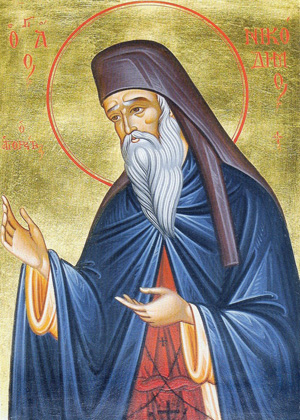
St. Nikodimos of the Holy Mountain
The only possible absolute guarantor of any true belief is God. True knowledge of God is only accessible by faith in him who is word (λόγος) and truth. God alone inspires true spiritual knowledge.

Such was certainly the understanding of many of the hesychastic fathers between the fourth and the fifteenth centuries, whose writings were compiled in the eighteenth-century into The Philokalia by St. Nikodimos of the Holy Mountain and St. Makarios of Corinth.[3] These fathers distinguish between two kinds of knowing. “According to patristic tradition, there is a rational or cataphatic knowledge of God, and an apophatic or ineffable knowledge.”[4]


___________________________________________
[3] The editors (G.E.H. Palmer, Philip Sherrard, and Kallistos Ware) of the English language Faber and Faber edition of The Philokalia ably synthesized the hesychastic understanding of knowledge in their Glossary, drawing from the writings of many fathers including St. Maximus the Confessor (in volume two) and St. Gregory Palamas (in volume four). The fourth post in this series will consider Maximus and the fifth post will consider Palamas. 

[4] Dumitru Staniloae. The Experience of God. Brookline: Holy Cross Orthodox Press, 1994. 95.

Wednesday, January 16, 2013

Silence

There is more to be learned from sitting in silence than from reading a blog post.

Sunday, June 5, 2011

Monasticism and the Baptized

Blessed Pope John Paul II on Mount Sinai, where, on Feb. 26, 2000, he visited the Orthodox Monastery of Saint Catherine, which, he said, "stands indomitable as a witness to divine wisdom and love."
One significant work of the recently beatified Pope John Paul II for the Eastern Churches is his Apostolic Letter, Orientale Lumen. In this letter, Blessed Pope John Paul II identifies monasticism as “a reference point for all the baptized.” One could look at each Christian way of life and see in it a model for all Christians, without denying the distinctiveness of particular vocations. Another way of putting it is that there is not one spirituality for monks, another for priests, and another for the married. There is one Christian spirituality and theology, just as there is one Christianity, one Christ, and one Church. “There is… one Lord, one faith, one baptism, one God who is Father of all” (Eph 4:4-6). A monk is not living just a part of the Christian life, but the whole of Christian life. The same is true of a priest, a married person, and each Christian. Looking at Christianity as expressed and lived in each vocation instructs each Christian in their own living of Christ. Monasticism, however, is particularly suited to this type of examination.

“In the East, monasticism was… presented as a symbolic synthesis of Christianity,” writes John Paul. This is for good reason. The life of the monk or nun is one of total absorption in Christ, shown by their commitment to prayer, their apostolically communal way of life, and their radical observance of poverty, chastity, and obedience. This is not to suggest that these elements are unique to monasticism, but that they are expressed by monasticism with rare clarity. As John Paul writes, “The monastery… is where the human being seeks God without limitation or impediment, becoming a reference point for all people.”

Monasticism, like martyrdom before it, stands as a radical sign of the coming kingdom, in which all people are called by God to participate, and which monastics, in a sense, already experience. The martyrs and the monastics count their sacrifices nothing, even a joy, as they know they are imitating the Lord and going to Him. “The Church invokes [the] return [of the cosmos to the Father], and the monk and the religious are its privileged witnesses,” according to John Paul. They witness and experience this recapitulation of the universe primarily in their lives of prayer, both liturgical and individual. John Paul continues, “As a living sign of this [eschatological] expectation, the monk continues and brings to fulfillment in the liturgy the invocation of the Church… a maranatha constantly repeated… with the whole of his life.”

The very breath of a true monastic is prayer. In the East, the witness of the hesychasts’ silent prayer of the heart particularly exemplifies this. “Silence (hesychia),” John Paul notes, “is an essential component of Eastern monastic spirituality,” and each Christian ought to incorporate, to that degree they are able, this prayer into their life.

Most Popular Posts this Month

Most Popular Posts of All Time