Showing posts with label Faith. Show all posts

Sunday, September 15, 2019

Experience the Apocalypse

“Amen,” Jesus says, “there are some standing here who will not taste death before they see the kingdom of God come in power” (Mark 9:1).  
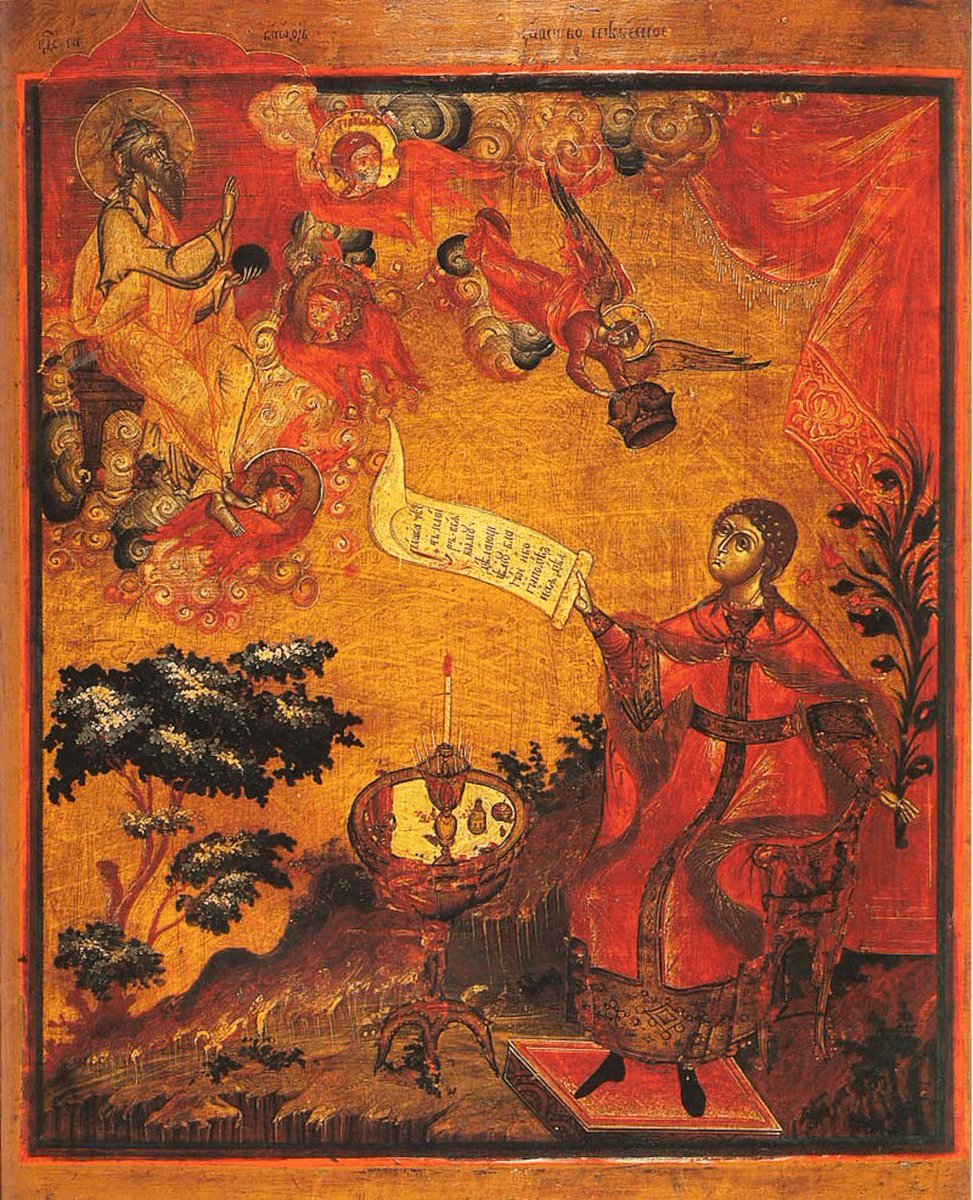
Icon of the Kingdom of Heaven
19th century Russian
State Museum of the History of Religion, St. Petersburg

What can this mean? This verse baffled me for years. How could it be, I thought, that people living at the time of Jesus have not yet tasted death? Surely all of them died by now.

If we read this without faith, it could read like an embarrassingly mistaken prediction of the time of the second coming – rather like all those doomsday dates that regularly get rolled out by various apocalyptic and fundamentalist groups - especially, I think, in this country.

The next date coming from Dr. F. Kenton Beshore is 2021. So, get ready, I guess. His previous prediction was 1988, but that embarrassment has not dissuaded him from making another prediction. I'll not go into his calculations.

The Lord is coming we know not when. Yet various Christians throughout the ages have made predictions as to what that date will be. Even some saints have gotten in on the act and made some predictions that turned out other than they expected.

But unlike all this merely human guesswork, surely the Lord Jesus Christ knows what he is talking about. And Jesus says to those standing with him almost 2,000 years ago that some of them will not taste death before they see the kingdom of God come in power. We know that everyone who was there all those years ago has by now tasted death. And we know that Jesus Christ, who is Truth himself, is not making an error here. He does not make errors. This leaves only one other possibility, that some who were standing there with Jesus did indeed see the kingdom of God come in power.

The Blessed Theophylact makes bold to name those Jesus means when he says "some standing here" and also to name the moment when they see the coming of the kingdom of God. He writes, 
Namely, Peter, James, and John, shall not die until [they see] at the Transfiguration the glory with which [Jesus] shall appear at the second coming. For the Transfiguration was nothing else than a foreshadowing of the second coming, and as he appeared shining then, so will he shine at the second coming, as will also all the righteous. 
To see the light of Jesus Christ on Mount Tabor is to see the coming kingdom of God as already come.

The Venerable Bede sees the coming kingdom of God also in another place. He writes, 
The present Church is called the kingdom of God, and some of the disciples were to live in the body until they should see the Church built up, and raised against the glory of the world.
If we can see the Church for what it really is, not obscured by the sin and corruption into which its worldly aspect has sunk, we would see it as the bride of Christ – one body with her bridegroom, who is the king of heaven and of earth.

To look upon Jesus on Mount Tabor and see in him the light of his Transfiguration; to look upon the Church and see in her the body of Christ; today, to look upon the cross and see there the king of glory enthroned  upon the cherubim; to see any of this, it is necessary to have eyes that see.

It's not a question of whether or not the Lord Jesus was right about the timing of the coming of the kingdom of God. It's a question of whether or not we have the eyes to see the truth that's all around us. It's a question of whether or not we have faith, which is the only way to know what's really going on. It's a question whether or not we have experienced the apocalypse.

We've forgotten what does the word apocalypse means. It doesn't mean the coming cataclysmic events surrounding the end of the world, at least not originally. The word apocalypse means "revelation" or, even more literally, an "unveiling." Some of you may remember a time when the Book of Revelation was commonly known as the Apocalypse of John. Apocalypse means Revelation. God revealing himself to us here and now.

Because he is here now. If we do not see him, it is not because he is not here, but because there remains a veil over our eyes, waiting to be lifted by his grace with the assent of our faith.

Today, we know from Jesus that there are some who have already seen the coming of the kingdom of God. So, why can't we see it? To that I say, who says we can't?

This is what this whole Byzantine Catholic way of life we’re trying to follow is meant to accomplish: the experience of God. This tradition is not a list of intellectual propositions to which we assent nor a series of rote behaviors we perform out of obligation or habit. It is tradition, not traditionalism, we have on offer here. “Tradition is the living faith of the dead; traditionalism is the dead faith of the living,” as Jaroslav Pelikan writes.

Our tradition passes on to us a bright and lively, warm and living experience of God. It opens our eyes to see the kingdom of God come in power. All this unceasing prayer and fasting, liturgy and sacrament, reading of scripture and the fathers is meant to unveil our eyes; to open our eyes to the light of Mount Tabor shining in all creation; to help us see the truth that God is with us and that his coming kingdom has come among us.

“The kingdom of God is not coming with signs to be observed. They will not say, “behold, here it is!” or “there it is!” for behold, the kingdom of God is within you” (Luke 17:21).

Sunday, August 18, 2019

Have all faith (not just a little faith).


If you have faith like a mustard seed, you will move the mountain. And nothing will be impossible for you. (Matt 17:20).

Our faith should be like mustard seed.

A mustard seed is tiny, but its tininess is not the whole story. Remember, the littleness of the disciples’ faith is the reason they cannot move the mountain – that they cannot cast the demon out of the boy and heal him.  

This, by the way, is what it means to move a mountain, in my opinion.[i] Most of us have a mountain in our lives that needs moving. It’s found most often deeply rooted in our hearts. And there’s usually a demon or two who planted it there and who try to keep it there.

If we had faith like a mustard seed, we would say to that mountain of passions or addiction; ill-will, resentments, or unforgiveness; selfishness and self-centeredness; gluttony, lust, and wickedness; unkindness, impatience, and failure to love – we would say to that mountain in our hearts, “move.”[ii] And it, with all its attendant demons would “be taken up and cast into the sea” (Matt 21:21), that is, into the abyss of hell,[iii] where all such inclinations and the demons that harbor them belong.

You know as well as I do, it would be easier to move a mountain in the literal sense. But nothing will be impossible for us if we have faith like a mustard seed.

I do not say that we should have faith “the size” of a mustard seed. Some translations[iv] add a comment here about size, which does not appear in the Greek. Jesus does not say “if you have faith the size of a mustard seed.” He says, “If you have faith like or as (ὡς) a mustard seed.”  

The tininess of the mustard seed is an important part of the power of the image, that’s true, and Jesus speaks about that in another place (Matt 13:32), but to overfocus on that attribute alone causes the image to lose its potency. If we think a little faith is enough because we hear our faith should be like mustard seed, we may have missed the point.  

When we say to one another, “have a little faith,” I hope we don’t mean it in the sense that Jesus does when he tells his disciples that they fail to cast out the demon because of their “little faith” (Matt 17:20).

Size alone is not the point. It’s important that we’re speaking here of a grain of mustard and not a grain of sand. There’s a world of difference between the two – and the difference is life.  

Jesus is not, I think, making a quantitative comparison between the littleness of the disciples’ faith and the size of the mustard seed, as if their faith was even smaller and they only need a bit more of it. Rather, I think he’s making a qualitative comparison between two tiny things. If your faith is so little, let it be little in the way that mustard seed is little – not like a grain of lifeless sand, but like a grain of living seed. It's alright to have a little faith, as long as it's little in the way that a mustard seed is little and not in the way that the disciples’ faith was little that day. The difference is life, growth, & potency.

St. Paul speaks of having “all faith so as to move mountains” (1 Cor 13:2). The kind of faith that moves mountains is not “little faith” but “all faith.” Faith that is like a mustard seed is total faith.[v] A mustard seed is tiny, but it contains the whole. It has the total mustard plant within it – a great shrub rather like a tree, “so that the birds of the air come and make nests in its branches” (Matt 13:32; cf. Luke 13:19).

Jesus also teaches that a mustard seed is like kingdom of heaven. So, let our faith be like the kingdom – small, maybe, but full of life and spirit and capable of growing to greatness.
How can a mustard seed move a mountain? Only because it can do something a mountain cannot do: it can grow. It is alive and not lifeless rock. And life always wins. Patient growth has the power to reshape the whole earth.

If we have a living, growing faith, we can trust that that mountain within us that needs to move will move. We can see it begin to erode, in fact – its stones broken by the growing roots of our faith, weakening to rubble the mountain that seemed immovable and preparing it to be swept away by grace.


In the meantime, if our faith is little in the way that shouldn't be, how are we to transform our faith into the faith that is like a mustard seed? One way is by the prayer and fasting that today Jesus says is necessary to cast out this kind of demon (Matt 17:21). Such is necessary because, through these means, God transforms our faith from some dry and lifeless assent to propositions into a living seed of the word within us, that grows and grows, like life in a womb.

A mustard seed is an embryonic mustard plant. The kingdom of heaven is like an embryo. An embryo can grow to become a king. Growth is key. Life is that which grows. If we stop growing, we’re dead. Eternal life is eternal growth. Let us grow ever closer to the infinite Lord for all eternity, and let us begin to grow today.


[i]The mountains here spoken of, in my opin­ion, are the hostile powers that have their being in a flood of great wickedness, such as are set­tled down, so to speak, in some souls of various people.” Origen, com­mentary on matthew 13.7.
[ii] “If they had had this faith within them, they would have been like the grain of mustard seed. By the power of the Word they would have thrown out this burden of sins and the heavy mass of their unbelief. They would have transferred it, like a mountain into the sea.” hilary of poitiers. on matthew 17.8.
[iii] “Then such a man will say to this mountain—I mean in this case the deaf and dumb spirit in him who is said to be epileptic— "Move from here to another place." It will move. This means it will move from the suffering per­son to the abyss.” Origen, com­mentary on matthew 13.7.
[iv] e.g. NIV and NAB
[v] “When someone has total faith…, then he has all faith like a grain of mus­tard seed” Origen, com­mentary on matthew 13.7.


Sunday, July 8, 2018

Faith of the Blind


on Matt 9:27-35. Seventh Sunday after Pentecost

Today, two blind men teach us much about faith and about prayer.

When they encounter Jesus, they don’t exactly ask what you might expect – for sight or for healing. Rather, they follow him, calling out, “Have mercy on us, Son of David!” Now, mercy is healing, but it also more than healing.

Eventually, Jesus asks them, “Do you believe that I am able do this? So, not only, “Do you believe I can heal you?” but really also, “Do you have faith that I can have mercy on you?” Jesus is not asking these blind men merely what they think of him or who he is in their opinion – he is asking them about their faith – about whom they know him to be in their hearts. And they confess their faith that he is the one who can have mercy on them in their blindness. They do believe and, according to their faith, Jesus touches their eyes and opens them.

The Two Blind Men, detail, 6th Century Mosaic, Sant' Appollinare Nuovo, Ravenna

What drove Jesus to ask the two blind men about their faith? Well, first they followed him for quite some time, it would seem, as he walked from the house of a ruler back to his own house. This was probably quite a way, because Jesus likely wasn't staying in the same neighborhood as such a socially significant person. This in and of itself is a marvel: though they were blind, they were able to follow Jesus all the way to his house. They could not see him, but yet they went wherever he went. Now, maybe they had help, or maybe they were following him by sound, or maybe they simply knew the way to his house – the Gospel doesn’t say – but regardless, I think it is a good image of faith that, though blind, they could still follow Christ. They could see him, not with the eyes of the body, but with the eyes of faith. According to their faith, they could see already. Perhaps this is why they ask for mercy and not only for their sight. “Blessed are they who have not seen, but have believed.”

And all the while as they were following him, they were crying out, “Have mercy on us, son of David!” This kind of prayerful petition, repeated again and again, ought to seem familiar to us who follow Byzantine tradition – for here is one of the roots of the Jesus Prayer. I hope you all know the Jesus Prayer and pray it daily:

Lord Jesus Christ, Son of God, have mercy on me, the sinner.

We can hear in this, I think, an echo of the blind men’s prayer: “Son of David, have mercy on us.” But it is also similar in the way that they prayed it – crying and saying their prayer while following after Jesus. It seems to me that they did not cry out their prayer only once, but continuously and repeatedly as they followed Jesus.

In our hesychast tradition, under the guidance of our spiritual fathers and mothers, we pray the Jesus prayer so frequently that the prayer becomes a part of our very breathing – and of the beating of our hearts so that we can aspire to pray unceasingly, as Paul teaches us (1 Thess 5:17). Again and again in peace we pray to the Lord for mercy – as did these two blind men before us.

Their way of prayer also evokes the uncomfortable parable of the widow and the unjust judge in Luke (18:1-8). Not once does the widow plead for justice, but repeatedly. Not once do the blind men cry out for mercy but continuously.

It seems sometimes like we have to nag the Lord; we have to bend his ear; we have to keep after him. Of course, this is only how it seems to us humans. Repetition, I think, helps evoke the eternal for us temporal creatures. And it helps us forgetful creatures to remember. Anyone memorizing lines for a play or multiplication tables for a math test knows the necessity of repetition for a human mind. If we creatures are to remember our creator and our God, we must often repeat our prayer to him and our calling upon his holy name. Lord Jesus Christ, Son of God, have mercy on me, the sinner.

It is only after the widow has often plead for justice that the judge gives her a just judgement and it is only after the blind men have followed Jesus quite a way calling out for mercy and followed him into his house that he asks them if they have faith. Only after they have demonstrated faithfulness to some extent does he ask if they have faith. We must be persistent. We must persevere in the faith even when it seems we get no answer to our prayer the first time or the second time or the seventh time we pray. Pray again! Do not lose heart. Keep following after Jesus with a pure heart – not just in the hope of some material reward, mind you, but in the hope of mercy. This is our petition: for mercy, for healing, for eternal life, and for union with God. 

The physical blindness of these two men has also for us, I believe, a spiritual meaning. We are the blind men – until we through faith receive the grace and mercy of the Lord, for which we must continually cry out. Our vision of all things is darkened until we see them in the light of Christ.

Only in the light of Christ is it possible to see things as they really are.

Only in the light of Christ can we understand the true meaning of the Torah and the prophets.

Only in the light of Christ can we see and love our enemies as images of God.

Only in the light of Christ can we find any meaning in our suffering because without Christ and his cross, all suffering is meaningless. Only in Christ and in his cross can suffering become a means of union with God – because only in Christ and in his cross does the impassible God suffer with us

Only in the light of Christ can we see that for us even death is but falling asleep in the Lord and that the great dawn of resurrection is coming, when we will awaken.

Without the light of Christ, we are blind. And so, according to our faith and due to our unceasing prayer, Christ will open our eyes.

This is a reworking of a sermon I preached three years ago: Jesus Opens our Eyes 

Sunday, April 8, 2018

Thomas of Great Faith

on John 20:19-31


Praise the Lord, who rescues us from our enemies (Ps. 29:2). “Sing psalms to the Lord, you who love him, give thanks to his holy name” (29:5). The maker of all things makes all things new, puts all things to right, turns all things to face him.

Sickness he turns into health (29:3)
Death he turns into life (29:4).
Tears he turns into joy (29:6).
Mourning he turns into dancing (29:12).
He removes our sackcloth and clothes us with joy (29:12).
He takes away fear and grants us peace.[i]
And today, he turns doubt into faith.  
“The lack of faith gives birth to a certainty of faith.”[ii]

Thomas doubts the word of his fellow apostles when they tell him, “We have seen the Lord.” He says that unless he also sees, he will not believe it. Let us not imitate Thomas in this moment, for “blessed are those who have not seen and have believed” (John 20:29).  

Yet, eight days later, on this day, the eighth day of Pascha, Thomas also sees the Lord, who appears among them again in the upper room even though the doors are locked. Jesus says to Thomas, offering himself and his wounds to be touched and probed, “Do not be faithless, but believing” (John 20:27).   

And upon seeing the risen Lord and hearing this, Thomas makes his statement of great faith: “My Lord and my God.” Thomas, if you will notice, is the first person in the gospels – perhaps the first person on this earth – to call Jesus “God” in so direct and unadorned a way.

By the grace of God, “Doubting Thomas” becomes Thomas of Great Faith.

Thomas is the first one bold enough to call Jesus, “God,” but he is not the last. The other apostles, led by Thomas, also begin to call Jesus “God.”

John is clear that Jesus is God. It is John alone who records this episode with Thomas. And, it was John who told us all last Sunday on Pascha, that Jesus is the Word who became flesh and dwelt among us and that the Word was in the beginning with God and that the Word was God.

At the Last Supper, “John leaned on the bosom of the Word” and today Thomas touches his side. “The first discovered the depth of theology,” and the other reveals “the mystery of Christ’s resurrection, saying, ‘My Lord and my God.’”[iii] To touch the body of Christ is to touch God and those who do so lovingly come away with an unshakeable faith in him and knowledge of his divinity.

Peter, who was also in that upper room and heard what Thomas said, addresses his second epistle “To those who have obtained a faith… in… our God and Savior Jesus Christ.” (2 Pet 1:1). It seems that perhaps even the faith of Peter, whose faith made it possible for him to become the rock upon which Jesus builds his Church,[iv] is inspired by the faith of Thomas, whom we often call a doubter.  

The Lord Jesus can and does take the least and makes of that one the greatest. So, the one apostle who doubts the resurrection most of all, becomes the one whose faith inspires us all.

We all echo Thomas, in a sense, at every Divine Liturgy and at every Compline when we chant the Symbol of Faith and say that Jesus Christ is “true God from true God.” Through this doubter, the Lord reveals to us more plainly than through any other the divinity of Jesus Christ.

Thomas cuts to the chase. Seeing his risen Lord, and seeing the still-present wounds in his body, he cries out, “My Lord and my God.” He sees his God before him… and he believes and he worships him.

But isn’t it remarkable which proofs convince Thomas? Which proofs he demanded? Thomas doesn’t simply want to see that Jesus lives again. He doesn’t simply want to see him and hear him again – or to embrace him. He wants to see and touch the wounds of Jesus. The marks of his death. “He said to them, "Unless I see in his hands the print of the nails, and place my finger in the mark of the nails, and place my hand in his side, I will not believe” (20:25). These are proofs not only that Jesus is living, but that he has died. And it is these marks of his death that convince Thomas, not only of the resurrection but also of the divinity of the risen one.

This is somewhat confounding because God does not die – that is, the immutable divine nature does not experience death – and, yet, in looking at and touching the marks of death upon his risen and living Lord, Thomas sees his Lord and his God. And I call that an act of great faith. He sees God in his humanity, which does die. But when divinized humanity dies, it rises again and reveals its divinity to Thomas and to all those who have faith and cry out with him, “My Lord and my God.”

Our Lord and our God has done everything for us – gone everywhere, endured everything. He has made all things new. Touching the body of Christ and the marks of death, Thomas touches the life of all. Beholding the living man, Thomas sees the glory of God.[v]

God is with us, and we must learn to see him with the eyes of faith in our lives and in one another. When we see the wounded, let us realize we are seeing God, as Thomas saw God in the wounded Christ. Let us recognize each other as the same body of Christ that Thomas touches. When we see the sick, the mournful, the depressed, the downtrodden, the fearful, and the doubtful – or when we ourselves endure these things – let us remember Thomas and see God, who is in the midst of us bringing us healing, joy, love, peace, and faith.

Jesus breaks into every dark place – he enters even though the doors are locked – and fills all things with light, for he is “our Light, our Resurrection, and our peace.”[vi]

Nothing will keep the Lord away from us. He did not deem Thomas unworthy for his lack of faith, but “confirmed his faith by showing him [his] pure side and the wounds in [his] hands and feet. He touched them, and when he saw [Jesus], he confessed [Jesus] to be neither an abstract God nor merely human, [but], ‘My Lord and my God.’”[vii] He is the God who is personally with us, who loves us beyond all reason or expectation and who will do anything – whatever is necessary to reach us and unite us to himself. We are not abandoned. He is with us even in our abandonment – abandoned with us. Even the one place we think is defined by his absence – the darkest, deepest recess in hell – he’s there too. He has broken the gates of hell and gone through the doors we locked.

Now, the only thing that can separate me from God is me. We can still reject him and push him away because we are still free. But rather than allowing anything that we suffer to drive us away from God, let us be faithful and realize that mysteriously God is there with us in the midst of everything. With Thomas, let us see divinity even in the marks of death – even in our crosses. With Thomas of great faith, let us cry out, My Lord and my God!


[i] “Although the doors were closed he appeared to his disciples [and] took away their fear and granted them peace” (Stichera of Thomas Sunday).
[ii] Aposticha of Thomas Sunday
[iii] Aposticha of Thomas Sunday
[iv] Matt 16. John Meyendorff, ed., The Primacy of Peter: Essays in Ecclesiology and the Early Church (Crestwood, N.Y.: St. Vladimir, 1992), 70.
[v] “For the glory of God is the living man, and the life of man is the vision of God.” – St. Irenaeus
[vi] Stichera of Thomas Sunday.
[vii] Stichera of Thomas Sunday 

Sunday, December 10, 2017

Faith and Thanksgiving

When a leper under the Mosaic covenant is healed of his leprosy, he is to go and show himself to the priest, who is to examine him and certify that he is indeed free of leprosy, so that he can perform the required rituals and sacrifices at the time of his cleansing (Lev. 14).

Ten Lepers by Bill Hoover, 2013
Today, ten lepers lift up their voices and shout to Jesus from a distance, saying, "Jesus, Master, have mercy on us!" (Luke 17:13). We can identify with the lepers at this point, I think. Wounded and broken, we cry out to the Lord from a distance, repeating these same words again and again in our Liturgy: ἐλέησον ἡμᾶς – have mercy on us. Well, Jesus does not respond by simply healing them – even though that’s what he has done in the past.

This isn’t the first time that Jesus heals a leper. Once, when a leper begged of him, “Lord, if you will, you can make me clean,” Jesus simply stretched out his hand, touched him, and said, “I will; be clean,” and immediately the leprosy left him (Luke 5:12-14).

This time, however, he tells them to go and show themselves to the priests. Remember, that's what you’re supposed to do after you've been healed of leprosy. By rights or at least expectations, Jesus ought to have healed them and then sent them to show themselves to the priests. But that's not what he does. He just sends them to the priests, without so much as mentioning – except by implication – that they're going to be healed at all. As St Cyril of Alexandria says, "He commanded them to go as being already healed" – though they were not already healed.

Remarkably, all ten lepers – to a man – step out in faith and obey Jesus's instruction. And as they go, they are cleansed (Luke 17:14). They believe first and obey Jesus's command and then, while doing so, they are healed. “Blessed are they who have not seen and yet believe” (John 20:29). They acted as if they had been healed – they were doing what healed people do – in obedience to Jesus Christ, and in doing so, they were I healed.

All ten of these lepers had faith – remarkable faith – and it is their faith that made them well (cf. Luke 17:19). More than seven times in the gospels, Jesus says to those whom he has healed, ““Your faith has saved you.” Or “made you well.” Or “made you whole.” Faith is key to our healing. But, what happens next shows us that faith alone is not enough to please the Lord.

One and only one of the lepers who were healed by Jesus returns to him, falls on his face, and gives him thanks (17:16). Jesus, exasperated at seeing only one-tenth of the gratitude that he should see, says, "Were not ten cleansed? Where are the other nine?" (17:17). Now, if only one-tenth of the Church offers thanksgiving to the Lord, we will exasperate him again. It's clear that each of us should be like the tenth leper, and not like the other nine who offer no expression of gratitude.

Our Holy Father Athanasius says, "You recall that [Jesus] loved the one who was thankful, but he was angry with the ungrateful ones because they did not acknowledge their deliverer. They thought more highly of their cure from leprosy than of him who had healed them" (Festal Letter, 6).

These are like those who offer prayers to God only when they need or want something – who regard God as a sort of divine problem solver whose primary role is to make us happy. These are like those unconcerned with pleasing the Lord and concerned only with being pleased by the Lord. And they outnumber the grateful ten to one.

Maybe they have faith – certainly they do (of a kind) – but faith alone is not enough. It is also necessary to give thanks. How often we forget to give thanks.

As a sign of how rare it is, note that at no other time, in any of the healings recorded in any of the gospels does the healed person offer thanksgiving to Jesus. Others at other times give glory to God, but only this cleansed Samaritan leper glorifies God and then offers thanks.

Scripturally speaking, this thanksgiving is a potent thing. In all but a couple of instances in the New Testament, thanks is addressed to God – and not to humans. So when this healed leper glorifies God and thanks Jesus, I think he is acknowledging that this man who cured him is also the very God who created him.

But he was the only one of the ten to do so. Ingratitude is a common bad attitude – from that day to this. How often the saints among us go unthanked for their many good deeds. Nine out of ten times, you might say. Thanksgiving is what makes this particular healing story so worthy of our proclamation, our meditation, and our imitation.  

Because when Jesus sees our faith, he not only heals us but also saves us and forgives us of our sins (Mark 2:5), which are the cause of all the suffering and death in the world. But take note: this time, Jesus says, “Your faith has saved you” to only one of the ten he has healed. Among the ten, only this one received in full the mercy for which they all cried out because this one alone thanked him.

The kind of faithfulness that saves us is no mere intellectual assent to a proposition, no mere belief or true opinion that Jesus Christ is Lord and Savior, as important as that is. All ten believed the Lord could heal them. But only one returned to thank him. And only that one was accounted truly faithful.

So, we must remember to be grateful. It can be hard in the midst of our sufferings to be grateful for the many blessing the Lord bestows upon us each day and is bestowing on us even now and in eternity.

But, He is giving us life and giving it to us abundantly, even when it doesn’t feel like it (John 10:10). Let us thank him. 

He blesses us with loved ones, our families, our neighbors, and our friends. Let us remember to thank him.

He gives us himself in the holy mysteries of our Church. Let us not forget to thank him.

Having offered him many prayers of thanksgiving every day of our lives, let us then also often come together to offer him the most perfect thanksgiving we can muster – the holy eucharist. The word for thanksgiving is εὐχαριστω – that is, eucharist. Eucharist means thanksgiving. Because the Son of God “took bread, gave thanks, broke it, and gave it to his holy disciples and apostles” (Luke 22:19).

Thanksgiving not only expresses a feeling of gratitude but also places us in proper relationship to God, in whom we live and move and have our being (Acts 17:28). And the supreme way of offering thanks is the eucharist, in which we partake for the remission of our sins and for life everlasting.


Sunday, April 3, 2016

Doors

On Acts 5:12-20 and John 20:19-31
Thomas Sunday

The Harrowing of Hell, a northern Russian icon
tentatively dated to late 13th century

All of Bright Week, the doors of the icon screen stood open. The way to heaven, to resurrected everlasting life is opened by Christ’s glorious triumph over death. There, in the icon of the resurrection – his harrowing of hades – he stands on the broken gates of death, now in the form of a cross. The tomb had been sealed, but our Lord, the Life of all, breaks open this seal and he rises from the grave. And so the doors are opened.

But today we close the doors of the icon screen. Beginning at Ninth Hour yesterday, the doors were closed, having stood open all week. And after this homily, I will close the royal doors again. Bright Week is ended. And we return to some of our more ordinary customs.

There is a kind of sadness to this moment of closing the doors. The gates of heaven have been open all week and now it strangely seems as though they are no longer.

Fr. Alexander Elchaninov writes,
“I am always grieved by the closing of the sanctuary gates on the Saturday of St. Thomas and in general by the ending of bright week. They still sing 'Christ is Risen' but everything becomes more difficult, as if the gates of the kingdom of heaven had really closed, those gates which have only just been opened in answer to our prayer and fasting. People plunge themselves once more with a sort of ravenousness into futile, worldly pursuits, and the churches become empty."

And yet, closed doors do not stop our Lord from entering. And hearts closed by faithlessness do not stop the Lord from entering.

Soon after we closed the doors yesterday, we sang Vespers. The first sticheron at Vespers begins, “When the doors were closed and the disciples were gathered together, you suddenly appeared in their midst, O Jesus our Almighty God.” Again and again, throughout this day’s services, the hymns are filled with this image of closed doors. Again and again, we are reminded that Christ enters regardless. 

It’s almost as if we close the doors just to demonstrate that this closing has no power to keep out the Lord. Shut the door and lock it, as the disciples did in the Upper Room. Soon the Lord will stand among us regardless, saying “Peace be with you.” Thomas tries to lock him out of his heart and mind, saying, “I will not believe.” Soon the Lord stands before him regardless, saying “Peace be with you,” showing Thomas his living body marked by the nails and the spear, and saying “do not be faithless, but believing.” And Thomas does believe. The doors were closed, but not to the Lord.

Русский: Уверение Фомы.
Дионисий и мастерская.
Икона из церкви Св. Троицы Павлова Обнорского монастыря.
1500 г. (ГРМ)

Where ever the apostles go, the Lord opens doors for them. Today, from Acts, we hear that the Sadducees, filled with jealousy, rise up and arrest “the apostles and put them in a common prison.” The apostles are again behind locked doors, but this time the doors are locked from the outside – a different kind of lock for the Lord to pick. So, “at night an angel of the Lord open[s] the prison doors and [brings] them out.” The next day, the officers report, “We found the prison securely locked and the sentries standing at the doors, but when we opened it we found no one inside” (Acts 5:23). There is no lock of metal or of mind that can keep out the Lord from where he wills to go.

And it is greatly encouraging to know that, as he repeatedly demonstrates, he wills to be with us – and for us to be with him – even after we have been faithless. Jesus loves Thomas and wants to be with him even though Thomas has been faithless. Jesus, our Christ and our God, stoops to prove himself to Thomas! He lowers himself to satisfy the doubting mind of a mere human, as if this human’s opinion of things counts for something. Thomas matters to Jesus this much.

To understand how Jesus regards Thomas and all of us who doubt or fall away or make mistakes or sin in countless ways, I think it may be helpful to consider the relationship of adults to children. After he washes their feet, Jesus says to his disciples, “You call me Teacher and Lord; and you are right, for so I am” (John 13:13). He is our teacher and our Lord. If we love him at all, we are his pupils, his students, his disciples. To our Lord, we are like children. We are like the little ones about whom he says, “Let the little children come to me” (Matt 19:14).

If you think about it, it is easy to see that, next to the eternal God, we really are like little children – no different at all than children. Just consider the age ratio. If someone 25 years younger than me – or 70 years younger than some – seems like child to us, imagine how we must seem to God, who is Ancient of Days (Daniel 7). We surely are merely children.

Many of us – perhaps like Thomas – often take ourselves too seriously, as if it really mattered above all else how we see things – as if our perceptions were really what it was all about. As if our opinions were great and weighty and really counted for something. We might do well to occasionally ask ourselves – where we were when God laid the foundations of the earth (Job 38:4).  We are new to this world, even compared to our ancestors, let alone to God. We are all like children.

It might help, then, to think about how we adults regard children, with all their struggles and their questions, because this will be similar, I think, to how Jesus regards Thomas, to how God regards us.

Well, first of all, many of the problems of childhood seem small to us. Tying my shoes is not really a problem for me anymore (except during liturgies, it seems). Nor am I preoccupied with endless questions about dinosaurs. But I also understand where they’re coming from. I’ve been there too. And I try to look upon them not with contempt, but with compassion. I try to treat them with patience and kindness and love. I have seen enormous patience with children from the teachers and parents among us. In this, they are icons of the Lord, our Teacher. 

So how does Jesus regard Thomas? How does he regard this man who doubts him? With contempt? Does he say to Thomas, as is his perfect right, “who are you to doubt me?” No. Not with contempt, but with compassion. Yes, he does rightfully reproach Thomas to a degree, but not to the point of rejection.

I believe that Jesus loves us all as he loves Thomas and that he will give every sinner and every doubter an opportunity to stand before him and say, as Thomas does, “My Lord and my God.” Even now we have this opportunity.

Those who believe without seeing are blessed. But those who doubt are not abandoned outright. Nor are those of us who turn away from God in countless other ways. Nor are those who worshiped with us on Pascha and are not here on Thomas Sunday. The Lord does not extinguish a dying ember. Rather, he does much to enkindle in us again the flame of faithfulness. Though the doors of Thomas’ heart were shut by his faithlessness, Jesus comes and stands with him anyway.

This is how it works now: The doors close now, but they also open again. We may be paused now a little in our dance in and out of the holy place, but we are not halted. The doors open and they close again. They close and they open again.

Sin and doubt threaten to lock us in a prison of despair. But the Lord opens these prison doors, as his angel opened the prison doors for the apostles (Acts 5:19). No doors – not even those of death – can keep out the Lord from where he wills to go.

Christ is risen!


Most Popular Posts this Month

Most Popular Posts of All Time