Sunday, August 26, 2018

An Invitation with Teeth

On Matthew 22:1-14

You know, for a wedding story, this parable is rather violent. Now, some of the guests invited to the wedding feast simply make light of it and – excusing themselves by this or that trifle – do not come. Others, however, shamefully seize and abuse and kill the servants whom the king sent bearing the glad news and invitation. Understandably outraged at this, the king sends in his troops. But they not only kill those heartless murderers, but also burn their entire city.

Having no guests left and finding his first-invited guests unworthy, the king invites in a multitude from the streets. This is where we come in, I expect. But the violence does not end here – for both the good and the bad now sit together at the feast – and the king makes sure the bad do not go unpunished.

He sees among the guests a man who has on no wedding garment and asks him how he got in so inappropriately dressed. The man says nothing. He is speechless. He has no defense. Some sources even say that the wedding garments would have been provided by the king in a situation like this. So what’s really going on here, once again, is refusal of the king’s hospitality.

So the king has him bound hand and foot and cast into the outer darkness where there is weeping and gnashing of teeth.

What is the meaning of all this violence? What kind of party is this? What party comes with such stakes? This is rather like getting a wedding invitation – but in fine print at the bottom is written, “come and celebrate with us or die.” It becomes rather clear that we are not talking here about the usual kind of wedding party. We might not want to be invited to a wedding like this – it sounds rather dangerous – but, like it or not, we are invited.

It is a free invitation to celebrate, but it’s an invitation you’d better accept. It’s an invitation with teeth. It is an occasion of great joy, but it is deadly serious. Those unwilling to partake joyfully will have hell to pay. Because this wedding feast, as Jesus says at the outset, is like the kingdom of heaven. The wedding garments we are to put on as we enter this feast are like those we put on at baptism and at the second baptism of holy repentance. That is, they are Christ himself, for all those who have been baptized into Christ have been clothed with Christ. To be thrown out of this wedding hall is to be thrown out the gates of heaven.  

But, you know, this party isn’t just exactly like heaven either. For one thing, it’s a party to which both the good and the bad have come. I’ve been to a few parties like that.… In fact, we’re at a party like that right now, if you think about it. This church – this Eucharistic celebration, is like a party to which both the good and the bad alike are invited. The sinners and the saints sit together in the pews…. For that matter, they’re usually sitting together in the same seat. If you’re wondering whether you’re a sinner or a saint, remember: you can be both. This struggle between the good and the bad happens mostly on the inside.

This parable reminds me of a passage in C.S. Lewis’ novel The Screwtape Letters, which I highly recommend. It’s framed as a series of letters from a senior demon named Screwtape to a junior demon – his nephew Wormwood – with advice on the best way to tempt a soul to keep him out of heaven and secure his place in hell. The demons sardonically call their victims “patients.”

Well, Wormwood gets in trouble one day when his “patient” converts to Christianity. Screwtape is mightily displeased. But, he assures his nephew, their hope of damning the poor soul to hell is not yet lost. “One of our great allies at present,” says Screwtape, “is the Church itself.”

You see, Screwtape is well aware of what Jesus is saying in today’s gospel: both good and bad guests fill the wedding hall – and the devils can use the bad ones to help corrupt the good. The Church in this world is a mixed bag. Don’t we know it.

Screwtape points out that the new Christian will get to his pew, look around himself and see just those neighbors “whom he has hitherto avoided.” You’ll want to “lean pretty heavily on those neighbors,” he advises Wormwood “It matters very little, of course, what kind of people that next pew really contains,” writes Screwtape. “Provided that any of those neighbors sing out of tune, or have boots that squeak, or double chins, or odd clothes, the patient will quite easily believe that their religion must therefore be somehow ridiculous... Never let him ask what he expected them to look like….”

It may be, of course, that “the people in the next pew” are actually good and holy people. Of course, if they’re not, writes Screwtape “– if the patient knows that the woman with the absurd hat is a fanatical bridge player or the man with squeaky boots is a miser and an extortioner – then your task is so much the easier.”

You see, the demons will use our sins not only to drag us down but also to drag others down with us if they can. Our neighbors see our sins and our hypocrisy and it sometimes convinces them that the Church itself is hypocritical or ridiculous or even evil. Of course, I’m reminded of that old retort to the common complaint that there are too many hypocrites in church: “Don’t worry, there’s always room for one more.”

So, let us not judge others. Let us look instead to our own sins.

That’s the point, I think. All are invited and welcome to the feast, regardless of their sinfulness. But those who accept the invitation have a serious duty. This love feast is not a free-for-all, come-one, come-all, do-as-you-please, orgiastic bacchanalia, no matter how it has been treated by members of the Church at all levels. This is a wedding feast – a celebration of commitment, fidelity, fruitfulness, life, and love. A wedding is where two become one, and at this wedding, we the Church become one with Christ our Lord. Those unprepared to celebrate these things – those unwilling to put on the wedding garment freely offered by our king – cannot remain in the kingdom of heaven. We are now before the gates of the kingdom of heaven and our king is inviting us in. His invitation is this: Repent and know the joy only Christ can bring.


This is a reworking of a sermon I preached two years ago: Celebrate or Die

Sunday, August 19, 2018

Evil Priests and Bishops cannot destroy the Church.

A householder planted a vineyard, and he set a hedge around it, and dug a winepress in it, and built a tower. And then he leased it to tenants, and went into another country (Matt 21:33). “Observe the great care that the householder took with this place…. He himself did the work the tenants should have done. It was he who planted a vineyard, and set a hedge around it, and dug a winepress in it and built a tower. He left little for them to do. All they had to do was take care of what was there and to preserve [and defend] what was given to [their care]…. But they made little effort to be productive, even after they had enjoyed such great blessings from him.”[i] Instead of tending the vineyard, the tenants devoured it themselves, leaving nothing for their Lord.[ii]

Saint Constance Mausoleum Rome

This is an image of God's creation of the cosmos, his setting apart of Israel, and his making of the Church. It is God – and not men – who makes the Church. It is his and not ours. Men are but tenants he leaves to care for it. They are stewards and not owners. And, too often, they are wicked tenants like those in the parable and not like the good servants the Lord sends to the vineyard to get his fruit.

The Church suffers and has suffered many wicked leaders. Leaders who not only fail to produce fruit for their Lord, but who abuse and rape and kill the Lord's true servants, his own children, and his beloved Son.

Good news: this is not, and never was, their Church. Whatever airs the wicked leaders in the Church may put on, these wicked tenants are tenants only and not sons of the householder. The true head of this house – of this Church – is, always was, and always will be Jesus Christ, the son of the Living God – in the parable, the son that the householder sends to the vineyard, saying, “They will respect my son.” Jesus alone is the head of the Church.

Remember this also on the parochial level. Whoever your priest is, remember that your parish is not the Church of Fr. so-and-so. It is the Church of Jesus Christ.

Yes, it is true that sometimes the Lord leaves wicked tenants in charge for a time and goes into another country. Why does he do that? About that, the Lord and I need to have words. Because I don't know why he does that.

But what I do know is this: He is coming. The owner of the vineyard is coming. Our deliverer is coming. And when he comes, the chief priests and Pharisees say, condemning themselves out of their own mouths, he will put those wretches to a miserable death and lease the vineyard to other tenants who will give him the fruit in due season (21:41).

The days of these wicked tenants are numbered. "In due time their foot will slip" – it has perhaps slipped already. And "their day of disaster is near, and their doom is coming quickly" (Deut 32:35). Haste the day of reckoning. Vengeance is the Lord's (Rom 12:19). 

After all, these are God's own children and members of the body of Jesus Christ, the Son of God, that the wicked leaders of our day have abused and raped and killed, just as the wicked tenants in the parable kill the son of the householder, who represents Jesus, the Son of God.

Let us put our trust in the Lord, who is coming, and not in men and the princes of this world, some of whom masquerade as holy men or men of the Church.


I am a priest. I am a member of an order, which also includes men very much like the wicked tenants. But let me tell you something: the fancy clothes we wear don't get us off the hook with God – and they shouldn’t get us off the hook even with men. Rather, membership in the holy order those fancy clothes represent puts us on the hook with God, and so it is only fitting that it would also do so with men.

"The road to hell is paved [not with good intentions, but] with the skulls of erring priests, with bishops as their signposts." St. John Chrysostom probably didn't say that, but that doesn't mean it isn't true. He certainly made it clear that we are responsible to an even greater degree for the spiritual welfare of those entrusted to our care. So, when one of us is abusive in any way, let alone in the intensely egregious ways now being revealed in Pennsylvania, the harm we do is amplified. And, I trust, that the consequences of it will be duly amplified as well, in all justice.

Though evil priests and bishops can do great harm, one thing they cannot do is destroy the Church. Because, as I have said and I’ll say again: this is not, and never was, their Church. This is the Church of Jesus Christ.

It has always been afflicted by stupid and evil leaders. Even among the apostles, there is Judas – the grasping, despairing traitor. And what we’re seeing now seems less like the lovable impulsive idiot Peter and more like the calculating murderous traitor Judas about whom Jesus says it would be better if he had never been born. Jesus says their crimes will be punished with a punishment worse than death by drowning in the sea with a millstone tied around their neck (Luke 17:2). Woe to anyone who causes one of the little ones who believe in Jesus to stumble.

Let us not give into any minimizing or excusing of this evil – nor comparisons with the sins of the world. When people fall into this pattern of whataboutism – you know, where they start saying, well what about the abuse that goes on in public schools? or, in other churches and religious communities? - I have to ask, do they think that the sins of the world absolve the sins of the Church? They do not! Our sins are not absolved by the sins of others, but by the grace of God available to us only through repentance.

Repentance is the only hope of the Church. Unless we repent, we will be damned. And repentance doesn't just mean saying you're sorry. It means change.

Much needs to change in the Church. The wicked tenants must be routed and replaced with fruitful tenants. Those who have loved their own image more than the children of God, must undergo change – a change of the heart, a metanoia, a turning around, a conversion, a conversio –

away from the way of death and towards the way of life,
away from abuse and toward healing,
away from love of human respect, privilege, and power and toward the love of God and the children of God, his Church.


[i] Chrysostom. The Gospel of Matthew, Homily 68.1.
[ii]  Orthodox Study Bible

Sunday, August 12, 2018

"Compulsion is Repugnant to God"

Jesus does not compel the rich young man – or us – to give away everything or to follow him (Matt 19:16-26). He invites us to that perfection, but he does not compel us to it. He does not force us to follow him, to love him, to believe in him. If these things were forced, they would not be love or faith.


Christ and the Rich Young Ruler
(in process)

And it is love and faith that Jesus wants from us. Mark says that Jesus looks upon the rich young man and loves him. He looks upon us and loves us, too.

Jesus, who is a man – who indeed is the man – relates to us humanly. This is how much he loves us: even though he is the Lord, he does not lord it over us. Rather, he wraps a towel around his waist and washes our feet like a servant, even though he is our God. We meet him face to face in his icon and heart to heart in prayer. We touch and taste and see his goodness in the most holy Eucharist. We encounter him daily in our neighbors – our friends, our family, and our enemies. Through these, he forms his personal relationship with us.  

Now, Jesus is the almighty God and, as such, he could do anything. He could make us follow him – compel our obedience to his commands. But, as Clement of Alexandria says, “God does not compel, for compulsion is repugnant to God, but he supplies to those who seek, and bestows on those who ask, and opens to those who knock.” Out of love, he chooses to relate to us, his creatures, as free persons and not as slaves. Love always respects the freedom of the other person – of the beloved. 

Our freedom is one of the ways in which we are like God. God made us in His image and likeness. But what does this mean? Well, it means a lot of things. One of the things it means is this: as a former pastor of mine, of blessed memory, always used to say: God is unique, relational, and free – and he made each of us unique, relational, and free. I think this is true. 

There is one God – and so he is unique. And God is a community of Persons – and so he is relational. And God is free. “The Lord is the Spirit, and where the Spirit of the Lord is, there is freedom” (2 Cor 3:17).   

If he took away our freedom, he would be taking away one of the things that makes us like himself. So, if he were to force us to follow him against our will, maybe it would seem like we were closer to him, but we would be less like him and so, in that more important way, we would be more distant from him.

So, Jesus is not a control freak. And Jesus, unlike us, actually has the power with which he could control others if that was what he wanted to do. But to do so is unloving – and he is love. And to do so would also deprive others of the opportunity to love in return. We must learn from Jesus. We must stop trying to control others and, instead, try to love them. Jesus loves the rich young man. He also lets him walk away.

Now, this doesn't mean – "I do my thing and you do your thing... and if by chance we find each other, it's beautiful,"[i] as the seventies slogan would have it. Loving one another includes respecting each other's freedom, but that's not all there is to it. If we love someone, we obviously want what is best for them. And what is best for them is to follow Jesus Christ. This isn't relativism I'm proposing or indifference to the choices others make. Not all ways are good or equivalent. There is one way and one truth and we are to preach him. That way and that truth are a person. And we are to invite – urge, even – and persuade one another to follow him – freely.

Just as Jesus himself invites us to follow him, as he invites the rich young man today. Indeed, this is more than an invitation. His invitation is in the imperative – “Go, sell what you possess and give to the poor; and you will have treasure in heaven; and come, follow me” (19:21). This is a command. But it is not a compulsion. He does not force us to follow him.

So when the rich young man goes away sorrowful and does not follow Jesus and does not sell his many possessions and give to the poor but rather chooses his wealth over Jesus, Jesus lets him go.

Likewise, we must let go of our passion to control others. Our efforts to do so always fail anyway. We have to learn to let go. If Jesus, who is God, lets go, we, who are only humans, should let go all the more.

This never means that we stop seeking the good of those we love. Our neighbors, our friends and enemies, or our family members who have perhaps rejected the faith need our love, and constant prayer, and witness to the life of faith, and willingness to listen with compassion, and preparation to make a defense for the hope that is within us. But we won’t win any souls for Christ by vainly trying to force the world into compliance. That’s not how this works. That is not evangelism.

Evangelism, rather, is to preach the good news that, while our salvation is impossible for us, with God, all things are possible. In Christ Jesus, we humans can be united to God. All the rich young man (and us) need to do to put an end to our ultimate sorrow is turn back to Christ – away from our worldly preoccupations – and to follow instead the Lord. He opens the way that is too narrow for us to pass through without him. He is the way.

It is this message that is compelling to the human heart. This is the way to life, for which every human heart yearns. Let us preach it from the rooftops, but let us let God do the real work of inspiring and converting hearts and give up on the vain notion that we can control others.


[i] Fritz Perls, "Gestalt Therapy Verbatim", 1969

Sunday, August 5, 2018

Forgive Everything

In a parable, our Lord Jesus Christ gives us a God’s eye view of sin and forgiveness (Matt 18:23-35).

An official owes his king ten thousand talents. The king is the Lord. You and I are the official. His debt represents our sinfulness. So, when Jesus describes this debt, he is actually describing our sinfulness, which concerns us personally and is worth considering carefully.
 
There are different estimates as to the actual value of ten thousand talents. We know that a talent was the largest unit of money at the time. It was worth about six thousand denarii, which was a day’s pay. 

So, a talent was more than 15 years of pay. So, even if a day’s pay was equivalent to less than half of the current minimum wage in Michigan, ten thousand talents would still be worth more than 2 billion dollars. Imagine the burden of a debt like that! It is an impossibly large sum – more than a laborer could make in two thousand lifetimes. 

It will help us to understand Jesus’ rhetoric a bit further if we also consider the word here for ten thousand – it’s μυρίος, which is the largest Greek numeral – and as such, it is sometimes used rhetorically and less technically to mean “countless” or “innumerable” – it’s where we get the word myriad. So the servant’s debt to his master is the largest numeral of the largest unit of money. In other words, it’s as big as it can be – that’s the point, I think.

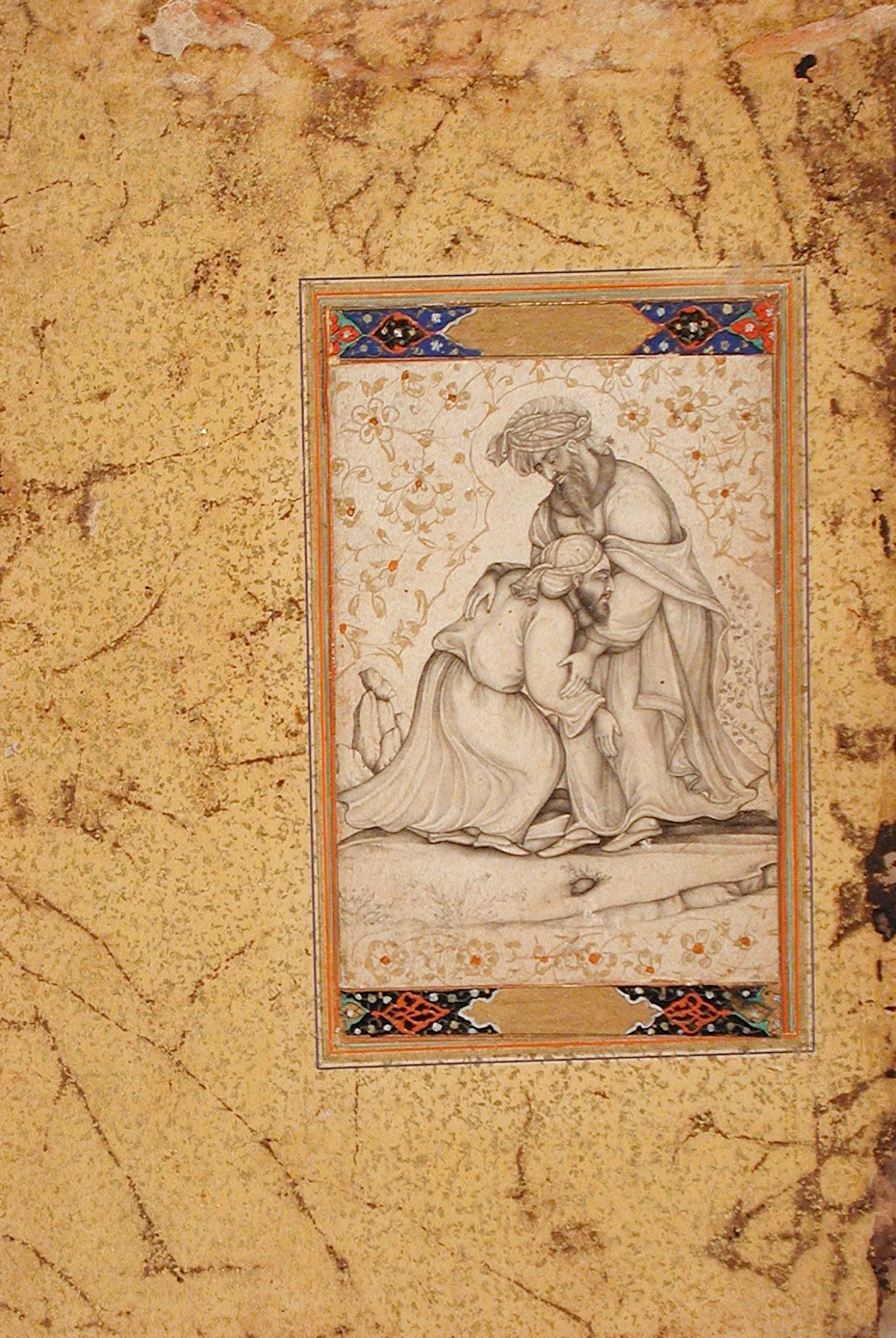
Mordecai and King Ahasuerus
India, Mughal, circa 1610
Ink with touches of color and gold
Paul Rodman Mabury Collection (39.12.76)
And it’s also possible that Jesus is making an allusion – because this isn’t the first time that the sum of ten thousand talents is mentioned in scripture. In the book of Esther, Haman, the enemy of the Jews, feeling himself insulted by the Jew Mordecai, offers to the Persian King Ahasuerus – also known as Xerxes – ten thousand talents of silver if he will agree to destroy all Jews (Esther 3:9).

Haman was indebted to his king ten thousand talents, just like the official in today’s parable. And for what? – for seeking “to destroy, to slay, and to annihilate all Jews”(Esther 3:13) – the people of God. So this sum of ten thousand talents here is blood money. The debt of the servant in today’s parable represents our sin  – and the wages of sin is death – and that death is born by the true Messiah of the Jews – Jesus Christ.

By our sins, we participate in the failed attempt to destroy Jesus, just as Haman, by his debt of ten thousand talents, participates in a failed attempt to destroy the Jews. In both cases, the Lord triumphs over sin and death. Through Esther, he delivers the Jews from oppression in Persia. And Jesus he raises from the dead. So there are meaningful parallels here, which show more clearly that this enormous debt is an image of sin and death.   

It is fitting that Jesus describes all our sinfulness with a parable about money – because the love of money is the root of all evil (1 Tim 6:10). But even if we think our sins don’t involve money, we mustn’t think that if that this isn’t about us – we must not leave this comfortably in the abstract.

We should feel invited to place ourselves in this parable as the servant, to examine our own consciences, and to discover our own sins against God and against our fellow servants. Sins perish in the light and thrive in the darkness – so we must name them and confess them to one another (James 5:16).

I cannot judge you. You and God alone know which sins trouble your hearts – and I can only know my own sins. We must all bring our sins to God in holy repentance, as the servant did at first – falling on his knees and begging for the patience and kindness of the Lord. When we do, we will receive the Lord’s forgiveness – which is more than the servant begged for.

Actually, when the extent of his debt is revealed, the servant stupidly asks for more time to pay back his king – it should be clear to us that this is a sum no servant could ever repay. It’s an absurdly large sum! This, I think, is how it must sound to the Lord if we ever say that we’ll make it up to him by being good people for the rest of our lives. That won’t make it up to him! That is good and necessary, but that doesn’t mean that it’s enough. Nothing we do can ever earn our union with God.

We are utterly and absolutely dependent upon his grace. Apart from the energies of God, there is no theosis. We do not partake of the divine nature by our own power, but by the power of God, with which we cooperate. We must make every effort to supplement our faith with virtue, but we must never think that our efforts can succeed unaided (2 Pet 1:3-5). They spring from, are supported by, and succeed in and only in the life of God, freely and gratuitously given by God.

So the king does not give his servant more time to pay him back, which would be impossible – no, he forgives the debt completely! He gives more than the servant asks for. The Lord is gracious and we depend upon his grace.

We must realize that our sin is like a debt too large for us to ever repay, and, having received the forgiveness of that debt, let us turn from our sin, repent, and sin no more. We should allow this seemingly inexcusable, impossible forgiveness and lovingkindness to prick our hearts so that we do not remain inert and insensible to our wickedness.[i] With all our hearts, let us turn away from the evils to which we cling and to which we are habituated and enslaved.

This turning, this repentance, this conversion, this μετάνοια begins, as our Lord demonstrates in this parable, with forgiveness. Not only with being forgiven, but also with forgiving others.

Our Lord taught us to pray, “forgive us our trespasses as we forgive those who trespass against us” (Matt 6:12). Or, a more literal translation is “Forgive us our debts as we forgive our debtors,” which closely ties the prayer to today’s parable of debts. So as we forgive, we will be forgiven. And if we are to have any hope for ourselves we must have the hope for others that forgiveness expresses.

After receiving the forgiveness of such an enormous amount, the servant should quickly and easily have followed his king’s example when a fellow servant begged for patience regarding a comparably small debt – a hundred denarii – a tiny fraction of what he had been forgiven.

The wrongs we suffer from our fellow servants – which really are wrongs – sometimes terrible wrongs – are nonetheless small when you compare them to the weight of our own sins against the Lord. So, let us remember our own sins and forgive others, as our heavenly Father forgives us.

Do not nurse hurt feelings or brood on wrongs. Do not let resentments grow in your hearts like weeds growing ever deeper roots. For, according to the measure with which you measure, it will be measured to you (Matt 7:2). If you would be forgiven, you must forgive – even those who don’t deserve it – even those who don’t ask for it – as Jesus and Stephen forgave those who were killing them even as they were driving the nails and throwing the stones (Luke 23:33-34; Acts 7:59-60). Let us imitate this indescribable love and forgive everything. 


[i] cf. Chrysostom, The Gospel of Matthew, Homily 61.1

Sunday, July 22, 2018

In almighty God’s own good time

Our Lord is not bound by time. But our Lord chooses to act in time – in his own good time. The first deacon says quietly to the priest at the beginning of the Divine Liturgy, “It is time for the Lord to act.” The Lord acts in time. He is acting here and now. However, it seems to us sometimes that he takes his time.

Not until the fourth watch of the night does Jesus come walking on the water to his disciples (Matthew 14:25). As soon as evening had fallen, the boat bearing the disciples was beaten by waves – and the wind was against them all night long (14:24). But not until the fourth watch of the night does Jesus come to them and cause the wind to cease (14:32). He had been alone in the hills praying. This teaches us something about the importance of prayer as compared to earthly cares.

What are these watches of the night? In the custom of the Roman military, the night was divided into four parts by soldiers who stood watch in shifts. That way, everyone could get at least some sleep and also the watch could continue ceaselessly. Each of these watches lasted 3 hours so that the four watches of the night together made up the 12 hours of night. So, the fourth watch is the last watch and is from about 3 am until 6 am.

This is when Jesus comes to them who are in the boat, walking to them on the windswept water, after they had been fighting the wind and waves all night long. “They had been in danger the whole night,”[i] but the Lord comes in his own good time.

We also wait upon the coming of the Lord. And maybe we are tossed about by the disturbances and cares of the world, by unremitting temptations, and by demonic provocations, just as the disciples are harassed by the wind and the waves. But the Lord is coming in the fourth watch – in his own good time. He will return perhaps to a roving and shipwrecked Church, but he will return.[ii]

We must wait upon the Lord, and, at the same time, practice an awareness of his presence in every moment of time, even when it seems to us that he is distant. Even when Jesus was praying in the hills, he who knows all things knew of the disciples’ plight in the water. And he also knew they would be alright. So, he let them struggle a little while, as he does with us. St. John Chrysostom says that “He was instructing them not too hast­ily to seek for deliverance from their pressing dangers but to bear all challenges courageously.” We must have a little courage for this life.

It’s clear that for his own reasons, the Lord allows us, his disciples, to be tossed about a bit. And it is also clear that he brings some good out of our time of struggle. Through it, he increases our desire for his coming, helps us remember him, and reveals to us our complete dependence on him.[iii]

We must have a little humility for this life. St. Peter, who was in that boat, instructs us from his experience to “humble [ourselves] under the mighty hand of God, that in due time he may exalt [us]. Cast all your anxieties on him, for he cares about you” (1 Peter 5:6). He will deliver us in time. We must have a little hope and a little trust and a little faith for this life.  

St. Paul says to Timothy, that “the appearing of our Lord Jesus Christ… will be made manifest at the proper time by the blessed and only Sovereign, the King of kings and Lord of lords, who alone has immortality and dwells in unapproachable light, whom no man has ever seen or can see. To him be honor and eternal dominion. Amen” (1 Tim 6:14-16).

As we wait upon his coming, we must paradoxically remember his constant presence with us. Every hour of the day and every watch of the night, we must be waiting and watching for the coming of the Lord. This is why, in our Byzantine tradition, there are services of liturgical prayer for every time of the day and night.


In charts of Byzantine time, one can see that there are still four watches and 12 hours of the night and day. There are traditional times of prayer throughout this cycle. There is Vespers, which belongs to the time of the setting of the sun, Compline, which is prayed usually around 9 in the evening just before bed, Mesonyktikon, which is the Midnight Office, and Matins – or Orthros as it is also called – which is meant to begin to come to an end about dawn. Other times of prayer in our tradition are First Hour, Third Hour, Sixth Hour, and Ninth Hour, corresponding to 7 and 9 in the morning, noon, and 3 in the afternoon. All this is to say, that all the time of the day and night is time for prayer, for calling attention to the presence of the Lord in each time, as we wait upon the Lord to come to us in his own good time.

There was an elderly and saintly priest in the parish I grew up in whose sermons eventually got to the point of always being the same. In every sermon, every Sunday, he said the same things – perhaps in a different order, but there were several key phrases that always got said. One thing he said again and again was that “almighty God will do what he will do in almighty God’s own good way and in almighty God’s own good time.” Wisdom. This is a voice of experience, I believe. We must wait upon the Lord.

God will act on our behalf just exactly when he means to. We must trust in him and hope in him. As we are buffeted by the storms of life, let us wait upon the Lord, watch, and pray for his coming. He is coming and he will calm the storm in due time.


[i] Jerome
[ii] Hilary of Poitiers, On Matthew 14:14
[iii] Chrys.: “But He suffers them to be tossed the whole night, exciting their hearts by fear, and inspiring them with greater desire and more lasting recollection of Him; for this reason He did not stand by them immediately.”

Friday, July 20, 2018

The Prophet, the Monk, and the Human Struggle against Death

The holy prophet Elijah is probably the most popular prophet in our church. And this despite the fact that he is one of the biblical prophets who does not even have a book named after him. What we know of Elijah we know mostly from the Books of Kings. I'm quite fond of him myself. I named my oldest son after him and John the Baptist. But why is he so popular with us? Is it only because on this day we get to have our cars blessed with his fiery chariot? I think there's more to it than that.

I think that one reason Christians may have traditionally loved Elijah so much is that he, though he lived long before Jesus Christ, seems to live rather like a Christian monk. The prophet has something of the monk about him and now the monks have something of the prophet about them. 

Good monks and nuns keep alive the prophetic spirit in the Church with their radical commitment to life in Christ and death to the world. This demonstrates to the world God's will for our lives. Monasticism is God speaking to the Church about how the Church should be living.

And the Prophet Elijah is a type for monks. He was the first of the prophets to embrace the life of virginity. And he lived an ascetic life of fasting and obedience to God and such a radical commitment to the prophetic message God had given him that he even embraced life in a deserted wilderness for it.

He is also rather like John the Baptist, our other early model of Christian monasticism. They both went into the wilderness, and fasted from ordinary food, and wore garments of coarse animal hair bound with leather belts. When John the Baptist went into the wilderness and behaved in this fashion, many believed that he was Elijah who was to come. Even Jesus says that John the Baptist comes in the spirit and the power of Elijah.

This was important because Malachi had prophesied that Elijah would return as the herald of the coming Messiah. This prophecy of Malachi is fulfilled in John the Forerunner and Baptist of the Lord. In our troparion today, we call Elijah the second forerunner of Christ. John, of course, is the first

The Messiah whose coming they herald turns out to be not only the deliverer of Israel from its enemies but also the deliverer of all of us who struggle from our last enemy of death. Elijah is important in this human struggle against death because Elijah is one of only two who never experiences death. The other is Enoch.

It is very rare to see an icon in the church of someone who has not experienced death.  Yet on the tetrapod today is Elijah. Notice that his background is red rather than the usual gold. Red for the fire of the fiery chariot that took him deathlessly into heaven.

Some say that Elijah will still return someday together with Enoch as the two witnesses mentioned in the Book of Revelation. As we await him, we honor him and remember him especially today on this his feast. Let us look to his example and to that of the monks and nuns who keep his prophetic spirit alive to guide us in a life of radical commitment and obedience to the word of God. 


Some of these ideas are stolen from Presvytera and Dr. Jeannie Constantinou: Elijah

Sunday, July 8, 2018

Faith of the Blind


on Matt 9:27-35. Seventh Sunday after Pentecost

Today, two blind men teach us much about faith and about prayer.

When they encounter Jesus, they don’t exactly ask what you might expect – for sight or for healing. Rather, they follow him, calling out, “Have mercy on us, Son of David!” Now, mercy is healing, but it also more than healing.

Eventually, Jesus asks them, “Do you believe that I am able do this? So, not only, “Do you believe I can heal you?” but really also, “Do you have faith that I can have mercy on you?” Jesus is not asking these blind men merely what they think of him or who he is in their opinion – he is asking them about their faith – about whom they know him to be in their hearts. And they confess their faith that he is the one who can have mercy on them in their blindness. They do believe and, according to their faith, Jesus touches their eyes and opens them.

The Two Blind Men, detail, 6th Century Mosaic, Sant' Appollinare Nuovo, Ravenna

What drove Jesus to ask the two blind men about their faith? Well, first they followed him for quite some time, it would seem, as he walked from the house of a ruler back to his own house. This was probably quite a way, because Jesus likely wasn't staying in the same neighborhood as such a socially significant person. This in and of itself is a marvel: though they were blind, they were able to follow Jesus all the way to his house. They could not see him, but yet they went wherever he went. Now, maybe they had help, or maybe they were following him by sound, or maybe they simply knew the way to his house – the Gospel doesn’t say – but regardless, I think it is a good image of faith that, though blind, they could still follow Christ. They could see him, not with the eyes of the body, but with the eyes of faith. According to their faith, they could see already. Perhaps this is why they ask for mercy and not only for their sight. “Blessed are they who have not seen, but have believed.”

And all the while as they were following him, they were crying out, “Have mercy on us, son of David!” This kind of prayerful petition, repeated again and again, ought to seem familiar to us who follow Byzantine tradition – for here is one of the roots of the Jesus Prayer. I hope you all know the Jesus Prayer and pray it daily:

Lord Jesus Christ, Son of God, have mercy on me, the sinner.

We can hear in this, I think, an echo of the blind men’s prayer: “Son of David, have mercy on us.” But it is also similar in the way that they prayed it – crying and saying their prayer while following after Jesus. It seems to me that they did not cry out their prayer only once, but continuously and repeatedly as they followed Jesus.

In our hesychast tradition, under the guidance of our spiritual fathers and mothers, we pray the Jesus prayer so frequently that the prayer becomes a part of our very breathing – and of the beating of our hearts so that we can aspire to pray unceasingly, as Paul teaches us (1 Thess 5:17). Again and again in peace we pray to the Lord for mercy – as did these two blind men before us.

Their way of prayer also evokes the uncomfortable parable of the widow and the unjust judge in Luke (18:1-8). Not once does the widow plead for justice, but repeatedly. Not once do the blind men cry out for mercy but continuously.

It seems sometimes like we have to nag the Lord; we have to bend his ear; we have to keep after him. Of course, this is only how it seems to us humans. Repetition, I think, helps evoke the eternal for us temporal creatures. And it helps us forgetful creatures to remember. Anyone memorizing lines for a play or multiplication tables for a math test knows the necessity of repetition for a human mind. If we creatures are to remember our creator and our God, we must often repeat our prayer to him and our calling upon his holy name. Lord Jesus Christ, Son of God, have mercy on me, the sinner.

It is only after the widow has often plead for justice that the judge gives her a just judgement and it is only after the blind men have followed Jesus quite a way calling out for mercy and followed him into his house that he asks them if they have faith. Only after they have demonstrated faithfulness to some extent does he ask if they have faith. We must be persistent. We must persevere in the faith even when it seems we get no answer to our prayer the first time or the second time or the seventh time we pray. Pray again! Do not lose heart. Keep following after Jesus with a pure heart – not just in the hope of some material reward, mind you, but in the hope of mercy. This is our petition: for mercy, for healing, for eternal life, and for union with God. 

The physical blindness of these two men has also for us, I believe, a spiritual meaning. We are the blind men – until we through faith receive the grace and mercy of the Lord, for which we must continually cry out. Our vision of all things is darkened until we see them in the light of Christ.

Only in the light of Christ is it possible to see things as they really are.

Only in the light of Christ can we understand the true meaning of the Torah and the prophets.

Only in the light of Christ can we see and love our enemies as images of God.

Only in the light of Christ can we find any meaning in our suffering because without Christ and his cross, all suffering is meaningless. Only in Christ and in his cross can suffering become a means of union with God – because only in Christ and in his cross does the impassible God suffer with us

Only in the light of Christ can we see that for us even death is but falling asleep in the Lord and that the great dawn of resurrection is coming, when we will awaken.

Without the light of Christ, we are blind. And so, according to our faith and due to our unceasing prayer, Christ will open our eyes.

This is a reworking of a sermon I preached three years ago: Jesus Opens our Eyes 

Most Popular Posts this Month

Most Popular Posts of All Time